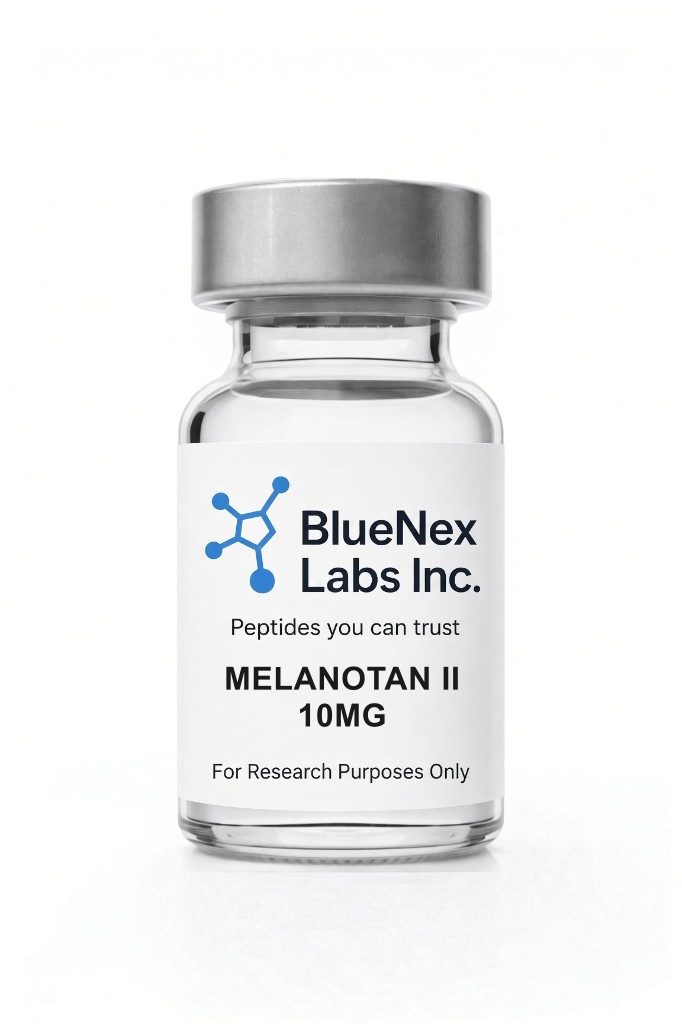
Melanotan II 10mg Research Peptide Canada
Research use only. Not for human or veterinary use.
Melanotan II 10mg is the MT-2 research fill with a published certificate when listed. Laboratory use only — not a tanning product.
Melanotan II Peptide | High‑Purity Melanocortin Analog for Receptor Research
Melanotan 2 (MT‑2) is a synthetic analog of the body’s natural melanocyte‑stimulating hormone (MSH). By activating melanocortin receptors, it promotes increased melanin production, leading to a deeper tanning effect even with limited sun exposure.
In addition to its role in pigmentation, Melanotan 2 has been explored for its potential influence on appetite regulation and sexual function, due to its interaction with specific neural pathways involved in these processes.
Key Research Areas & Mechanistic Highlights
🎨 Pigmentation & Melanin Production
- Synthetic analog of endogenous α‑MSH
- Activates MC1R receptors on melanocytes
- Studied for its ability to increase eumelanin synthesis
- Used in research exploring UV‑independent pigmentation pathways
🧠 Neural Pathways & Receptor Activity
- Interacts with multiple melanocortin receptors (MC1R–MC5R)
- Examined for its influence on CNS signaling networks
- Studied in relation to neuroendocrine communication and behavioral pathways
🍽️ Appetite & Energy Regulation
- Investigated for potential effects on satiety‑related signaling
- Explored in metabolic research involving melanocortin‑mediated pathways
- Used to study mechanisms related to energy balance and feeding behavior
🔥 Sexual Function & Arousal Pathways
- Preclinical interest due to interactions with MC3R and MC4R
- Studied for its role in neural circuits associated with sexual response
- Considered a model compound for understanding melanocortin‑linked arousal mechanisms.
🔬 Research Applications (Non‑Medical)
Melanotan II is widely used in melanocortin‑receptor research, particularly involving MC1R, MC3R, MC4R, and MC5R signaling in controlled in‑vitro systems.
Key research applications include:
- Receptor‑binding assays — used to evaluate affinity and receptor‑subtype selectivity across the melanocortin family.
- Intracellular signaling studies — supports research into cAMP accumulation, PKA activation, and downstream transcriptional responses.
- Structure–activity analysis — applied in comparisons of cyclic vs. linear melanocortin analogs to evaluate stability and receptor bias.
- Peptide‑stability modeling — used to study enzymatic degradation and cyclic‑peptide resistance to proteolysis.
- Analytical method development — suitable for validating chromatographic separation of cyclic heptapeptides.
🧬 Molecular Characteristics
- Type: Cyclic heptapeptide melanocortin analog.
- Form: Lyophilized powder (10mg).
- Identity: Verified via MS and HPLC/UPLC.
- Biochemical Notes:
- Cyclic structure enhances stability and receptor affinity.
- Solubility varies with pH; performs best in mildly acidic buffers.
- Stability:
- Stable in dry form; sensitive to hydrolysis and oxidation in solution.
- Avoid prolonged exposure to elevated temperatures.
❄️ Storage & Handling
- Store at –20°C, protected from humidity and light.
- Reconstituted solutions should be stored at 2–8°C and used promptly.
- Avoid repeated freeze–thaw cycles.
📄 Documentation / COA Visibility
- COA includes MS identity, HPLC purity, solvent system, and lot traceability.
- RUO‑only; not for human or veterinary use.
⚠️ Compliance Notice
Melanotan II is supplied for laboratory research only. Not for human or veterinary use. No therapeutic, metabolic, or performance‑related claims are made or implied.
Molecular characteristics
- form
- Lyophilized powder
- purity
- ≥99% (COA verified)
- use
- Research use only
Documentation (HPLC / UPLC, MS, COA)
Published lots for this SKU are listed at the exact certificate section. Identity is typically confirmed by mass spectrometry; purity by HPLC / UPLC. A report for another peptide or fill size does not document this vial.
Questions about laboratory procurement? Contact BlueNex Labs.