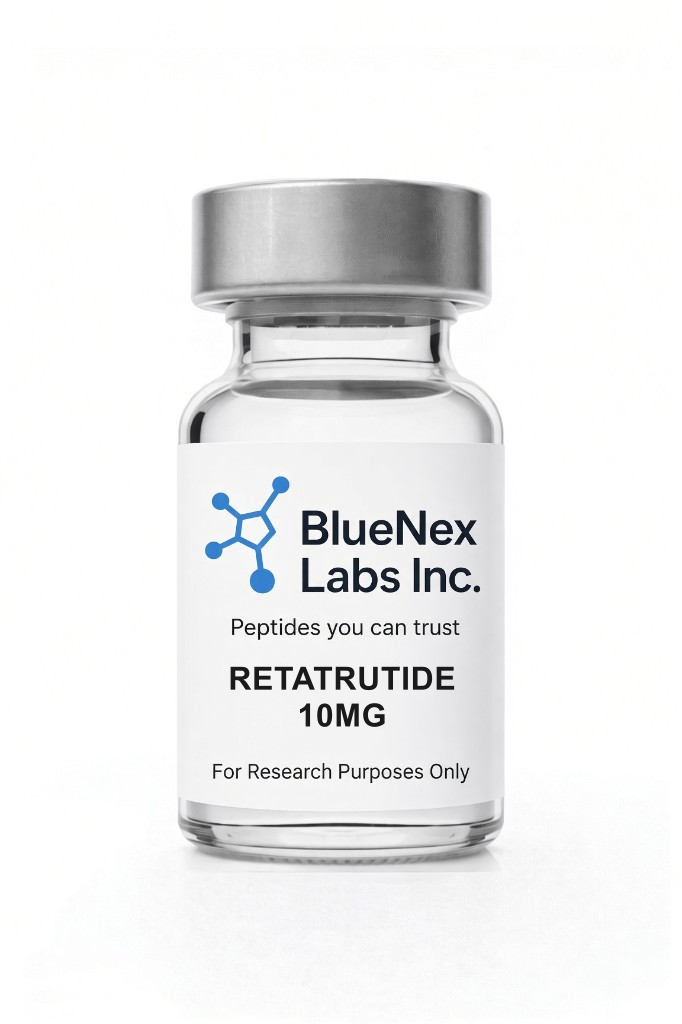
Retatrutide 30mg - COA Certified - Research Grade Peptide

$120.00

🧬 Retatrutide Peptide — 30 mg

High‑Purity Triple‑Agonist Research Peptide for Metabolic & Receptor‑Signaling Studies (Canada)

Retatrutide is a high‑purity, research‑grade synthetic long‑chain peptide engineered as a triple‑agonist analog targeting GLP‑1 receptor (GLP‑1R), GIP receptor (GIPR), and glucagon receptor (GCGR) signaling pathways. It is widely referenced in laboratory research involving multi‑receptor metabolic signaling, energy‑regulation models, and advanced incretin‑pathway biology.

Supplied by BlueNexLabs, Retatrutide is available as a lyophilized research peptide in 10 mg, 20 mg, and 30 mg fill sizes, with COA‑verified purity, analytical consistency, and audit‑safe Research‑Use‑Only (RUO) labeling, supporting advanced experimental workflows in Canadian research environments.

🔬 Overview of Retatrutide in Research Settings

Retatrutide is designed to support simultaneous investigation of three hormonally linked receptor systems, making it a valuable model compound for exploring how balanced vs. biased receptor activation influences downstream metabolic signaling.

In controlled laboratory settings, Retatrutide is commonly referenced in studies examining:

  • Multi‑agonist incretin‑pathway signaling

  • Receptor cross‑talk between GLP‑1R, GIPR, and GCGR

  • Energy‑regulation and metabolic‑stress adaptation models

  • Receptor‑specific vs. integrated transcriptional responses

  • Structure–function relationships in long‑chain peptide analogs

Its triple‑agonist architecture enables side‑by‑side comparison of single‑, dual‑, and multi‑receptor activation paradigms.

🧪 What Is Retatrutide?

Retatrutide is a synthetic triple‑agonist research peptide designed for laboratory studies involving concurrent activation of:

  • GLP‑1R (glucagon‑like peptide‑1 receptor)

  • GIPR (glucose‑dependent insulinotropic polypeptide receptor)

  • GCGR (glucagon receptor)

This multi‑receptor engagement allows researchers to investigate coordinated incretin and glucagon pathway signaling within a single experimental system.

In research contexts, Retatrutide supports studies involving:

  • Complex metabolic‑signaling integration

  • Receptor‑pathway hierarchy and signaling dominance

  • Multi‑axis energy‑regulation models

  • Synergistic vs. independent receptor activation

📡 Mechanistic Research Overview (Audit‑Safe)

🔵 GLP‑1R‑Linked Signaling

  • Referenced in studies examining incretin‑associated transcriptional activity

  • Used in models exploring metabolic‑stress signaling pathways

  • Supports investigation of receptor‑linked intracellular signaling cascades

🟠 GIPR‑Linked Signaling

  • Applied in research involving adipocyte‑associated signaling markers

  • Supports studies of incretin‑mediated receptor cross‑talk

  • Used in comparative incretin‑pathway modeling

🟣 GCGR‑Linked Signaling

  • Examined in glucagon‑associated energy‑mobilization research

  • Supports hepatic‑signaling pathway modeling

  • Used in receptor‑specific activation studies

🔗 Triple‑Agonist Integration

  • Enables analysis of balanced vs. biased receptor activation

  • Supports multi‑axis metabolic‑signaling models

  • Used in studies exploring synergistic pathway behavior

🧱 Molecular & Chemical Characteristics

Type: Synthetic long‑chain triple‑agonist peptide
Form: Lyophilized powder
Available Fill Sizes: 10 mg / 20 mg / 30 mg
Identity Verification: Mass Spectrometry (MS)
Purity Analysis: HPLC / UPLC

Structural & Biochemical Notes

  • Sequence includes stabilizing modifications for protease resistance

  • Incorporates a fatty‑acid conjugation region to support albumin association in vitro

  • Demonstrates predictable behavior in receptor‑binding and analytical workflows

  • Sensitive to hydrolysis and oxidation post‑reconstitution

🔬 Research Focus Areas

Retatrutide is commonly referenced in laboratory research involving:

  • Triple‑agonist incretin‑pathway modeling

  • GLP‑1R / GIPR / GCGR receptor cross‑talk analysis

  • Metabolic‑stress and energy‑balance studies

  • Receptor‑specific vs. receptor‑balanced signaling comparisons

  • Long‑chain peptide stability and degradation‑resistance assays

  • Structure–function analysis of multi‑agonist peptide analogs

Its broad mechanistic scope supports advanced, pathway‑specific metabolic‑biology research in regulated laboratory settings.

❄️ Storage & Handling Guidelines

  • Store lyophilized peptide at –20 °C, protected from light and moisture

  • Reconstituted solutions: 2–8 °C, short‑term research use only

  • Avoid prolonged exposure to room temperature after reconstitution

  • Avoid repeated freeze–thaw cycles; aliquot when necessary

  • Use sterile preparation techniques and low‑binding labware

📄 Certificate of Analysis & Documentation

Each batch of Retatrutide supplied by BlueNexLabs includes audit‑ready documentation, ensuring traceability and reproducibility:

  • Mass Spectrometry identity confirmation

  • HPLC / UPLC purity profile

  • Solvent system disclosure

  • Lot and batch traceability

  • Research‑Use‑Only (RUO) designation

🔗View Certificate of Analysis (COA)
🔗Learn About Our Testing Standards
🔗 Explore the BlueNexLabs Research Peptide Catalog

🇨🇦 Supplied for Canadian Research Laboratories

BlueNexLabs supplies Retatrutide research peptide to laboratories across Vancouver, Toronto, Montreal, Calgary, Edmonton, Ottawa, and throughout Canada.

Why Researchers Choose BlueNexLabs

  • 🇨🇦 Canada‑wide domestic shipping

  • 📄 COA‑verified, traceable batches

  • 🧪 Audit‑safe RUO labeling

  • ⚡ Fast fulfillment & responsive support

  • 🔬 Research‑focused metabolic‑pathway peptide catalog

⚠️ Compliance Notice

This product is supplied strictly for laboratory research use only (RUO).
Not for human or veterinary use.
No medical, therapeutic, metabolic, diagnostic, or performance‑related claims are made or implied.

🧬 Retatrutide Peptide — 30 mg

High‑Purity Triple‑Agonist Research Peptide for Metabolic & Receptor‑Signaling Studies (Canada)

Retatrutide is a high‑purity, research‑grade synthetic long‑chain peptide engineered as a triple‑agonist analog targeting GLP‑1 receptor (GLP‑1R), GIP receptor (GIPR), and glucagon receptor (GCGR) signaling pathways. It is widely referenced in laboratory research involving multi‑receptor metabolic signaling, energy‑regulation models, and advanced incretin‑pathway biology.

Supplied by BlueNexLabs, Retatrutide is available as a lyophilized research peptide in 10 mg, 20 mg, and 30 mg fill sizes, with COA‑verified purity, analytical consistency, and audit‑safe Research‑Use‑Only (RUO) labeling, supporting advanced experimental workflows in Canadian research environments.

🔬 Overview of Retatrutide in Research Settings

Retatrutide is designed to support simultaneous investigation of three hormonally linked receptor systems, making it a valuable model compound for exploring how balanced vs. biased receptor activation influences downstream metabolic signaling.

In controlled laboratory settings, Retatrutide is commonly referenced in studies examining:

  • Multi‑agonist incretin‑pathway signaling

  • Receptor cross‑talk between GLP‑1R, GIPR, and GCGR

  • Energy‑regulation and metabolic‑stress adaptation models

  • Receptor‑specific vs. integrated transcriptional responses

  • Structure–function relationships in long‑chain peptide analogs

Its triple‑agonist architecture enables side‑by‑side comparison of single‑, dual‑, and multi‑receptor activation paradigms.

🧪 What Is Retatrutide?

Retatrutide is a synthetic triple‑agonist research peptide designed for laboratory studies involving concurrent activation of:

  • GLP‑1R (glucagon‑like peptide‑1 receptor)

  • GIPR (glucose‑dependent insulinotropic polypeptide receptor)

  • GCGR (glucagon receptor)

This multi‑receptor engagement allows researchers to investigate coordinated incretin and glucagon pathway signaling within a single experimental system.

In research contexts, Retatrutide supports studies involving:

  • Complex metabolic‑signaling integration

  • Receptor‑pathway hierarchy and signaling dominance

  • Multi‑axis energy‑regulation models

  • Synergistic vs. independent receptor activation

📡 Mechanistic Research Overview (Audit‑Safe)

🔵 GLP‑1R‑Linked Signaling

  • Referenced in studies examining incretin‑associated transcriptional activity

  • Used in models exploring metabolic‑stress signaling pathways

  • Supports investigation of receptor‑linked intracellular signaling cascades

🟠 GIPR‑Linked Signaling

  • Applied in research involving adipocyte‑associated signaling markers

  • Supports studies of incretin‑mediated receptor cross‑talk

  • Used in comparative incretin‑pathway modeling

🟣 GCGR‑Linked Signaling

  • Examined in glucagon‑associated energy‑mobilization research

  • Supports hepatic‑signaling pathway modeling

  • Used in receptor‑specific activation studies

🔗 Triple‑Agonist Integration

  • Enables analysis of balanced vs. biased receptor activation

  • Supports multi‑axis metabolic‑signaling models

  • Used in studies exploring synergistic pathway behavior

🧱 Molecular & Chemical Characteristics

Type: Synthetic long‑chain triple‑agonist peptide
Form: Lyophilized powder
Available Fill Sizes: 10 mg / 20 mg / 30 mg
Identity Verification: Mass Spectrometry (MS)
Purity Analysis: HPLC / UPLC

Structural & Biochemical Notes

  • Sequence includes stabilizing modifications for protease resistance

  • Incorporates a fatty‑acid conjugation region to support albumin association in vitro

  • Demonstrates predictable behavior in receptor‑binding and analytical workflows

  • Sensitive to hydrolysis and oxidation post‑reconstitution

🔬 Research Focus Areas

Retatrutide is commonly referenced in laboratory research involving:

  • Triple‑agonist incretin‑pathway modeling

  • GLP‑1R / GIPR / GCGR receptor cross‑talk analysis

  • Metabolic‑stress and energy‑balance studies

  • Receptor‑specific vs. receptor‑balanced signaling comparisons

  • Long‑chain peptide stability and degradation‑resistance assays

  • Structure–function analysis of multi‑agonist peptide analogs

Its broad mechanistic scope supports advanced, pathway‑specific metabolic‑biology research in regulated laboratory settings.

❄️ Storage & Handling Guidelines

  • Store lyophilized peptide at –20 °C, protected from light and moisture

  • Reconstituted solutions: 2–8 °C, short‑term research use only

  • Avoid prolonged exposure to room temperature after reconstitution

  • Avoid repeated freeze–thaw cycles; aliquot when necessary

  • Use sterile preparation techniques and low‑binding labware

📄 Certificate of Analysis & Documentation

Each batch of Retatrutide supplied by BlueNexLabs includes audit‑ready documentation, ensuring traceability and reproducibility:

  • Mass Spectrometry identity confirmation

  • HPLC / UPLC purity profile

  • Solvent system disclosure

  • Lot and batch traceability

  • Research‑Use‑Only (RUO) designation

🔗View Certificate of Analysis (COA)
🔗Learn About Our Testing Standards
🔗 Explore the BlueNexLabs Research Peptide Catalog

🇨🇦 Supplied for Canadian Research Laboratories

BlueNexLabs supplies Retatrutide research peptide to laboratories across Vancouver, Toronto, Montreal, Calgary, Edmonton, Ottawa, and throughout Canada.

Why Researchers Choose BlueNexLabs

  • 🇨🇦 Canada‑wide domestic shipping

  • 📄 COA‑verified, traceable batches

  • 🧪 Audit‑safe RUO labeling

  • ⚡ Fast fulfillment & responsive support

  • 🔬 Research‑focused metabolic‑pathway peptide catalog

⚠️ Compliance Notice

This product is supplied strictly for laboratory research use only (RUO).
Not for human or veterinary use.
No medical, therapeutic, metabolic, diagnostic, or performance‑related claims are made or implied.

Why is it grouped as an Metabolic and Appetite Suppressing Peptide

Retatrutide is categorized as a Metabolic and Appetite Signaling Peptide based on its molecular design and receptor‑level activity, which are the primary criteria used to organize compounds on this site for research and educational purposes.

From a research classification standpoint, Retatrutide is a synthetic peptide engineered to interact with multiple metabolic signaling pathways that are commonly studied in laboratory models examining energy balance, nutrient signaling, and appetite‑related mechanisms. Specifically, Retatrutide has been extensively investigated in scientific literature for its interaction with incretin and glucagon receptor systems, which play central roles in metabolic regulation and appetite signaling processes.

Within non‑clinical research settings, peptides that engage these signaling pathways are typically grouped together to help researchers identify compounds associated with metabolic signaling networks, rather than structural peptides or compounds studied for unrelated molecular functions. This grouping reflects research focus and signaling pathway involvement, not intended use, outcomes, or applications.

Accordingly, Retatrutide is placed within the Metabolic and Appetite Signaling Peptides category to align with its receptor‑level research profile and its frequent inclusion in studies examining metabolic pathway modulation, appetite‑related signaling mechanisms, and energy‑balance models under controlled laboratory conditions.

What is Retatrutide – Structure

Retatrutide is a synthetic, laboratory‑engineered peptide developed for research applications involving metabolic signaling pathways. From a structural standpoint, Retatrutide is classified as a modified linear peptide composed of 39 amino acid residues, with additional chemical modifications designed to influence molecular stability and receptor interaction characteristics.

The peptide backbone of Retatrutide is derived from an incretin‑based scaffold, which has been systematically modified through targeted amino‑acid substitutions and terminal modifications. These structural changes allow the molecule to engage multiple hormone‑related receptor systems within controlled experimental models, making it a subject of interest in studies examining coordinated metabolic signaling.

A defining structural feature of Retatrutide is the presence of a long‑chain fatty diacid moiety covalently attached to a lysine residue within the peptide sequence. This lipid conjugation promotes reversible binding to serum albumin in experimental systems, which contributes to increased molecular stability and extended circulation time in research settings.

Additional structural elements include the incorporation of non‑standard amino acids, such as α‑aminoisobutyric acid (Aib), and C‑terminal amidation. These modifications are commonly used in peptide engineering to enhance resistance to enzymatic degradation and to preserve conformational integrity during laboratory handling and analysis.

From an analytical perspective, the identity and purity of Retatrutide are typically characterized using mass spectrometry, chromatographic techniques, and peptide mapping, which confirm molecular weight, sequence integrity, and the presence of expected conjugations. These structural characteristics collectively distinguish Retatrutide from unmodified peptide sequences and support its classification within metabolic and appetite‑signaling research categories.

How Is Retatrutide Studied?

In laboratory and non‑clinical research settings, Retatrutide is studied as a multi‑receptor signaling peptide to better understand how engineered peptide structures interact with metabolic and appetite‑related signaling pathways. Research involving Retatrutide focuses on molecular behavior, receptor engagement, and pathway‑level signaling, rather than outcomes or applications.

Receptor‑Level Signaling Studies

A primary area of investigation involves receptor‑binding and activation assays, where Retatrutide is evaluated for its interaction with incretin and glucagon receptor systems. These studies examine how a single, structurally modified peptide can engage multiple G‑protein‑coupled receptors within controlled experimental models, allowing researchers to analyze signal integration, receptor bias, and pathway crosstalk.

In‑Vitro and Cellular Models

Retatrutide is commonly examined using in‑vitro assays, including cell‑based signaling models that measure downstream molecular responses such as second‑messenger activation, receptor internalization patterns, or transcriptional signaling cascades. These systems enable researchers to isolate structure–function relationships and compare Retatrutide’s signaling profile with other peptide constructs under identical laboratory conditions.

Structural and Analytical Characterization

In addition to biological assays, Retatrutide is studied through analytical chemistry and structural characterization techniques. Methods such as liquid chromatography–mass spectrometry (LC‑MS), peptide mapping, and stability testing are used to confirm molecular identity, verify lipid conjugation, and monitor degradation behavior. These studies support reproducibility and quality control in research environments.

Comparative Research Frameworks

Retatrutide is frequently included in comparative research designs, where it is evaluated alongside other incretin‑based or metabolically active peptides. In these contexts, researchers assess differences in receptor engagement patterns, signaling duration, and molecular stability, contributing to broader investigations into multi‑pathway peptide engineering and metabolic signaling models.

Research Classification and Grouping

Because these studies emphasize metabolic signaling networks and appetite‑related pathways, Retatrutide is typically grouped within Metabolic and Appetite Signaling Peptide categories in research catalogs. This classification reflects how the compound is studied at a molecular and signaling level, rather than any intended use or effect.