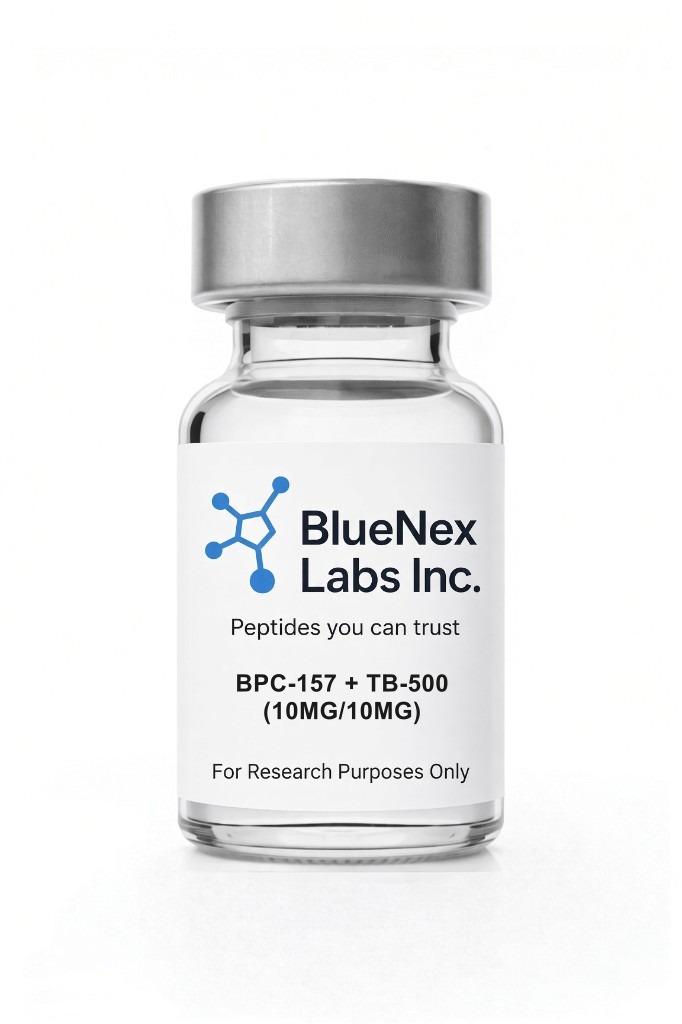
BPC-157 TB-500 10mg/10mg Peptide Canada
Research use only. Not for human or veterinary use.
This 10mg/10mg dual-peptide fill is listed separately from the 5mg/5mg SKU. Confirm the milligram split on the COA before assigning a lot to an assay. Research-use only.
🧬 BPC‑157 + TB‑500 — Advanced Dual Peptide Research Blend
The BPC‑157 + TB‑500 formulation is a high‑purity dual‑peptide blend referenced in Canadian laboratory environments for studies involving cellular migration, angiogenesis, structural‑modeling pathways, and recovery‑phase signaling. This combination is engineered for controlled research use and supports multi‑pathway peptide investigations across in‑vitro and preclinical settings.
🔍 What Is BPC‑157 + TB‑500?
This dual‑peptide blend combines two widely referenced research peptides:
- BPC‑157 (10mg) — a pent decapeptide examined in studies involving connective‑tissue models, angiogenesis pathways, and cellular‑signaling activity.
- TB‑500 (10mg)— a synthetic fragment of thymosin beta‑4 associated with actin modulation, cell migration, and structural‑modeling research.
Together, they form a multi‑pathway research complex frequently used in studies involving soft‑tissue modeling, cellular‑migration dynamics, and comparative peptide‑mechanism analysis.
📡 Mechanistic Overview
🧩BPC‑157 — Signaling & Structural‑Modeling Peptide
- Referenced in studies involving connective‑tissue environments
- Examined for its role in angiogenesis‑linked pathways
- Utilized in models involving epithelial and structural‑integrity research
⚡ TB‑500 — Actin‑Modulating Peptide Fragment
- Associated with cell‑migration and cytoskeletal‑organization studies
- Referenced in angiogenesis and structural‑remodeling models
- Used in research involving muscle, fascia, and soft‑tissue environments
🧱 Structural Overview
🧪 Molecular Composition
- BPC‑157: 15‑amino‑acid pentadecapeptide
- TB‑500: Actin‑binding peptide fragment derived from thymosin beta‑4
🧬 Functional Domains
- Repair‑modeling domain: BPC‑157
- Migration & angiogenesis domain: TB‑500
- Synergy domain: Combined pathways for structural and cellular‑modeling research
🎯 Pathway Targets
- Angiogenesis‑linked signaling (VEGF‑associated)
- Actin‑modulated cell migration
- Structural‑remodeling and fibroblast‑activity models
- Recovery‑phase signaling environments
🔬 Research Focus Areas
BPC‑157 + TB‑500 is referenced in research involving:
- Soft‑tissue and structural‑remodeling models
- Angiogenesis and cellular‑migration pathways
- Connective‑tissue and extracellular‑matrix studies
- Multi‑peptide synergy investigations
- Comparative research vs. single‑peptide controls
🇨🇦 Optimized for Canadian Research Environments
BlueNexLabs provides BPC‑157 + TB‑500 with:
- High‑purity, COA‑verified peptide materials
- Consistent batch quality
- Audit‑safe RUO labeling
- Canada‑wide availability for research institutions
⚠️ Compliance Notice
This product is supplied for laboratory research only. Not for human or veterinary use. No therapeutic, cosmetic, or performance‑related claims are made or implied.
Storage & Handling
- Store lyophilized material at –20 °C, protected from light and moisture
- Reconstituted solutions: 2–8 °C, short-term laboratory use only
- Avoid repeated freeze–thaw cycles; use sterile technique
Documentation
Identity is typically confirmed by mass spectrometry (MS) and purity by HPLC / UPLC. Batch Certificates of Analysis are listed in the certificates library when published for this SKU. Do not assume a lot report that is not listed.
Vial size
$75.00CAD
9 in stock · SKU SQ1251012
Molecular characteristics
- form
- Lyophilized powder
- purity
- ≥99% (COA verified)
- use
- Research use only
Documentation (HPLC / UPLC, MS, COA)
Batch Certificates of Analysis are added to the certificates library when published. This page does not invent lot numbers.
Questions about laboratory procurement? Contact BlueNex Labs.