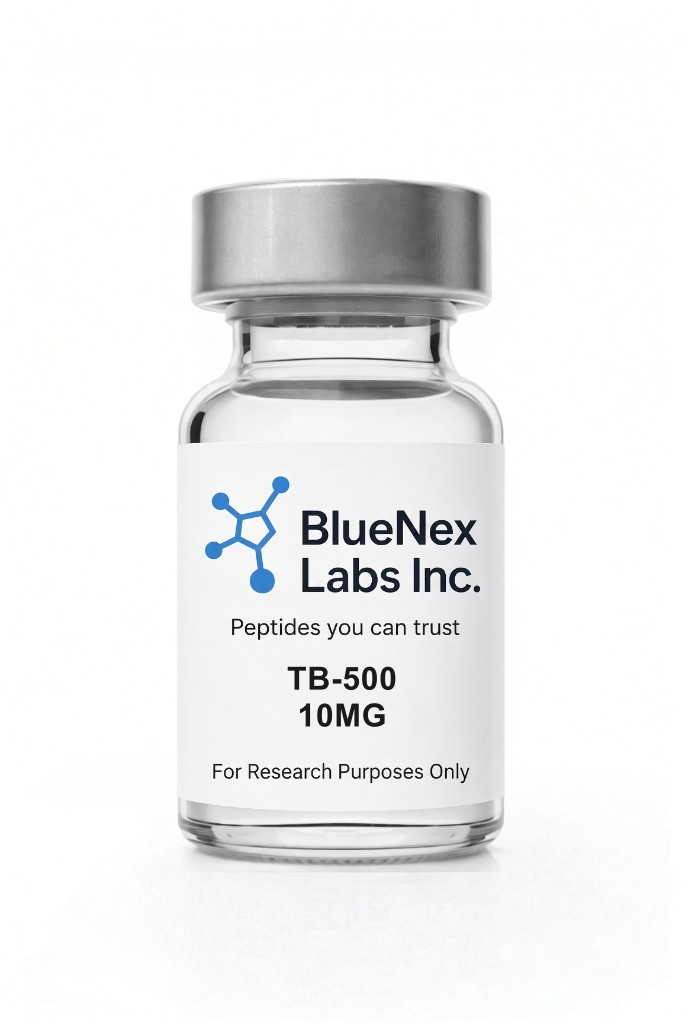
TB-500 10mg Research Peptide Canada
Research use only. Not for human or veterinary use.
TB-500 10mg is listed as a thymosin-beta-4 fragment research solid. Batch reports appear in the certificates library when published for this SKU. Research-use only.
🧬 TB‑500 (5mg / 10mg) — High‑Purity Thymosin Beta‑4 Peptide for Angiogenesis & Tissue‑Modeling Research
TB‑500 is a high‑purity, research‑grade synthetic peptide fragment modeled after a functional region of Thymosin Beta‑4 (Tβ4), a naturally occurring actin‑binding protein involved in cellular migration, angiogenesis, and tissue‑remodeling pathways.
Widely referenced in Canadian laboratory environments, TB‑500 is used in in‑vitro and preclinical research exploring cytoskeletal dynamics, cell‑motility mechanisms, vascular‑growth signaling, and multi‑pathway tissue‑modeling systems.
Available in 5mg and 10mg fills, TB‑500 is engineered for mechanistic reproducibility, high stability, and broad applicability across cellular‑biology and regenerative‑signaling research.
🔍 What Is TB‑500?
TB‑500 is a synthetic peptide fragment derived from the active region of Thymosin Beta‑4, a protein known for its involvement in:
- Actin‑binding and cytoskeletal organization
- Cellular migration and motility pathways
- Angiogenesis and vascular‑growth signaling
- Tissue‑modeling and structural‑remodeling environments
- Stress‑response and cellular‑repair signaling
In research settings, TB‑500 is used to study:
- Actin‑modulating mechanisms
- Fibroblast migration and cytoskeletal dynamics
- Vascular‑growth and angiogenesis models
- Cellular‑resilience and stress‑adaptation pathways
- Comparative analysis vs. full‑length Thymosin Beta‑4
Its compact structure and mechanistic specificity make TB‑500 a widely used model compound for regenerative‑biology, cytoskeletal‑research, and tissue‑modeling studies across Canada.
📡 Mechanistic Overview (Audit‑Safe)
🔷 Actin‑Binding & Cytoskeletal Dynamics
- Referenced in studies involving actin‑modulating pathways
- Supports mapping of cellular‑migration mechanisms
- Used in models examining cytoskeletal organization
🔶 Cellular‑Migration & Motility Pathways
- Applied in fibroblast‑migration and wound‑modeling research
- Supports investigations into cell‑motility signaling
- Used in multi‑pathway tissue‑remodeling studies
🔵 Angiogenesis & Vascular‑Growth Signaling
- Examined in vascular‑growth and endothelial‑cell models
- Supports peptide‑mediated angiogenesis research
- Used in comparative studies vs. other regenerative peptides
🟣 Stress‑Response & Tissue‑Modeling
- Referenced in oxidative‑stress and cellular‑resilience assays
- Supports modeling of tissue‑remodeling environments
- Used in multi‑axis regenerative‑signaling investigations
🧱 Structural Overview
🧪 Molecular Composition
- Type: Synthetic peptide fragment of Thymosin Beta‑4
- Form: Lyophilized powder (5mg / 10mg fills)
- Identity: Verified via MS and HPLC/UPLC
- Origin: Derived from the actin‑binding region of Tβ4
🧬 Functional Domains
- Actin‑modulation domain: Cytoskeletal‑pathway research
- Migration domain: Fibroblast‑motility and tissue‑modeling studies
- Angiogenesis domain: Vascular‑growth signaling
🎯 Pathway Targets
- Actin‑binding and cytoskeletal networks
- Cellular‑migration and motility pathways
- Angiogenesis and endothelial‑cell signaling
- Tissue‑remodeling and structural‑repair cascades
- Peptide–protein interaction models
🔬 Research Focus Areas
TB‑500 is referenced in research involving:
- Cytoskeletal‑dynamics and actin‑binding assays
- Fibroblast‑migration and cellular‑motility studies
- Angiogenesis and vascular‑growth modeling
- Tissue‑remodeling and structural‑biology research
- Stress‑response and oxidative‑marker analysis
- Comparative regenerative‑peptide investigations
Its clean mechanistic profile makes it suitable for controlled, pathway‑specific research environments across Canada.
Storage & Handling
- Store lyophilized material at –20 °C, protected from light and moisture
- Reconstituted solutions: 2–8 °C, short-term laboratory use only
- Avoid repeated freeze–thaw cycles; use sterile technique
Documentation
Identity is typically confirmed by mass spectrometry (MS) and purity by HPLC / UPLC. Batch Certificates of Analysis are listed in the certificates library when published for this SKU. Do not assume a lot report that is not listed.
Compliance Notice
Research-use only. Not for human or veterinary use. No medical, cosmetic, or performance claims are made or implied.
Vial size
$55.00CAD
11 in stock · SKU SQ3244884
Molecular characteristics
- form
- Lyophilized powder
- purity
- ≥99% (COA verified)
- use
- Research use only
Documentation (HPLC / UPLC, MS, COA)
Batch Certificates of Analysis are added to the certificates library when published. This page does not invent lot numbers.
Questions about laboratory procurement? Contact BlueNex Labs.