.collection-title, .page-title, .index-page-title { display: none !important; }
0
Skip to Content
BlueNexLabs Inc.
Canadian Peptides Distribution
Order Here
PRODUCT Categories
Certificates of Analysis
Research
FAQ
Terms and Conditions
BlueNexLabs Inc.
Canadian Peptides Distribution
Order Here
PRODUCT Categories
Certificates of Analysis
Research
FAQ
Terms and Conditions
Canadian Peptides Distribution
Order Here
PRODUCT Categories
Certificates of Analysis
Research
FAQ
Terms and Conditions
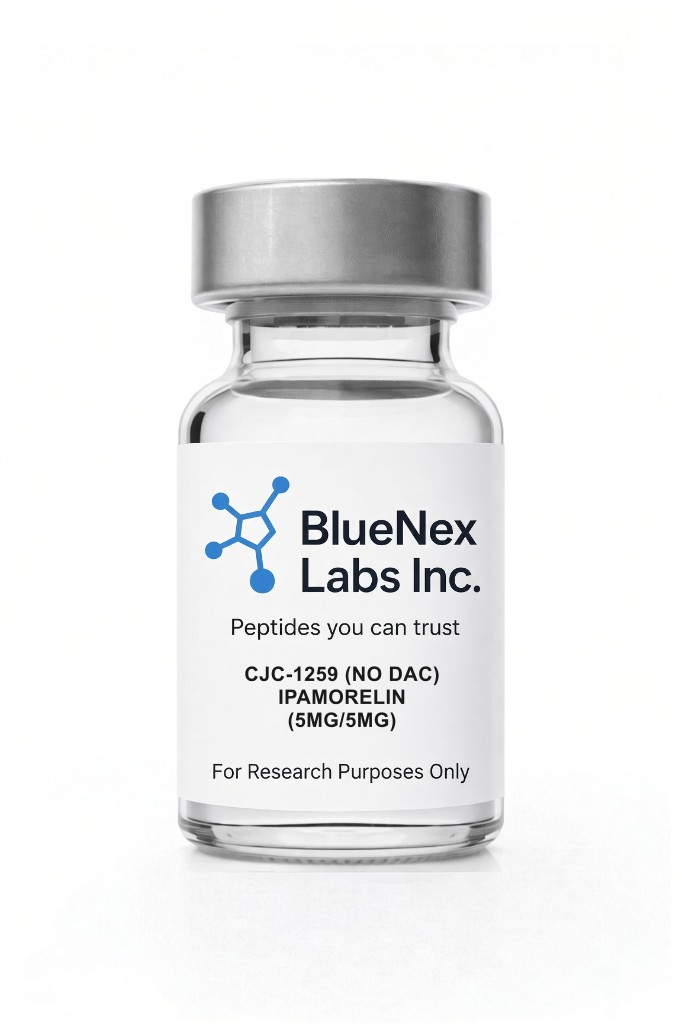
CJCIPa55.png
Research Peptide Products › CJC-1259 (no DAC) / Ipamorelin 5mg / 5mg - COA Certified - Research Grade Peptide

CJC-1259 (no DAC) / Ipamorelin 5mg / 5mg - COA Certified - Research Grade Peptide

$60.00

CJC‑1295 (No DAC) + Ipamorelin: Dual‑Pathway GHRH & GHSR‑1a Research Applications in Canada

CJC‑1295 (no DAC) is a synthetic growth hormone–releasing hormone (GHRH) analog designed to stimulate the natural release of growth hormone (GH) from the pituitary gland. By enhancing endogenous GH secretion, it is frequently studied for its potential influence on muscle growth, recovery, fat metabolism, and overall hormonal regulation.

Unlike CJC‑1295 with DAC (Drug Affinity Complex)—which dramatically extends the peptide’s half‑life—the no‑DAC version has a significantly shorter duration of action. This shorter half‑life makes it especially valuable for research focused on physiological, pulsatile GH release, allowing investigators to examine more natural secretion patterns and their downstream biological effects.

🔬 Research Applications (Non‑Medical)

This dual‑peptide blend is widely used in endocrine‑signaling and receptor‑coactivation research, particularly in controlled in‑vitro systems examining how GHRH‑R (CJC‑1295 no DAC) and GHSR‑1a (Ipamorelin) pathways behave independently and in combination.

Expanded research applications include:

  • Dual‑pathway receptor activation — used to study how simultaneous stimulation of GHRH‑R and GHSR‑1a influences intracellular signaling hierarchy, receptor crosstalk, and pathway amplification.

  • cAMP and Ca²⁺ signaling integration — supports research into how GHRH‑R–driven cAMP accumulation interacts with GHSR‑linked Ca²⁺ mobilization, enabling mapping of convergent vs. divergent downstream transcriptional responses.

  • Receptor‑bias and internalization kinetics — applied in assays measuring β‑arrestin recruitment, receptor recycling, and ligand‑dependent trafficking patterns.

  • Sequence–function analysis — used to compare short‑acting GHRH analogs (no DAC) with selective pentapeptide secretagogues to evaluate structural determinants of receptor selectivity and stability.

  • Peptide‑interaction modeling — supports studies examining whether co‑administration alters solubility, aggregation behavior, or chromatographic retention times.

  • Analytical method development — suitable for validating multi‑peptide separation, quantification, and stability‑tracking under various solvent systems.

All applications remain strictly non‑medical and research‑use‑only.

🧬 Molecular Characteristics

  • Type: Dual‑peptide blend (CJC‑1295 no DAC + Ipamorelin).

  • Form: Lyophilized powder (5mg CJC‑1295 no DAC + 5mg Ipamorelin).

  • Identity: Each peptide independently verified via MS and HPLC/UPLC.

CJC‑1295 (no DAC) — Structural & Biochemical Notes

  • Short‑acting GHRH analog lacking the DAC (Drug Affinity Complex) modification.

  • Designed for rapid receptor engagement with a shorter in‑vitro half‑life, enabling high‑resolution kinetic studies.

  • Exhibits strong solubility in polar buffers; stability influenced by pH and ionic strength.

  • Susceptible to hydrolysis, oxidation, and temperature‑dependent degradation in solution.

Ipamorelin — Structural & Biochemical Notes

  • Highly selective pentapeptide agonist of GHSR‑1a with minimal off‑target receptor activity in vitro.

  • Demonstrates predictable solubility in aqueous systems and low nonspecific binding.

  • Exhibits clean receptor‑bias behavior, making it useful for dissecting GHSR‑specific signaling pathways.

  • Sensitive to hydrolysis and oxidation; stability improves in mildly acidic buffers.

Combined Biochemical Behavior

  • When used together, the peptides enable dual‑axis signaling studies, allowing researchers to map how GHRH‑R and GHSR‑1a pathways converge or diverge at the level of cAMP, Ca²⁺, MAPK, and CREB‑linked transcription.

  • No DAC modification ensures short‑window kinetic resolution, ideal for time‑course experiments.

  • Both peptides exhibit low aggregation risk when properly buffered.

❄️ Storage & Handling

Unreconstituted (Lyophilized):

  • Store at –20°C in a dry, light‑protected environment.

  • Allow vial to reach room temperature before opening to prevent condensation and moisture uptake.

  • Keep sealed until use; peptides are hygroscopic.

Reconstituted:

  • Store at 2–8°C for short‑term use only.

  • Prepare minimal working volumes; long‑chain and short‑chain peptides degrade more rapidly in solution.

  • Use sterile, low‑binding labware to minimize adsorption and concentration loss.

  • Avoid repeated vial punctures and oxygen exposure.

General Handling:

  • Maintain anhydrous conditions during aliquoting.

  • Use appropriate buffers (often mildly acidic) to optimize solubility and minimize degradation.

  • Avoid freeze–thaw cycles; aliquot immediately after reconstitution if needed.

📄 Documentation / COA Visibility

  • Compliance:

    • Supplied strictly as Research‑Use‑Only (RUO) material.

    • Not for human consumption, therapeutic use, or veterinary application.

    • Documentation follows audit‑safe standards for traceability, purity verification, and laboratory compliance.

🇨🇦 Optimized for Canadian Research Environments

BlueNexLabs provides CJC‑1295 no DAC + Ipamorelin to laboratories across Vancouver, Toronto, Montreal, Calgary, Edmonton, Ottawa, and Canada‑wide, offering:

  • High‑purity, COA‑verified peptide materials

  • Consistent batch quality and traceability

  • Audit‑safe RUO labeling

  • Fast, Canada‑wide fulfillment

  • Research‑focused support for endocrine‑pathway studies

⚠️ Compliance Notice

CJC‑1295 no DAC + Ipamorelin is supplied for laboratory research only. Not for human or veterinary use. No therapeutic, cosmetic, or performance‑related claims are made or implied.

CJC‑1295 (No DAC) + Ipamorelin: Dual‑Pathway GHRH & GHSR‑1a Research Applications in Canada

CJC‑1295 (no DAC) is a synthetic growth hormone–releasing hormone (GHRH) analog designed to stimulate the natural release of growth hormone (GH) from the pituitary gland. By enhancing endogenous GH secretion, it is frequently studied for its potential influence on muscle growth, recovery, fat metabolism, and overall hormonal regulation.

Unlike CJC‑1295 with DAC (Drug Affinity Complex)—which dramatically extends the peptide’s half‑life—the no‑DAC version has a significantly shorter duration of action. This shorter half‑life makes it especially valuable for research focused on physiological, pulsatile GH release, allowing investigators to examine more natural secretion patterns and their downstream biological effects.

🔬 Research Applications (Non‑Medical)

This dual‑peptide blend is widely used in endocrine‑signaling and receptor‑coactivation research, particularly in controlled in‑vitro systems examining how GHRH‑R (CJC‑1295 no DAC) and GHSR‑1a (Ipamorelin) pathways behave independently and in combination.

Expanded research applications include:

  • Dual‑pathway receptor activation — used to study how simultaneous stimulation of GHRH‑R and GHSR‑1a influences intracellular signaling hierarchy, receptor crosstalk, and pathway amplification.

  • cAMP and Ca²⁺ signaling integration — supports research into how GHRH‑R–driven cAMP accumulation interacts with GHSR‑linked Ca²⁺ mobilization, enabling mapping of convergent vs. divergent downstream transcriptional responses.

  • Receptor‑bias and internalization kinetics — applied in assays measuring β‑arrestin recruitment, receptor recycling, and ligand‑dependent trafficking patterns.

  • Sequence–function analysis — used to compare short‑acting GHRH analogs (no DAC) with selective pentapeptide secretagogues to evaluate structural determinants of receptor selectivity and stability.

  • Peptide‑interaction modeling — supports studies examining whether co‑administration alters solubility, aggregation behavior, or chromatographic retention times.

  • Analytical method development — suitable for validating multi‑peptide separation, quantification, and stability‑tracking under various solvent systems.

All applications remain strictly non‑medical and research‑use‑only.

🧬 Molecular Characteristics

  • Type: Dual‑peptide blend (CJC‑1295 no DAC + Ipamorelin).

  • Form: Lyophilized powder (5mg CJC‑1295 no DAC + 5mg Ipamorelin).

  • Identity: Each peptide independently verified via MS and HPLC/UPLC.

CJC‑1295 (no DAC) — Structural & Biochemical Notes

  • Short‑acting GHRH analog lacking the DAC (Drug Affinity Complex) modification.

  • Designed for rapid receptor engagement with a shorter in‑vitro half‑life, enabling high‑resolution kinetic studies.

  • Exhibits strong solubility in polar buffers; stability influenced by pH and ionic strength.

  • Susceptible to hydrolysis, oxidation, and temperature‑dependent degradation in solution.

Ipamorelin — Structural & Biochemical Notes

  • Highly selective pentapeptide agonist of GHSR‑1a with minimal off‑target receptor activity in vitro.

  • Demonstrates predictable solubility in aqueous systems and low nonspecific binding.

  • Exhibits clean receptor‑bias behavior, making it useful for dissecting GHSR‑specific signaling pathways.

  • Sensitive to hydrolysis and oxidation; stability improves in mildly acidic buffers.

Combined Biochemical Behavior

  • When used together, the peptides enable dual‑axis signaling studies, allowing researchers to map how GHRH‑R and GHSR‑1a pathways converge or diverge at the level of cAMP, Ca²⁺, MAPK, and CREB‑linked transcription.

  • No DAC modification ensures short‑window kinetic resolution, ideal for time‑course experiments.

  • Both peptides exhibit low aggregation risk when properly buffered.

❄️ Storage & Handling

Unreconstituted (Lyophilized):

  • Store at –20°C in a dry, light‑protected environment.

  • Allow vial to reach room temperature before opening to prevent condensation and moisture uptake.

  • Keep sealed until use; peptides are hygroscopic.

Reconstituted:

  • Store at 2–8°C for short‑term use only.

  • Prepare minimal working volumes; long‑chain and short‑chain peptides degrade more rapidly in solution.

  • Use sterile, low‑binding labware to minimize adsorption and concentration loss.

  • Avoid repeated vial punctures and oxygen exposure.

General Handling:

  • Maintain anhydrous conditions during aliquoting.

  • Use appropriate buffers (often mildly acidic) to optimize solubility and minimize degradation.

  • Avoid freeze–thaw cycles; aliquot immediately after reconstitution if needed.

📄 Documentation / COA Visibility

  • Compliance:

    • Supplied strictly as Research‑Use‑Only (RUO) material.

    • Not for human consumption, therapeutic use, or veterinary application.

    • Documentation follows audit‑safe standards for traceability, purity verification, and laboratory compliance.

🇨🇦 Optimized for Canadian Research Environments

BlueNexLabs provides CJC‑1295 no DAC + Ipamorelin to laboratories across Vancouver, Toronto, Montreal, Calgary, Edmonton, Ottawa, and Canada‑wide, offering:

  • High‑purity, COA‑verified peptide materials

  • Consistent batch quality and traceability

  • Audit‑safe RUO labeling

  • Fast, Canada‑wide fulfillment

  • Research‑focused support for endocrine‑pathway studies

⚠️ Compliance Notice

CJC‑1295 no DAC + Ipamorelin is supplied for laboratory research only. Not for human or veterinary use. No therapeutic, cosmetic, or performance‑related claims are made or implied.

BAC Water 3ml - COA Certified - Research Grade
$5.00

You Might Also Like

TB-500  10mg - COA Certified - Research Grade Peptide TB-500 Peptide Muscle Building Power Peptide Energy
Quick View
TB-500 10mg - COA Certified - Research Grade Peptide
$55.00
Sermorelin 10mg - COA Certified - Research Grade Peptide sermorelin10.png
Quick View
Sermorelin 10mg - COA Certified - Research Grade Peptide
$55.00
Ipamorelin 10mg - COA Certified - Research Grade Peptide ipamorelin peptide recovery longevity fitness
Quick View
Ipamorelin 10mg - COA Certified - Research Grade Peptide
$50.00
Tesamorelin 10mg - COA Certified - Research Grade Peptide Tesamorelin Peptide Muscle Fitness bodybuilding
Quick View
Tesamorelin 10mg - COA Certified - Research Grade Peptide
$75.00

BlueNexLabs Inc.

Peptides you can trust

BlueNexLabs@gmail.com
4309 Canada Way, Burnaby, BC V6C3L1