Image 1 of 1
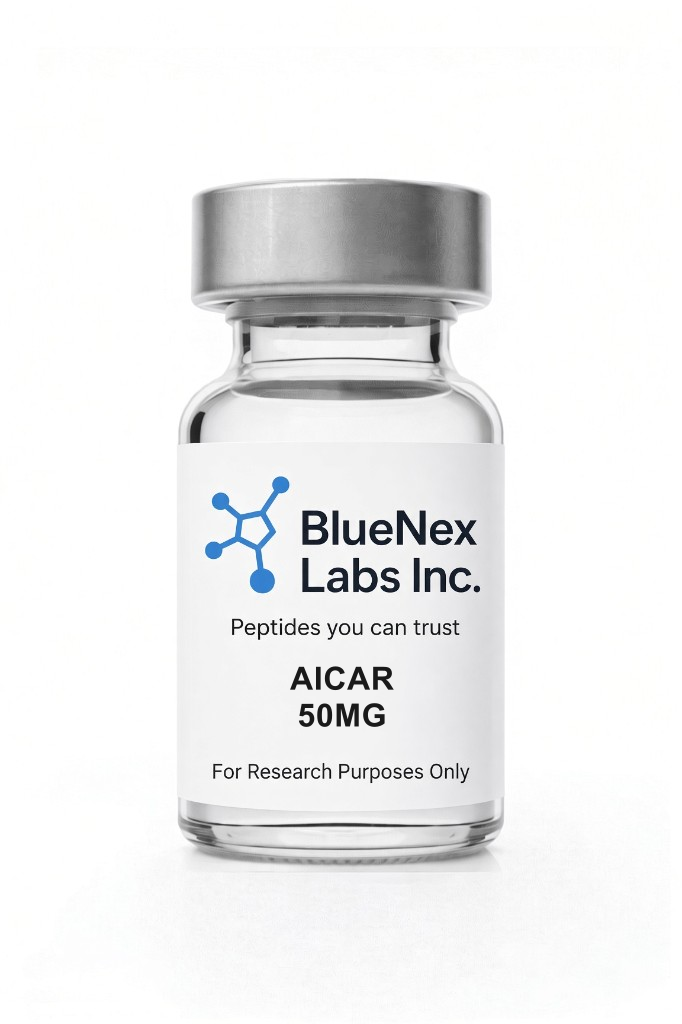
AICAR 50 mg - Research Grade Compound
ORDER HERE
🧬 AICAR Research Compound | High-Purity AMPK Research Material Canada
High-Purity AICAR for AMPK Signaling, Cellular Energy Research & Metabolic Pathway Studies
AICAR (5-Aminoimidazole-4-carboxamide ribonucleotide), also known as Acadesine in scientific literature, is a well-established biochemical research compound used extensively in laboratory investigations focused on AMP-activated protein kinase (AMPK) signaling, cellular energy sensing, and metabolic pathway regulation.
As a synthetic adenosine nucleotide analog, AICAR is frequently utilized in controlled research models designed to examine how cells detect fluctuations in energy availability and respond through intracellular signaling networks.
BlueNexLabs supplies high-purity AICAR research compound with analytical documentation and Research-Use-Only (RUO) labeling for qualified laboratory and scientific research applications throughout Canada.
🧪 What Is AICAR?
AICAR (5-Aminoimidazole-4-carboxamide ribonucleotide) is a synthetic purine nucleotide analog that has become an important tool compound in molecular biology and biochemical research.
Within laboratory environments, AICAR is primarily studied because of its relationship with cellular energy regulation pathways, particularly those involving AMPK, a conserved protein kinase involved in cellular responses to changes in energy status.
Researchers use AICAR-containing experimental systems to investigate:
Intracellular energy-sensing mechanisms
AMP-related signaling pathways
Cellular adaptation responses
Metabolic pathway communication
Bioenergetic regulation
Mitochondrial signaling networks
AICAR serves as a valuable research model for studying how molecular signals influence cellular behavior under different experimental conditions.
📡Overview AICAR Research Applications
AICAR is widely referenced in scientific research involving cellular signaling, metabolism, and molecular regulation.
Common research areas include:
AMPK Signaling Pathway Research
AMP-activated protein kinase (AMPK) functions as an important cellular energy sensor studied across many areas of molecular biology.
AICAR is commonly used in experimental models investigating:
AMPK-associated signaling cascades
Energy availability sensing mechanisms
Intracellular phosphorylation events
Regulation of downstream signaling pathways
Cellular responses to altered energy states
Researchers use AICAR as a biochemical tool to better understand relationships between energy signals and cellular regulation.
Cellular Energy & Bioenergetic Research
Cellular energy balance involves complex interactions between nutrient availability, molecular signaling, and metabolic pathways.
AICAR is studied in laboratory models examining:
Cellular energy homeostasis
ATP-related signaling mechanisms
Bioenergetic adaptation processes
Energy stress response pathways
Metabolic communication between cellular systems
These studies help researchers characterize how cells coordinate energy-related processes at the molecular level.
Mitochondrial Function & Metabolic Signaling Studies
Mitochondria play a central role in cellular energy production and metabolic signaling.
Research involving AICAR may include investigations into:
Mitochondrial signaling pathways
Cellular respiration models
Energy utilization mechanisms
Metabolic adaptation responses
Molecular pathways associated with mitochondrial activity
AICAR provides researchers with a controlled compound for studying interactions between energy sensing and cellular function.
Metabolic Pathway Research Models
AICAR is frequently included in laboratory investigations exploring complex metabolic networks.
Research applications may include:
Glucose metabolism pathway studies
Lipid metabolism signaling research
Nutrient-response models
Cellular stress adaptation experiments
Comparative pathway analysis
These experimental models allow researchers to examine how individual signaling pathways interact within broader cellular systems.
🧱 Molecular & Chemical Characteristics
AICAR and AMP-Related Signaling
AICAR is structurally related to adenosine nucleotide molecules involved in cellular energy communication.
In research settings, AICAR is investigated for its ability to participate in experimental models involving:
AMP-associated signaling pathways
Energy sensing mechanisms
Protein kinase regulation studies
Intracellular molecular communication
AICAR in Cellular Stress Research
Cells continuously monitor their internal energy environment.
Research models involving AICAR are used to explore:
Cellular adaptation mechanisms
Energy limitation models
Stress-response signaling
Regulatory feedback pathways
These studies contribute to a broader understanding of how cells maintain molecular balance during changing conditions.
AICAR Chemical & Analytical Information
Compound Name:
5-Aminoimidazole-4-carboxamide ribonucleotide
Common Name:
AICAR
CAS Number:
2627-69-2
Molecular Formula:
C9H14N4O5
Molecular Weight:
Approximately 258.23 g/mol (free compound reference)
Appearance:
White to off-white powder (typical)
Purity:
≥99% (analytical specification)
Research Classification:
Research Use Only (RUO)
🔬 Research Quality & Documentation
BlueNexLabs provides AICAR with documentation designed to support laboratory quality management and research documentation requirements.
Each batch includes analytical information such as:
Research-use labeling
Researchers and institutions can review documentation to support internal quality procedures and experimental record keeping.
🔗 Learn About Our Testing Standards
🔗 Explore the BlueNexLabs Research Compound Catalog
❄️ Storage & Laboratory Handling Information
AICAR should be handled according to appropriate laboratory protocols and institutional procedures.
General research handling considerations include:
Store under recommended laboratory storage conditions
Protect material from excessive moisture and environmental exposure
Minimize unnecessary temperature fluctuations
Follow applicable laboratory safety procedures
Maintain proper documentation during handling and storag
Storage requirements may vary depending on experimental protocols and preparation methods.
Why Choose BlueNexLabs AICAR Research Compound?
BlueNexLabs provides research compounds designed for qualified scientific and laboratory applications across Canada.
Researchers choose BlueNexLabs for:
✔ High-purity research materials
✔ COA-supported documentation
✔ Research-Use-Only labeling
✔ Canada-focused fulfillment
✔ Research-oriented product standards
✔ Transparent compound information
Available for Canadian Research Institutions
BlueNexLabs supplies AICAR research compound for qualified research applications throughout Canada, including:
Vancouver, British Columbia
Toronto, Ontario
Montreal, Quebec
Calgary, Alberta
Edmonton, Alberta
Ottawa, Ontario
Canadian research facilities nationwide
Our research compound catalog supports laboratories requiring documented, high-quality materials for scientific investigation.
Frequently Asked Questions About AICAR Research Compound
What is AICAR used for in research?
AICAR is primarily used as a biochemical research compound in studies involving AMPK signaling, cellular energy regulation, metabolic pathways, and molecular biology models.
Is AICAR approved for human use?
No. BlueNexLabs supplies AICAR strictly as a Research-Use-Only compound. It is not intended for human consumption, veterinary applications, diagnosis, treatment, or prevention of disease.
What pathway is AICAR studied with?
AICAR is commonly investigated in relation to AMP-activated protein kinase (AMPK) signaling and related cellular energy regulation pathways.
Does AICAR include analytical documentation?
BlueNexLabs provides research documentation including batch information and analytical verification materials where applicable.
⚠️ Compliance Notice
This product is supplied strictly for laboratory research use only (RUO).
Not for human or veterinary use.
No medical, therapeutic, metabolic, diagnostic, or performance‑related claims are made or implied.
ORDER HERE
🧬 AICAR Research Compound | High-Purity AMPK Research Material Canada
High-Purity AICAR for AMPK Signaling, Cellular Energy Research & Metabolic Pathway Studies
AICAR (5-Aminoimidazole-4-carboxamide ribonucleotide), also known as Acadesine in scientific literature, is a well-established biochemical research compound used extensively in laboratory investigations focused on AMP-activated protein kinase (AMPK) signaling, cellular energy sensing, and metabolic pathway regulation.
As a synthetic adenosine nucleotide analog, AICAR is frequently utilized in controlled research models designed to examine how cells detect fluctuations in energy availability and respond through intracellular signaling networks.
BlueNexLabs supplies high-purity AICAR research compound with analytical documentation and Research-Use-Only (RUO) labeling for qualified laboratory and scientific research applications throughout Canada.
🧪 What Is AICAR?
AICAR (5-Aminoimidazole-4-carboxamide ribonucleotide) is a synthetic purine nucleotide analog that has become an important tool compound in molecular biology and biochemical research.
Within laboratory environments, AICAR is primarily studied because of its relationship with cellular energy regulation pathways, particularly those involving AMPK, a conserved protein kinase involved in cellular responses to changes in energy status.
Researchers use AICAR-containing experimental systems to investigate:
Intracellular energy-sensing mechanisms
AMP-related signaling pathways
Cellular adaptation responses
Metabolic pathway communication
Bioenergetic regulation
Mitochondrial signaling networks
AICAR serves as a valuable research model for studying how molecular signals influence cellular behavior under different experimental conditions.
📡Overview AICAR Research Applications
AICAR is widely referenced in scientific research involving cellular signaling, metabolism, and molecular regulation.
Common research areas include:
AMPK Signaling Pathway Research
AMP-activated protein kinase (AMPK) functions as an important cellular energy sensor studied across many areas of molecular biology.
AICAR is commonly used in experimental models investigating:
AMPK-associated signaling cascades
Energy availability sensing mechanisms
Intracellular phosphorylation events
Regulation of downstream signaling pathways
Cellular responses to altered energy states
Researchers use AICAR as a biochemical tool to better understand relationships between energy signals and cellular regulation.
Cellular Energy & Bioenergetic Research
Cellular energy balance involves complex interactions between nutrient availability, molecular signaling, and metabolic pathways.
AICAR is studied in laboratory models examining:
Cellular energy homeostasis
ATP-related signaling mechanisms
Bioenergetic adaptation processes
Energy stress response pathways
Metabolic communication between cellular systems
These studies help researchers characterize how cells coordinate energy-related processes at the molecular level.
Mitochondrial Function & Metabolic Signaling Studies
Mitochondria play a central role in cellular energy production and metabolic signaling.
Research involving AICAR may include investigations into:
Mitochondrial signaling pathways
Cellular respiration models
Energy utilization mechanisms
Metabolic adaptation responses
Molecular pathways associated with mitochondrial activity
AICAR provides researchers with a controlled compound for studying interactions between energy sensing and cellular function.
Metabolic Pathway Research Models
AICAR is frequently included in laboratory investigations exploring complex metabolic networks.
Research applications may include:
Glucose metabolism pathway studies
Lipid metabolism signaling research
Nutrient-response models
Cellular stress adaptation experiments
Comparative pathway analysis
These experimental models allow researchers to examine how individual signaling pathways interact within broader cellular systems.
🧱 Molecular & Chemical Characteristics
AICAR and AMP-Related Signaling
AICAR is structurally related to adenosine nucleotide molecules involved in cellular energy communication.
In research settings, AICAR is investigated for its ability to participate in experimental models involving:
AMP-associated signaling pathways
Energy sensing mechanisms
Protein kinase regulation studies
Intracellular molecular communication
AICAR in Cellular Stress Research
Cells continuously monitor their internal energy environment.
Research models involving AICAR are used to explore:
Cellular adaptation mechanisms
Energy limitation models
Stress-response signaling
Regulatory feedback pathways
These studies contribute to a broader understanding of how cells maintain molecular balance during changing conditions.
AICAR Chemical & Analytical Information
Compound Name:
5-Aminoimidazole-4-carboxamide ribonucleotide
Common Name:
AICAR
CAS Number:
2627-69-2
Molecular Formula:
C9H14N4O5
Molecular Weight:
Approximately 258.23 g/mol (free compound reference)
Appearance:
White to off-white powder (typical)
Purity:
≥99% (analytical specification)
Research Classification:
Research Use Only (RUO)
🔬 Research Quality & Documentation
BlueNexLabs provides AICAR with documentation designed to support laboratory quality management and research documentation requirements.
Each batch includes analytical information such as:
Research-use labeling
Researchers and institutions can review documentation to support internal quality procedures and experimental record keeping.
🔗 Learn About Our Testing Standards
🔗 Explore the BlueNexLabs Research Compound Catalog
❄️ Storage & Laboratory Handling Information
AICAR should be handled according to appropriate laboratory protocols and institutional procedures.
General research handling considerations include:
Store under recommended laboratory storage conditions
Protect material from excessive moisture and environmental exposure
Minimize unnecessary temperature fluctuations
Follow applicable laboratory safety procedures
Maintain proper documentation during handling and storag
Storage requirements may vary depending on experimental protocols and preparation methods.
Why Choose BlueNexLabs AICAR Research Compound?
BlueNexLabs provides research compounds designed for qualified scientific and laboratory applications across Canada.
Researchers choose BlueNexLabs for:
✔ High-purity research materials
✔ COA-supported documentation
✔ Research-Use-Only labeling
✔ Canada-focused fulfillment
✔ Research-oriented product standards
✔ Transparent compound information
Available for Canadian Research Institutions
BlueNexLabs supplies AICAR research compound for qualified research applications throughout Canada, including:
Vancouver, British Columbia
Toronto, Ontario
Montreal, Quebec
Calgary, Alberta
Edmonton, Alberta
Ottawa, Ontario
Canadian research facilities nationwide
Our research compound catalog supports laboratories requiring documented, high-quality materials for scientific investigation.
Frequently Asked Questions About AICAR Research Compound
What is AICAR used for in research?
AICAR is primarily used as a biochemical research compound in studies involving AMPK signaling, cellular energy regulation, metabolic pathways, and molecular biology models.
Is AICAR approved for human use?
No. BlueNexLabs supplies AICAR strictly as a Research-Use-Only compound. It is not intended for human consumption, veterinary applications, diagnosis, treatment, or prevention of disease.
What pathway is AICAR studied with?
AICAR is commonly investigated in relation to AMP-activated protein kinase (AMPK) signaling and related cellular energy regulation pathways.
Does AICAR include analytical documentation?
BlueNexLabs provides research documentation including batch information and analytical verification materials where applicable.
⚠️ Compliance Notice
This product is supplied strictly for laboratory research use only (RUO).
Not for human or veterinary use.
No medical, therapeutic, metabolic, diagnostic, or performance‑related claims are made or implied.