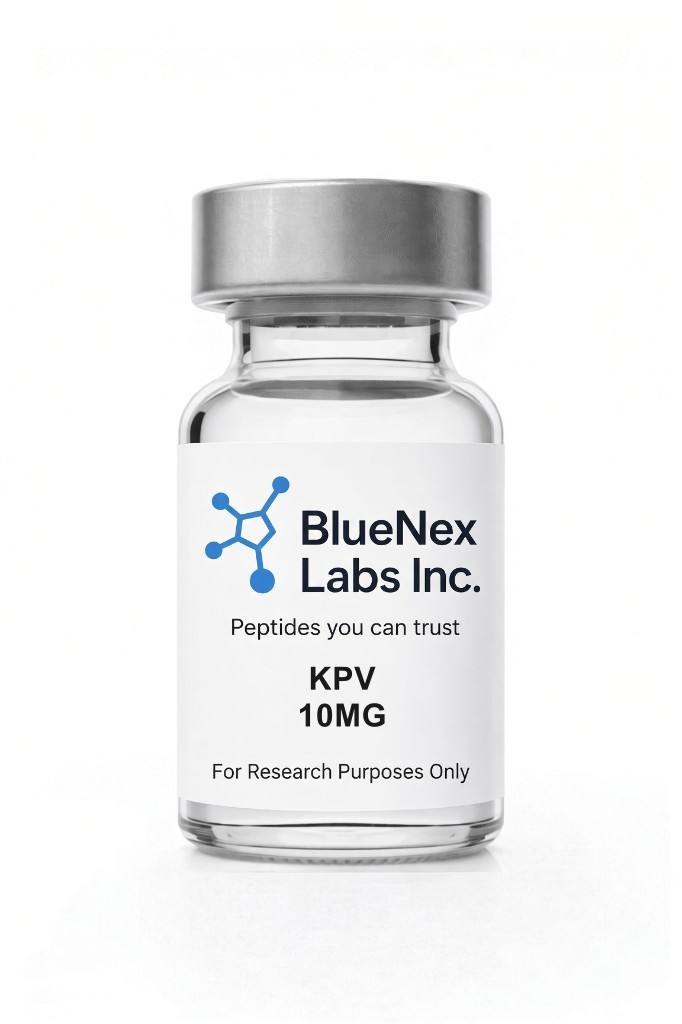
KPV 10mg - COA Certified Research Grade
🧬 KPV Peptide (Lys‑Pro‑Val) — 10 mg
High‑Purity α‑MSH‑Derived Tripeptide for Inflammatory Pathway, Barrier Integrity & Cellular Signaling Research (Canada)
KPV (Lys‑Pro‑Val) is a high‑purity, research‑grade tripeptide derived from the C‑terminal sequence of α‑melanocyte‑stimulating hormone (α‑MSH). It is widely referenced in laboratory research involving inflammatory‑pathway signaling, epithelial‑barrier integrity, immune‑related signaling networks, and cellular‑stress response mechanisms.
Supplied by BlueNexLabs, KPV is provided as a lyophilized peptide (10 mg) with COA‑verified purity, analytical consistency, and audit‑safe Research‑Use‑Only (RUO) labeling, supporting controlled experimental workflows across Canadian research environments.
🔬 Overview of KPV in Research Settings
Despite its compact size, KPV retains key mechanistic characteristics associated with melanocortin‑linked signaling, making it a valuable model peptide in pathway‑specific research systems. In controlled laboratory settings, KPV is frequently referenced in studies examining:
Inflammatory‑pathway and cytokine‑linked signaling cascades
NF‑κB‑associated transcriptional activity
Epithelial‑barrier function and cellular‑resilience models
Oxidative‑stress and metabolic‑stress response networks
Peptide–receptor and peptide–protein interaction dynamics
Its stability and well‑defined structure make KPV suitable for reproducible in‑vitro and preclinical research.
🧪 What Is KPV?
KPV (Lys‑Pro‑Val) is a synthetic α‑MSH–derived tripeptide used in laboratory research involving:
Inflammatory‑pathway regulation models
Cytokine‑signaling and immune‑pathway studies
Epithelial‑barrier integrity and cellular‑resilience research
Oxidative‑ and metabolic‑stress signaling assays
Melanocortin‑fragment comparative analysis
Its minimal structure enables straightforward analytical characterization while preserving mechanistic relevance across several signaling domains.
📡 Mechanistic Research Overview (Audit‑Safe)
⚖️ Inflammatory Pathway & Cytokine Signaling
Referenced in studies examining cytokine‑linked signaling markers
Used in models mapping NF‑κB‑associated transcriptional activity
Supports peptide‑mediated immune‑signaling pathway analysis
🧫 Barrier Integrity & Epithelial Signaling
Applied in research involving epithelial‑barrier function
Supports investigation of cellular‑resilience and adaptation pathways
Used in multi‑pathway epithelial‑biology research systems
🔋 Cellular Stress & Oxidative Marker Dynamics
Examined in oxidative‑stress and metabolic‑stress models
Supports peptide‑mediated stress‑adaptation research
Used in comparative studies versus full‑length α‑MSH and related fragments
🧱 Molecular & Chemical Characteristics
Type: Synthetic tripeptide (Lys‑Pro‑Val)
Form: Lyophilized powder
Fill Size: 10 mg
Origin: Derived from α‑MSH C‑terminal sequence
Identity Verification: Mass Spectrometry (MS)
Purity Analysis: HPLC / UPLC
Structural & Biochemical Notes
Compact structure supports high stability in dry form
Resistant to rapid degradation relative to longer peptides
Sensitive to hydrolysis following reconstitution if improperly handled
🔬 Research Focus Areas
KPV is commonly referenced in laboratory research involving:
Inflammatory‑pathway and cytokine‑signaling modeling
NF‑κB‑linked transcriptional studies
Epithelial‑barrier and cellular‑resilience research
Oxidative‑stress and metabolic‑stress assays
Peptide–receptor and peptide–protein interaction analysis
Comparative melanocortin‑fragment research
Its clean mechanistic profile supports controlled, pathway‑specific research workflows in regulated laboratory environments.
❄️ Storage & Handling Guidelines
Store lyophilized peptide at –20 °C, protected from light and moisture
Reconstituted solutions: 2–8 °C, short‑term research use only
Avoid prolonged exposure to room temperature after reconstitution
Avoid repeated freeze–thaw cycles; aliquot where necessary
Use sterile preparation techniques and low‑binding labware
📄 Certificate of Analysis & Documentation
Each batch of KPV supplied by BlueNexLabs includes audit‑ready documentation, supporting traceability and reproducibility:
Mass Spectrometry identity confirmation
HPLC / UPLC purity profile
Solvent system disclosure
Lot and batch traceability
Research‑Use‑Only (RUO) designation
🔗 View Certificate of Analysis (COA)
🔗 Learn About Our Testing Standards
🔗 Explore the BlueNexLabs Research Peptide Catalog
🇨🇦 Supplied for Canadian Research Laboratories
BlueNexLabs supplies KPV research peptide to laboratories across Vancouver, Toronto, Montreal, Calgary, Edmonton, Ottawa, and throughout Canada.
Why Researchers Choose BlueNexLabs
🇨🇦 Canada‑wide domestic shipping
📄 COA‑verified, traceable batches
🧪 Audit‑safe RUO labeling
⚡ Fast fulfillment & responsive support
🔬 Research‑focused immune‑ and epithelial‑biology peptide catalog
⚠️ Compliance Notice
This product is supplied strictly for laboratory research use only (RUO).
Not for human or veterinary use.
No medical, therapeutic, metabolic, diagnostic, or performance‑related claims are made or implied.
🧬 KPV Peptide (Lys‑Pro‑Val) — 10 mg
High‑Purity α‑MSH‑Derived Tripeptide for Inflammatory Pathway, Barrier Integrity & Cellular Signaling Research (Canada)
KPV (Lys‑Pro‑Val) is a high‑purity, research‑grade tripeptide derived from the C‑terminal sequence of α‑melanocyte‑stimulating hormone (α‑MSH). It is widely referenced in laboratory research involving inflammatory‑pathway signaling, epithelial‑barrier integrity, immune‑related signaling networks, and cellular‑stress response mechanisms.
Supplied by BlueNexLabs, KPV is provided as a lyophilized peptide (10 mg) with COA‑verified purity, analytical consistency, and audit‑safe Research‑Use‑Only (RUO) labeling, supporting controlled experimental workflows across Canadian research environments.
🔬 Overview of KPV in Research Settings
Despite its compact size, KPV retains key mechanistic characteristics associated with melanocortin‑linked signaling, making it a valuable model peptide in pathway‑specific research systems. In controlled laboratory settings, KPV is frequently referenced in studies examining:
Inflammatory‑pathway and cytokine‑linked signaling cascades
NF‑κB‑associated transcriptional activity
Epithelial‑barrier function and cellular‑resilience models
Oxidative‑stress and metabolic‑stress response networks
Peptide–receptor and peptide–protein interaction dynamics
Its stability and well‑defined structure make KPV suitable for reproducible in‑vitro and preclinical research.
🧪 What Is KPV?
KPV (Lys‑Pro‑Val) is a synthetic α‑MSH–derived tripeptide used in laboratory research involving:
Inflammatory‑pathway regulation models
Cytokine‑signaling and immune‑pathway studies
Epithelial‑barrier integrity and cellular‑resilience research
Oxidative‑ and metabolic‑stress signaling assays
Melanocortin‑fragment comparative analysis
Its minimal structure enables straightforward analytical characterization while preserving mechanistic relevance across several signaling domains.
📡 Mechanistic Research Overview (Audit‑Safe)
⚖️ Inflammatory Pathway & Cytokine Signaling
Referenced in studies examining cytokine‑linked signaling markers
Used in models mapping NF‑κB‑associated transcriptional activity
Supports peptide‑mediated immune‑signaling pathway analysis
🧫 Barrier Integrity & Epithelial Signaling
Applied in research involving epithelial‑barrier function
Supports investigation of cellular‑resilience and adaptation pathways
Used in multi‑pathway epithelial‑biology research systems
🔋 Cellular Stress & Oxidative Marker Dynamics
Examined in oxidative‑stress and metabolic‑stress models
Supports peptide‑mediated stress‑adaptation research
Used in comparative studies versus full‑length α‑MSH and related fragments
🧱 Molecular & Chemical Characteristics
Type: Synthetic tripeptide (Lys‑Pro‑Val)
Form: Lyophilized powder
Fill Size: 10 mg
Origin: Derived from α‑MSH C‑terminal sequence
Identity Verification: Mass Spectrometry (MS)
Purity Analysis: HPLC / UPLC
Structural & Biochemical Notes
Compact structure supports high stability in dry form
Resistant to rapid degradation relative to longer peptides
Sensitive to hydrolysis following reconstitution if improperly handled
🔬 Research Focus Areas
KPV is commonly referenced in laboratory research involving:
Inflammatory‑pathway and cytokine‑signaling modeling
NF‑κB‑linked transcriptional studies
Epithelial‑barrier and cellular‑resilience research
Oxidative‑stress and metabolic‑stress assays
Peptide–receptor and peptide–protein interaction analysis
Comparative melanocortin‑fragment research
Its clean mechanistic profile supports controlled, pathway‑specific research workflows in regulated laboratory environments.
❄️ Storage & Handling Guidelines
Store lyophilized peptide at –20 °C, protected from light and moisture
Reconstituted solutions: 2–8 °C, short‑term research use only
Avoid prolonged exposure to room temperature after reconstitution
Avoid repeated freeze–thaw cycles; aliquot where necessary
Use sterile preparation techniques and low‑binding labware
📄 Certificate of Analysis & Documentation
Each batch of KPV supplied by BlueNexLabs includes audit‑ready documentation, supporting traceability and reproducibility:
Mass Spectrometry identity confirmation
HPLC / UPLC purity profile
Solvent system disclosure
Lot and batch traceability
Research‑Use‑Only (RUO) designation
🔗 View Certificate of Analysis (COA)
🔗 Learn About Our Testing Standards
🔗 Explore the BlueNexLabs Research Peptide Catalog
🇨🇦 Supplied for Canadian Research Laboratories
BlueNexLabs supplies KPV research peptide to laboratories across Vancouver, Toronto, Montreal, Calgary, Edmonton, Ottawa, and throughout Canada.
Why Researchers Choose BlueNexLabs
🇨🇦 Canada‑wide domestic shipping
📄 COA‑verified, traceable batches
🧪 Audit‑safe RUO labeling
⚡ Fast fulfillment & responsive support
🔬 Research‑focused immune‑ and epithelial‑biology peptide catalog
⚠️ Compliance Notice
This product is supplied strictly for laboratory research use only (RUO).
Not for human or veterinary use.
No medical, therapeutic, metabolic, diagnostic, or performance‑related claims are made or implied.