
Research · 2026-04-27
Scientific lead: Alice Kay, Ph.D.
What is BPC-157? Structure & research
Direct answer
How published papers use BPC-157 in cell-signalling, inflammatory-marker, and gastrointestinal models. Educational laboratory overview — not a shop listing.
Scope
Tissue, matrix & repair models. BPC-157, GHK-Cu, TB-500, and related matrix or cell-migration papers. Educational overviews, not product listings.
Reviewer: Alice Kay, Ph.D., scientific lead. This note does not claim that the reviewer authored any cited paper.
BPC-157 Research Overview
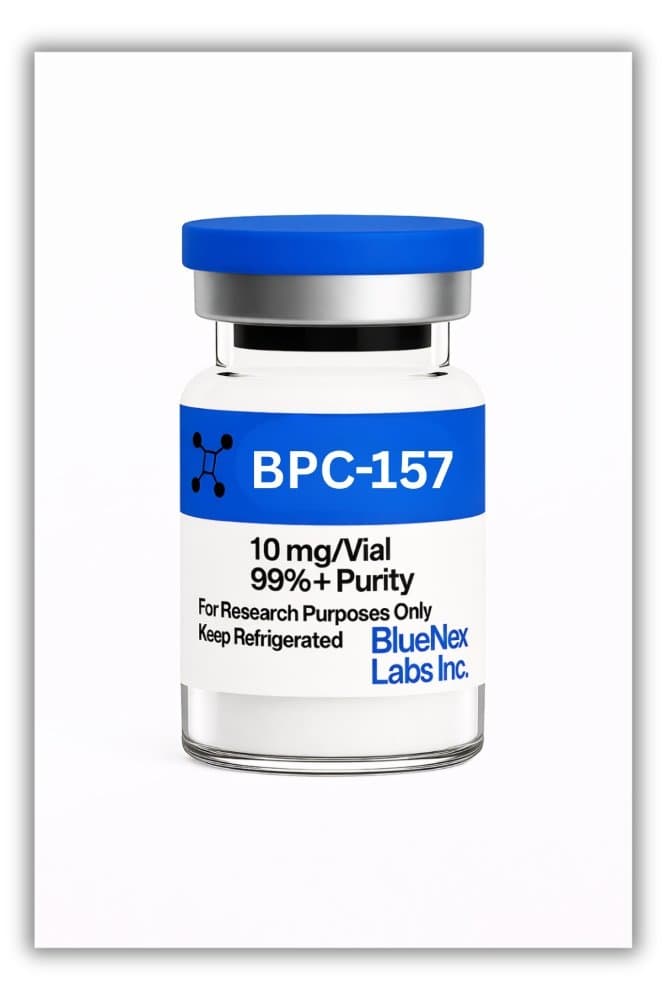
This note follows the 15-residue gastric protein fragment called BPC-157 through published cell-signaling and gastrointestinal laboratory models. The documented 10mg vial is a separate catalog page.
This page provides laboratory-focused information for BPC-157. Content is intended for research use only and should be read with the published documentation and analytical data.
Research-use notice: This article is laboratory and educational information only. It is not medical or legal advice, and it does not include how-to-use instructions. BlueNex Labs materials are research use only and are not intended for human or veterinary use. Research-use-only labelling is not a Health Canada authorization.
Publication status: Prepared for the BlueNex Labs Research Knowledge Centre. Literature and library notes checked September 24, 2026. Primary papers and the public COA library can change; verify the lot report in hand before an assay.
BPC-157 is a synthetic pentadecapeptide: fifteen amino acids, written Gly-Glu-Pro-Pro-Pro-Gly-Lys-Pro-Ala-Asp-Asp-Ala-Gly-Leu-Val, and often abbreviated GEPPPGKPADDAGLV. Papers give the free-peptide mass as about 1419 daltons. The sequence is a partial sequence taken from a larger gastric protein that early authors called body protection compound. This page is a structure and model note. The milligram fill, price, and stock are on the BPC-157 10 mg product page. The page is not a protocol.
Sequence, mass, and what a name does not prove
A common name is not an identity test. Laboratories confirm a lot by comparing the observed mass with the mass calculated from GEPPPGKPADDAGLV, then read the chromatographic purity on the same report. The BPC-157 section of the COA library is the published Janoshik link for the 10 mg vial when that lot is listed. How to read a peptide Certificate of Analysis separates an HPLC percentage from a mass result. What is a peptide COA in Canada? is the shorter primer on what the document is for.
Literature codes such as PL-14736 appear in older gastrointestinal papers. Those codes are historical labels in the citation, not extra catalogue SKUs and not evidence that a research solid is an authorized drug. If a secondary source uses a different spelling or a brand-like alias, return to the sequence and the lot mass.
Gastrointestinal models in the published record
The sequence entered the research literature through experimental gastrointestinal work. Sikiric and colleagues reviewed that body of rodent and related laboratory models in Current Pharmaceutical Design in 2011 (PMID 21548867). The review discusses lesion models along the gut, sphincter-pressure measurements in rats, and proposed interactions with nitric-oxide pathways. Those are assay systems. A result inside one model stays inside that model. BlueNex Labs does not restate the review as a catalogue claim, and this note does not copy the review's wording about medical use.
Readers who need the Canadian legal frame, rather than the rat-model frame, should use Are research peptides legal in Canada?. A research-use-only label does not create a Drug Identification Number. Health Canada looks at advertising and intended use as well as the words on a vial.
A fibroblast culture paper, with concentrations left in the paper
Chang, Tsai, Hsu, and Pang reported a tendon-fibroblast experiment in Molecules in 2014 (PMC6271067). They added the pentadecapeptide to cultures of rat Achilles tendon fibroblasts at 0.1, 0.25, and 0.5 micrograms per millilitre and measured growth-hormone receptor mRNA and protein, plus a downstream kinase readout when growth hormone was also added. Those figures are culture-medium concentrations in that paper. They are not instructions, they are not a human exposure, and they are not a value to copy onto a purchasing form. The useful laboratory point is narrower: the authors treated receptor expression as something an in-vitro system can quantify, at stated concentrations, over one to three days.
The same paper describes the fifteen-residue fragment as stable in the authors' handling and as lacking an obvious match to other well-known peptide families. That is their characterization. It still does not replace mass spectrometry on the vial you hold.
Cell migration and vascular readouts
Other preclinical papers place the same sequence in cell-migration assays and in angiogenesis-marker panels. Endpoints in that literature include endothelial behaviour in culture, inflammatory-mediator panels, and tissue histology in defined animal lesions. Gwyer, Wragg, and Wilson reviewed the musculoskeletal subset in Cell and Tissue Research in 2019 (PMID 30915550). They noted that the detailed work available to them was concentrated in a small number of research groups and that human confirmation was still lacking. A 2019 review is not a 2026 regulatory decision. It is a map of what the animal and culture papers were actually doing.
This catalogue does not rank those papers, does not call one endpoint a product feature, and does not tell a laboratory which model to run. If your protocol needs a cytoskeletal ligand rather than the gastric pentadecapeptide, read What is TB-500? Actin-fragment research instead of stretching this page across both sequences.
Two sequences are not one lot
Methods papers sometimes cite BPC-157 beside a thymosin beta-4 fragment because both names appear in cell-migration work. That citation habit is explained in BPC-157 and TB-500 as paired laboratory topics. The paired note is still not a protocol. For the single-peptide TB-500 vial, see TB-500 10 mg. Convenience fills that contain both solids are separate SKUs: 5 mg/5mg and 10 mg/10mg. The public library has separate Janoshik reports for the 5 mg/5 mg blend, the 10 mg/10 mg blend, and the TB-500-only vial (the TB-500 10 mg certificate). Neither blend PDF documents the 10 mg pentadecapeptide or the TB-500-only vial.
KLOW, when you need the four-peptide fill rather than BPC-157 alone, is a different lot again: KLOW 80 mg. Category grouping under Cellular & Biological Peptides is taxonomy. It is not a reason to share one certificate across the group.
Regulatory status is a separate question from structure
Structure and mass answer an analytical question. Authorization answers a legal one. The July 2026 U.S. Pharmacy Compounding Advisory Committee discussion of specified bulk substances, including this sequence, is summarized in FDA peptide review 2026, Canada. A committee recommendation is not FDA approval and it does not change Health Canada requirements. Nothing in that meeting turns a lyophilized research vial into a medicine.
Receipt and storage, without solution steps
The solid is supplied lyophilized because removing water slows hydrolysis. After Canada Post delivery, move the sealed vial into controlled storage the same day. Coastal humidity and winter temperature swings are the practical Canadian risks. Photograph damage within 7 days. Full receiving practice is in Peptide storage for Canadian laboratories. This article does not list solvent volumes, syringe steps, or personal-use schedules.
Orders are fulfilled in Canada only, paid by Interac e-Transfer, with Xpresspost labels from a Port Moody PO Box and a desk in Burnaby. Sold-out cards stay on the shop and cannot be added to the cart. Confirm the institution's purchasing rules before you order.
Claims that go past this structure note are sorted by evidence type in Viral Peptide Claims vs Evidence.
Frequently asked questions
What does research use only mean for a BPC-157 vial?
Research use only means the lyophilized solid is sold for laboratory and in-vitro work, not as a medicine, food, cosmetic, or veterinary product. The label is not a Health Canada drug authorization and it does not create a Drug Identification Number.
Where is the BPC-157 Certificate of Analysis?
The published 10 mg lot sits in the certificates library at the BPC-157 anchor. Open that Janoshik report and match the compound name to the vial. A blend report, including the 5 mg/5mg BPC-157 and TB-500 lot, does not document the single-peptide vial.
How does BlueNex Labs fulfil a BPC-157 order in Canada?
Checkout uses a Canadian address and Interac e-Transfer. Parcels move on Canada Post Xpresspost. The desk is in Burnaby, British Columbia, and the Xpresspost sender line uses a Port Moody PO Box. The catalogue does not ship outside Canada.
How should a laboratory store a lyophilized BPC-157 vial after delivery?
Move the sealed vial out of the parcel into controlled storage the same day. Keep it closed until the assay, limit time at the bench, and follow the temperature on the product note. Photograph shipping damage within 7 days. This page does not give solution volumes or personal-use steps.
Catalogue cross-reference
This page is a literature note for the pentadecapeptide. Milligrams and CAD price stay on the BPC-157 10 mg URL. Match that lot's certificate before the vial enters a study file.
Orders ship inside Canada only after Interac e-Transfer checkout. Sold-out SKUs remain listed and cannot be added to the cart. Match each vial to its own Certificate of Analysis when a lot is published. Research use only. Not for human or veterinary use.
References
- PMID 21548867
- PMID 30915550
Research use only. BlueNex Labs does not provide medical or veterinary advice. Confirm your institution’s policies before purchase. Lot-file rules for this note are on the documentation standards page. Scientific lead: Alice Kay, Ph.D.