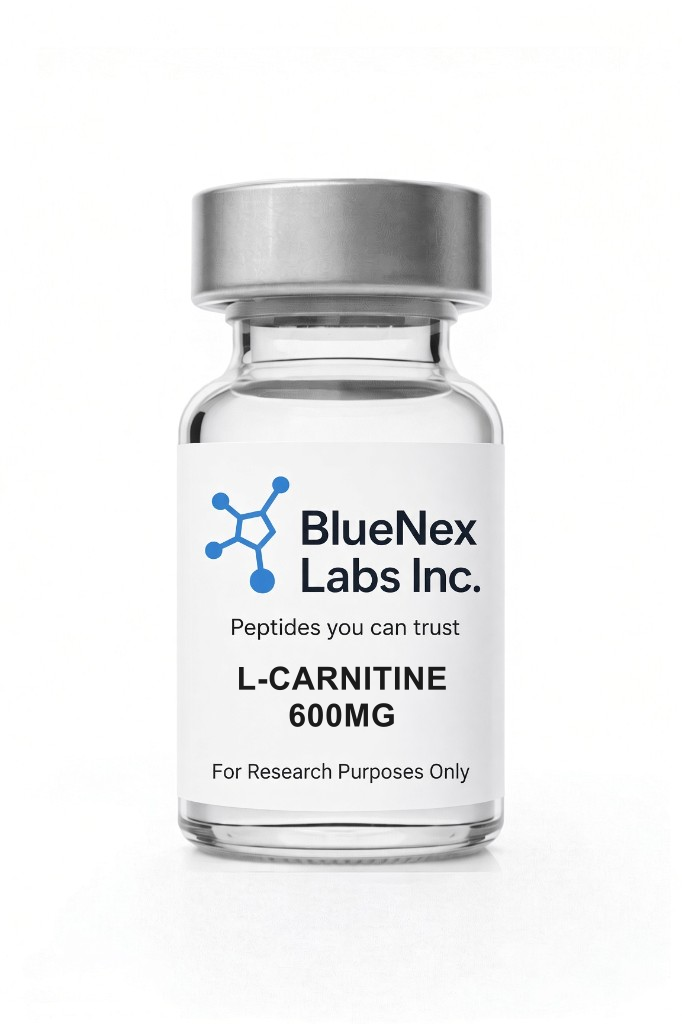
L-Carnitine 600mg Research Canada
Research use only. Not for human or veterinary use.
L-Carnitine 600mg is supplied as a research reagent for mitochondrial-transport assays, not a sports-nutrition consumer SKU. Research-use only.
🧬 L‑Carnitine — High‑Purity Research‑Grade Amino‑Acid Derivative for Mitochondrial‑Function, Fatty‑Acid Transport & Cellular‑Energy Studies
L‑Carnitine is a high‑purity, research‑grade quaternary ammonium amino‑acid derivative widely referenced in Canadian laboratory environments for studies involving mitochondrial energy metabolism, fatty‑acid transport, β‑oxidation pathways, and cellular‑energy regulation.
As a central component of mitochondrial fatty‑acid shuttling, L‑Carnitine is frequently used in in‑vitro and preclinical research exploring metabolic‑stress adaptation, ATP‑production efficiency, acyl‑CoA transport, and cellular‑resilience mechanisms.
Engineered for controlled laboratory use, L‑Carnitine offers strong stability, predictable biochemical behavior, and broad mechanistic relevance, making it a commonly referenced compound in Canadian laboratory studies of energy metabolism, mitochondrial function, and lipid‑oxidation pathways.
🔍 What Is L‑Carnitine?
L‑Carnitine is a naturally occurring amino‑acid‑derived molecule synthesized from lysine and methionine. It plays a central role in transporting long‑chain fatty acids into the mitochondrial matrix, enabling their conversion into usable cellular energy through β‑oxidation.
In research settings, L‑Carnitine is used to study:
- Mitochondrial fatty‑acid transport
- Acyl‑CoA shuttling and β‑oxidation
- Cellular‑energy production and ATP generation
- Metabolic‑stress and oxidative‑stress adaptation
- Lipid‑metabolism and energy‑balance pathways
- Carnitine‑dependent enzymatic activity
Its well‑characterized biochemical profile makes L‑Carnitine a widely used model compound for metabolic, mitochondrial, and cellular‑energy research across Canada.
📡 Mechanistic Overview (Audit‑Safe)
🔷 Fatty‑Acid Transport & β‑Oxidation
- Facilitates transport of long‑chain fatty acids into mitochondria
- Supports research involving acyl‑CoA transfer and oxidation
- Used in models examining lipid‑metabolism efficiency
🔶 Mitochondrial‑Energy Production
- Referenced in studies involving ATP‑generation pathways
- Supports mapping of mitochondrial respiratory‑chain activity
- Used in metabolic‑stress and energy‑balance research
🔵 Cellular‑Stress & Redox Regulation
- Examined in oxidative‑stress and metabolic‑stress models
- Supports investigations into cellular‑resilience mechanisms
- Used in comparative studies vs. other metabolic cofactors
🧱 Structural Overview
🧪 Molecular Composition
- Type: Quaternary ammonium amino‑acid derivative
- Form: High‑purity research‑grade liquid
- Identity: Verified via MS and HPLC/UPLC
- Origin: Synthesized analog of endogenous L‑Carnitine
🧬 Functional Domains
- Transport domain: Fatty‑acid shuttling into mitochondria
- Energy‑production domain: β‑oxidation and ATP‑linked pathways
- Stress‑response domain: Oxidative‑marker and metabolic‑adaptation models
🎯 Pathway Targets
- Mitochondrial fatty‑acid transport
- β‑oxidation and lipid‑metabolism pathways
- ATP‑production and respiratory‑chain activity
- Redox‑state and oxidative‑stress markers
- Acyl‑CoA transport and enzymatic regulation
🔬 Research Focus Areas
L‑Carnitine is referenced in research involving:
- Mitochondrial‑function and energy‑production modeling
- Fatty‑acid transport and β‑oxidation assays
- Metabolic‑stress and oxidative‑marker studies
- Acyl‑CoA transport and enzymatic‑activity analysis
- Comparative metabolic‑cofactor research
- Multi‑pathway cellular‑energy investigations
Its clean mechanistic profile makes it suitable for controlled, pathway‑specific research environments across Canada.
🇨🇦 Optimized for Canadian Research Environments
BlueNexLabs supplies L-Carnitine to laboratories across Canada as a research reagent with Interac checkout and Canada-only shipping. It is not a sports-nutrition consumer SKU on this site.
Storage & Handling
- Store lyophilized material at –20 °C, protected from light and moisture
- Reconstituted solutions: 2–8 °C, short-term laboratory use only
- Avoid repeated freeze–thaw cycles; use sterile technique
Documentation
Batch Certificates of Analysis are listed in the certificates library when published. Match vial size and lot notes before assigning a lot to an assay.
Compliance Notice
Research-use only. Not for human or veterinary use. No medical, cosmetic, or performance claims are made or implied.
Vial size
$25.00CAD
54 in stock · SKU SQ3566472
Molecular characteristics
- form
- Lyophilized powder
- purity
- ≥99% (COA verified)
- use
- Research use only
Documentation (HPLC / UPLC, MS, COA)
Batch Certificates of Analysis are added to the certificates library when published. This page does not invent lot numbers.
Questions about laboratory procurement? Contact BlueNex Labs.