
Research · 2025-09-21
Scientific lead: Alice Kay, Ph.D.
What is Epithalon? Tetrapeptide research
Direct answer
Epithalon (also spelled epitalon) is the synthetic tetrapeptide Ala-Glu-Asp-Gly discussed in telomerase and cellular-aging laboratory models. The 10 mg vial is a separate page.
Scope
Tissue, matrix & repair models. BPC-157, GHK-Cu, TB-500, and related matrix or cell-migration papers. Educational overviews, not product listings.
Reviewer: Alice Kay, Ph.D., scientific lead. This note does not claim that the reviewer authored any cited paper.
Epithalon Research Overview
Epithalon, also spelled epitalon, is the synthetic tetrapeptide Ala-Glu-Asp-Gly discussed in telomerase and cellular-aging laboratory models. The 10mg and 50mg vials are separate catalog pages. No lot file is published for the 50mg fill.
This page provides laboratory-focused information for Epithalon. Content is intended for research use only and should be read with the published documentation and analytical data.
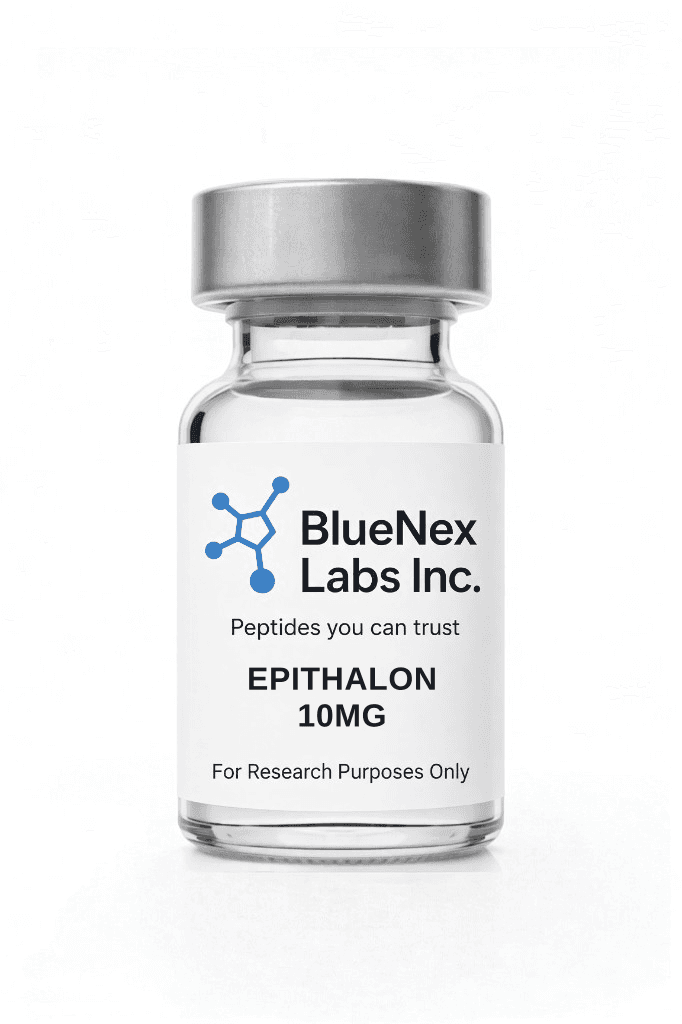
> Research-use notice: This article is educational laboratory context only. It is not medical advice. No dosing, administration, or human-use guidance is provided. BlueNex Labs research-use-only products are not intended for human or veterinary use.
Epithalon is a synthetic tetrapeptide with the sequence Ala-Glu-Asp-Gly. Published papers also spell it epitalon. Both names refer to the same short sequence, which is discussed as a fragment related to epithalamin, a pineal polypeptide preparation. This page is a research guide. The catalogue SKU, price, and Canada fulfilment sit on the Epithalon 10 mg product page. A published lot, when listed, sits on the Epithalon certificate anchor.
Structure
Laboratory descriptions of this material usually focus on four points:
A four-residue sequence, Ala-Glu-Asp-Gly, that can be synthesized and checked by mass spectrometry
The epitalon spelling used in much of the pineal-peptide literature, versus the catalogue spelling epithalon
Relationship to epithalamin as a historical source mixture, not as a substitute for a defined synthetic lot
Identity and chromatographic purity on the Certificate of Analysis for the vial in hand
Exact sequence notation on a lot report outranks a general article. Do not treat a neighbouring peptide’s certificate as documentation for this SKU.
Mechanisms discussed in research settings
Papers place the tetrapeptide in cellular-aging and pineal-related models, including:
Telomerase expression and telomere-length readouts in cell-culture systems
Markers tied to circadian and pineal signalling in controlled models
Oxidative-stress enzyme measurements reported alongside those assays
Comparisons with other short peptides that appear in the same longevity literature, without ranking them
Those results stay inside the model that produced them. A mechanism note is not a use instruction, and it is not evidence that the solid changes human aging.
What this guide is not
It is not a ranked longevity list. For the multi-compound roundup, see Longevity peptides under study, 2026. Mitochondrial SKUs as a group are listed under Mitochondrial Research Peptides Canada.
Documentation and RUO
Identity and purity are analytical questions. How to read a peptide Certificate of Analysis explains HPLC versus mass spectrometry.
Research use only. Not for human or veterinary use.
References
This note does not add a separate citation list. Named papers, when the body links them, stay in the text above.
Research use only. BlueNex Labs does not provide medical or veterinary advice. Confirm your institution’s policies before purchase. Lot-file rules for this note are on the documentation standards page. Scientific lead: Alice Kay, Ph.D.