
Research · 2026-11-04
By Alice Kay · Last reviewed 4 Nov 2026
What Is PE-22-28?
Research-use notice: This article summarizes published scientific literature for educational purposes. It is not medical advice and does not provide dosing, administration or human-use information. Findings described in the literature do not apply to any BlueNex Labs product, which is supplied only for in-vitro laboratory research and not for human or animal use.
Direct answer
PE-22-28 is a 7-amino-acid peptide cut down from spadin, a fragment of the sortilin protein. In cell tests it blocks the TREK-1 potassium channel far more strongly than spadin does. In mice it produced antidepressant-like behaviour, along with signs of new brain cell growth, within 4 days. No harm was reported, but its safety hasn't been studied in depth, and no human trials have been published.
Scope
Cognitive & neuroscience models. Sleep-architecture and neuroendocrine peptides discussed in laboratory literature.
This note does not claim that Alice Kay authored any cited paper.
For research use only. PE-22-28 isn't approved for human use, and nothing here is medical advice or dosing guidance.
TL;DR: PE-22-28 is a 7-amino-acid peptide cut down from spadin, a fragment of the sortilin protein. In cell tests it blocks the TREK-1 potassium channel far more strongly than spadin does. In mice it produced antidepressant-like behaviour, along with signs of new brain cell growth, within 4 days. No harm was reported, but its safety hasn't been studied in depth, and no human trials have been published.
What is PE-22-28, in plain terms?
PE-22-28 is a short research peptide. It's only seven amino acids long. A French team at CNRS's Institut de Pharmacologie Moléculaire et Cellulaire, led by Jean Mazella, Marc Borsotto and Catherine Heurteaux, made it by trimming a longer peptide called spadin. Nearly everything published about it comes from that one group.
To see why they bothered, you need two pieces of background: sortilin and TREK-1.
Where PE-22-28 comes from: sortilin, spadin and TREK-1
Sortilin and its propeptide
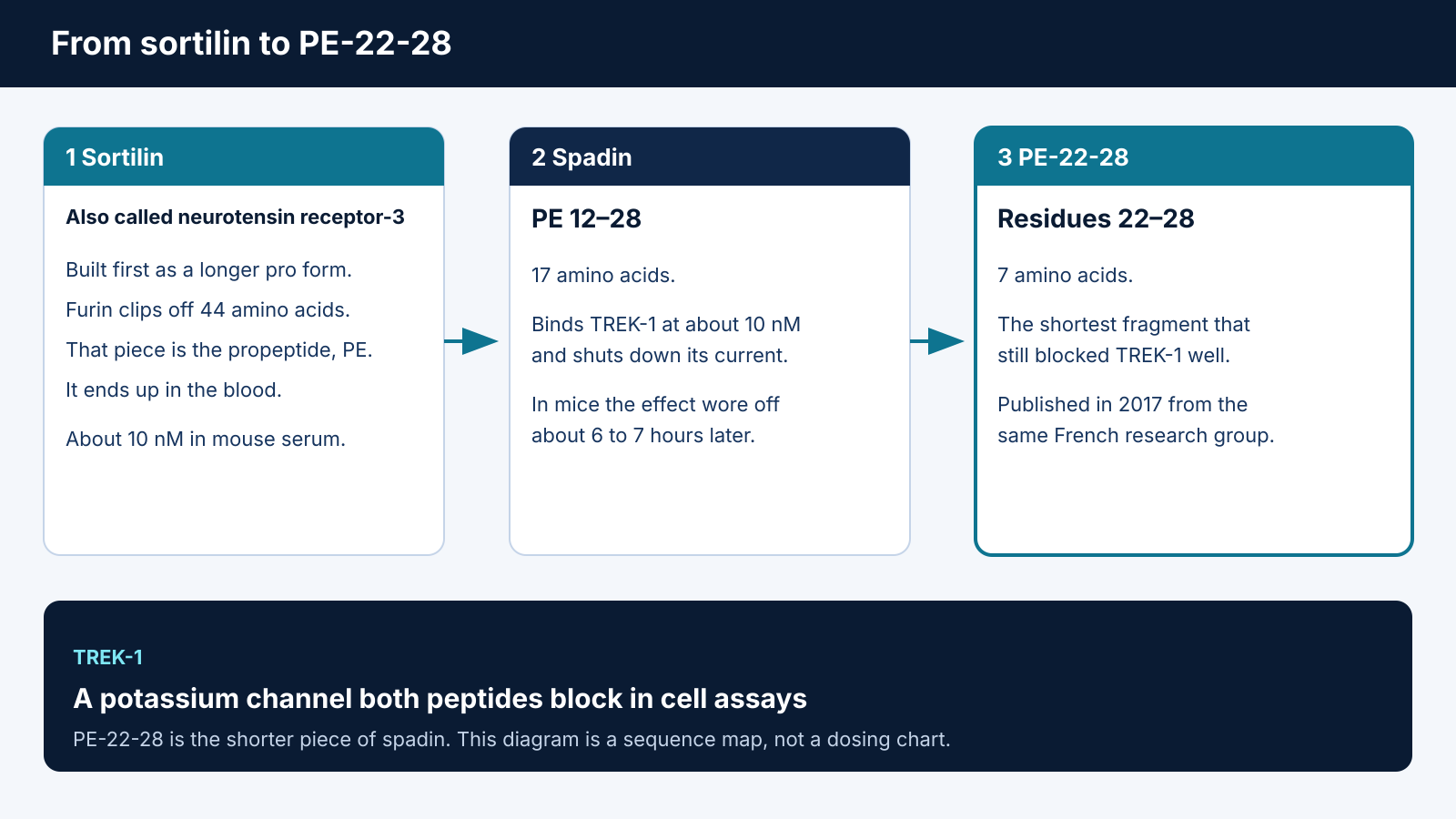
Cells first build sortilin, also called neurotensin receptor-3, as a longer "pro" form. Inside the Golgi apparatus, an enzyme called furin clips off a 44-amino-acid piece from the front end. That piece is the propeptide, or "PE", and it ends up in the blood. Mice carry about 10 nM of it in their serum [2].
Why researchers care about TREK-1
TREK-1 is a potassium channel. In 2006 the same group reported that mice bred without TREK-1 looked depression-resistant across five behavioural models [1]. That made a drug that blocks TREK-1 an obvious thing to look for.
From spadin to PE-22-28
In 2010 the team showed that sortilin and TREK-1 physically interact in neurons. They also found that a 17-amino-acid stretch of the propeptide binds TREK-1 at about 10 nM and shuts down its current. They named it spadin (PE 12-28) [2]. The catch was that in mice its effect wore off about 6 to 7 hours after an injection [1].
So they looked at how spadin breaks down in mouse serum and built shorter fragments. Each one was screened on human TREK-1 channels grown in HEK cells. The shortest one that still worked well was residues 22 to 28. That's PE-22-28, published in Frontiers in Pharmacology in 2017 [1].
PE-22-28 vs spadin
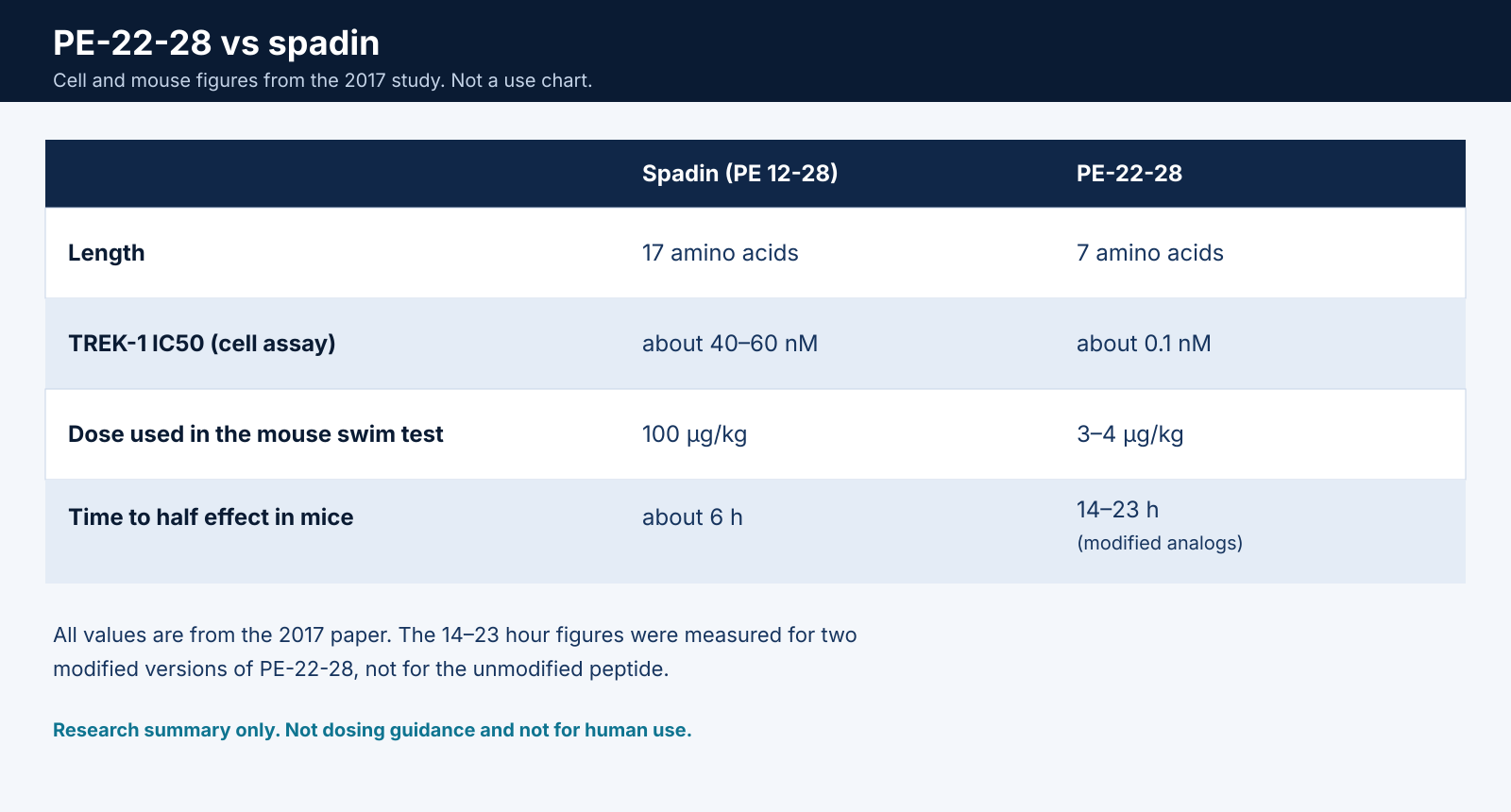
| Spadin (PE 12-28) | PE-22-28 | |
|---|---|---|
| Length | 17 amino acids | 7 amino acids |
| TREK-1 IC50 (cell assay) | about 40–60 nM | about 0.1 nM |
| Dose used in the mouse swim test | 100 µg/kg | 3–4 µg/kg |
| Time to half effect in mice | about 6 h | 14–23 h (modified analogs) |
All values are from [1]. The 14–23 hour figures were measured for two modified versions of PE-22-28, not for the unmodified peptide.
How PE-22-28 has been studied
Everything published so far is preclinical: cell work and mice. Here's what the 2017 study did [1].
Cell assays
TREK-1 blocking: The team switched TREK-1 on with arachidonic acid in human TREK-1/HEK cells and measured the current by patch clamp. Each peptide was tested at 100 nM.
Selectivity: PE-22-28 was checked against four related channels: TREK-2, TRAAK, TRESK and TASK-1. The analogs were also tested at 10 µM on hERG, a key heart channel.
Analogs: The team made 16 variants of PE-22-28. Two went forward with it: G/A-PE-22-28, which has one glycine swapped for alanine, and a biotinylated form of that.
Mouse studies
Animals: male C57Bl/6J mice, 7 to 9 weeks old, usually 10 per group.
Tests: the forced swim test, novelty-suppressed feeding and learned helplessness. There was also a model where 7 weeks of corticosterone brings on depression-like behaviour.
Dosing: one injection into the abdomen (intraperitoneal) of about 3–4 µg/kg, 30 minutes before testing, or the same dose daily for 4 days. Spadin was given at 100 µg/kg for comparison. One group got the peptides by mouth at 1 mg/kg.
New brain cells: after 4 days, they counted newly divided (BrdU-labelled) cells in the hippocampus.
Synapses: they treated cultured mouse neurons with 0.1 µM and tracked PSD-95, a synapse marker, for up to 36 hours.
What the research found
All of these results are from cells and mice [1].
Much stronger TREK-1 blocking. At 100 nM, PE-22-28 cut TREK-1 current by about 55%. Its IC50 was about 0.1 nM, versus 40–60 nM for spadin. That's roughly 300 times more potent.
Selective. It didn't change current through the four related channels at 100 nM, and the analogs didn't affect hERG at 10 µM.
Antidepressant-like behaviour in mice. After one injection, mice spent about 92 seconds immobile in the swim test, versus about 162 seconds on saline. That matched spadin at roughly a thirtieth of the dose. It also worked in the corticosterone and learned-helplessness tests, and when given by mouth.
Fast onset. After 4 days, corticosterone-treated mice started eating sooner in the feeding test. The authors point out that standard antidepressants usually need 3 to 4 weeks to do that in these models.
More new cells. After 4 days there were about 1,736 BrdU-positive hippocampal cells, versus about 899 with saline. That's roughly double.
More synapse protein. PSD-95 in cultured neurons was about twice as high at 36 hours as at 5 hours.
PE-22-28 half-life and stability
This was the whole reason for making PE-22-28. In mice, the swim-test effect of the two modified analogs took 14 to 23 hours to fall by half, depending on the version and dose. Spadin's took about 6 hours [1]. The 23-hour figure is for biotinylated G/A-PE-22-28 at 40 µg/kg.
There's a catch. The authors say the peptides still break down fairly quickly in serum in the test tube. "Lasts longer in mice" isn't the same as a long blood half-life [1].
PE-22-28 side effects: what was and wasn't seen
No toxicology study dedicated to PE-22-28 has been published. Here's what's on record.
The worry: mice lacking TREK-1 are more sensitive to pain, seizures and stroke-type brain injury, so blocking the channel might cause the same problems [3].
Spadin was tested for exactly that. In rodents it didn't change pain responses, seizures triggered by kainate, or brain damage after a focal stroke, even after 3 weeks of treatment. Blood sugar didn't change either. It didn't block the I(Kr) or I(Ks) heart currents and didn't change systolic blood pressure or heart rate [3]. An earlier study found no change in movement over 24 hours or in anxiety-related behaviour [2].
For PE-22-28 itself, the 2017 paper reports no adverse effects. What it actually measured, though, was selectivity: no effect on the four related channels or on hERG [1]. The authors say they "could expect" no side effects because it hits the same targets as spadin. That's a reasonable guess, not a test result.
Bottom line: no harm has been reported in mice, but PE-22-28's safety hasn't been properly studied yet.
Has PE-22-28 been tested in humans?
No published human trials were found. A ClinicalTrials.gov search for "PE-22-28" and for "spadin" turned up zero studies when we checked on November 4, 2026 [4]. Everything above comes from mice and cell cultures.
Where PE-22-28 research could go next
In 2017 the authors said they wanted to move these analogs toward clinical use [1]. They gave five reasons:
it works on a different target from most current antidepressants
it acted within days in animal models
it's highly selective for TREK-1
its effect lasts longer than spadin's
a 7-residue peptide is cheaper to make
Plenty is still unanswered: how well it gets into the brain, full pharmacokinetic and toxicology data, whether the results hold in other species, and whether anyone will run human trials. For now it's a lab tool for studying TREK-1, sortilin-derived peptides and how the brain rewires itself.
Buying PE-22-28 for research in Canada
BlueNex Labs supplies PE-22-28 10mg to researchers for laboratory use only. It's not for human or veterinary use. You can browse the rest of our research peptides, check shipping across Canada, or read our general FAQ.
PE-22-28 FAQ
What is PE-22-28?
It's a 7-amino-acid peptide matching residues 22–28 of the sortilin propeptide. It's a shortened version of spadin (PE 12-28) and was first described in 2017.
Who developed PE-22-28?
The Mazella, Borsotto and Heurteaux group at CNRS's Institut de Pharmacologie Moléculaire et Cellulaire in Valbonne, France.
How does PE-22-28 work on TREK-1?
In cell studies it blocks the TREK-1 potassium channel with an IC50 of about 0.1 nM. It didn't affect the related channels it was tested against.
How is PE-22-28 different from spadin?
It's shorter (7 residues instead of 17) and about 300 times more potent at TREK-1 in cell assays. It worked in mice at much lower doses. Its modified analogs also lasted 14–23 hours to half effect, versus about 6 hours for spadin.
What did PE-22-28 animal studies find?
In mice it produced antidepressant-like behaviour in several standard tests, with effects seen after 4 days. New hippocampal cells roughly doubled. In cultured neurons, the synapse marker PSD-95 also increased.
Does PE-22-28 have side effects?
None were reported in mice. The dedicated side-effect testing was done on spadin, which didn't affect pain, seizures, stroke injury, blood sugar or heart function in rodents. For PE-22-28, the data so far only show that it doesn't act on hERG or the other channels tested.
Has PE-22-28 been tested in people?
No published human trials were found, and ClinicalTrials.gov lists none.
Is PE-22-28 approved for human use?
No. It's sold strictly for laboratory research.
References
1. Djillani A, Pietri M, Moreno S, Heurteaux C, Mazella J, Borsotto M. Shortened Spadin Analogs Display Better TREK-1 Inhibition, In Vivo Stability and Antidepressant Activity. Front. Pharmacol. 2017;8:643. https://doi.org/10.3389/fphar.2017.00643
2. Mazella J, Pétrault O, Lucas G, et al. Spadin, a Sortilin-Derived Peptide, Targeting Rodent TREK-1 Channels: A New Concept in the Antidepressant Drug Design. PLoS Biol. 2010;8(4):e1000355. https://doi.org/10.1371/journal.pbio.1000355
3. Moha Ou Maati H, Veyssiere J, Labbal F, et al. Spadin as a new antidepressant: absence of TREK-1-related side effects. Neuropharmacology. 2012;62(1):278-288. https://pubmed.ncbi.nlm.nih.gov/21807005/
4. ClinicalTrials.gov searches for "PE-22-28" and "spadin" (0 results, November 4, 2026). https://clinicaltrials.gov/search?term=PE-22-28
References
- PMID 21807005
- DOI 10.3389/fphar.2017.00643
- DOI 10.1371/journal.pbio.1000355
Research use only. BlueNex Labs does not provide medical or veterinary advice. Confirm your institution’s policies before purchase. Lot-file rules for this note are on the documentation standards page. By Alice Kay.