
Research · 2025-09-20
Scientific lead: Alice Kay, Ph.D.
What is Selank? Research & mechanisms
Direct answer
Selank is the heptapeptide Thr-Lys-Pro-Arg-Pro-Gly-Pro, a tuftsin analogue with a Pro-Gly-Pro extension. Sequence, literature, and lot identity. Not a Semax page.
Scope
Cognitive & neuroscience models. Sleep-architecture and neuroendocrine peptides discussed in laboratory literature.
Reviewer: Alice Kay, Ph.D., scientific lead. This note does not claim that the reviewer authored any cited paper.
Selank Research Overview
Selank is covered here as a tuftsin-derived heptapeptide in neuromodulation and immune-signaling models. It is a different sequence from the ACTH-derived peptide Semax.
This page provides laboratory-focused information for Selank. Content is intended for research use only and should be read with the published documentation and analytical data.
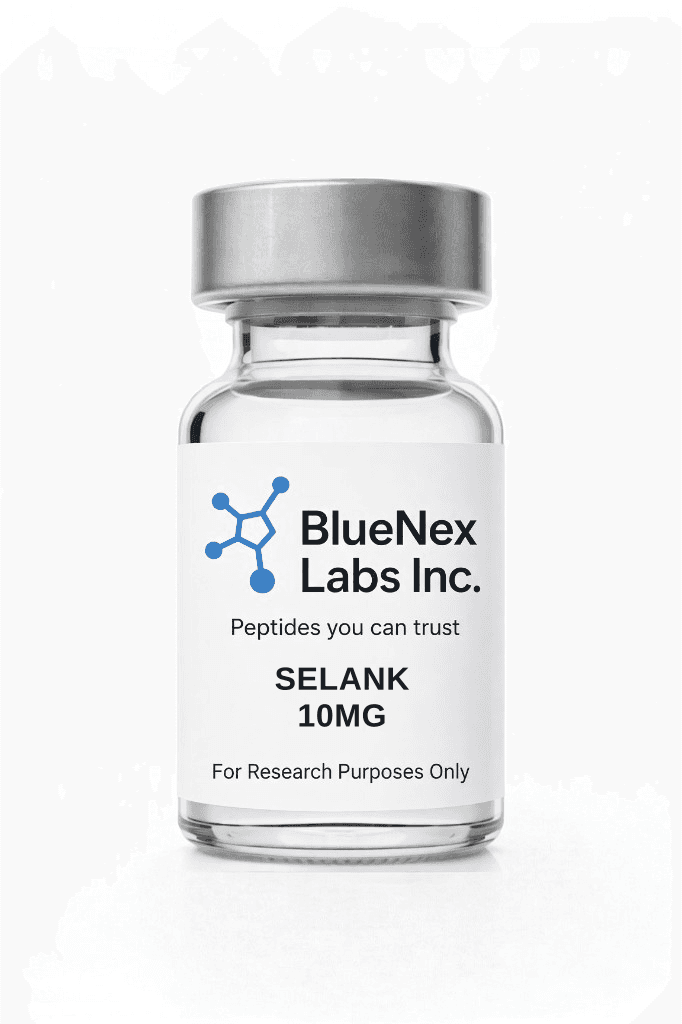
Research-use notice: This article is laboratory and educational information only. It is not medical or legal advice, and it does not include how-to-use instructions. BlueNex Labs materials are research use only and are not intended for human or veterinary use. Research-use-only labelling is not a Health Canada authorization.
Publication status: Prepared for the BlueNex Labs Research Knowledge Centre. Literature and library notes checked September 25, 2026. Primary papers and the public COA library can change; verify the lot report in hand before an assay.
Selank is the synthetic heptapeptide Thr-Lys-Pro-Arg-Pro-Gly-Pro. The first four residues are tuftsin, a fragment of the immunoglobulin G heavy chain that immunologists have used as a phagocytosis-related probe since the 1970s. The C-terminal Pro-Gly-Pro tripeptide is the same stability extension used on Semax, which is why the two names are often ordered together and why they are easy to mix up. They are not the same chain. The shop URL is Selank 10 mg.
Tuftsin versus the heptapeptide
Tuftsin is Thr-Lys-Pro-Arg. Selank adds Pro-Gly-Pro. A paper that uses the tetrapeptide is not a paper about the heptapeptide unless the methods say so. Semenova and colleagues compared the two names on serotonin metabolism in rats pretreated with a serotonin-synthesis inhibitor (PMID 19803361). In that report the heptapeptide and the tetrapeptide did not move the metabolite in the same direction in every region. That single comparison is enough reason to keep two lines in a materials table.
Kozlovskaya and colleagues reviewed short tuftsin-family peptides, including Selank, in stress-behaviour models (PMID 14969422). The review is about adaptive-behaviour assays in animals. It is not a finished-product claim, and BlueNex Labs does not adopt the review's activity wording as catalogue copy.
Later expression papers, including Volkova and colleagues in Frontiers in Pharmacology in 2016, report changes in transcripts related to GABA signalling after Selank in rodent brain. A transcript panel is a molecular readout. It does not authorize a use, and it does not identify the vial. Identity remains the mass.
Analytical data for this SKU only
The September 2026 library row for Selank 10 mg includes a mass and purity link and an endotoxin link at the Selank 10 mg certificate row. Endotoxin is not implied by the HPLC percentage. If a later lot drops the endotoxin test, write "not on this report" rather than carrying the old number forward. Semax, on the Semax 10 mg certificate, is a different peptide. For the reading guide, see how to read a peptide COA, and the endotoxin primer is endotoxin testing on peptide COAs.
Sequence notation on the label should match Thr-Lys-Pro-Arg-Pro-Gly-Pro or the equivalent one-letter string the report uses. A counter-ion, if the PDF names one, is part of the species that was weighed. Do not add an acetate or a trifluoroacetate mass the file does not print.
Cluster navigation without collapsing the sequences
For the ACTH-fragment note, see What is Semax?. For the product page for that other heptapeptide, see Semax 10 mg. DSIP, the historical nonapeptide on the same neuroscience shelf, has its own article and its own vial. Category grouping under cognitive and neuroscience is taxonomy. It is not a combined experiment.
Russian registration history appears in secondary reviews of a finished Selank medicine. Read that as a foreign finished-product story. It is not a DIN, and it is not evidence that a lyophilized research solid is the registered article. For the canadian frame, see Are research peptides legal in Canada?.
Receiving the dry solid
Shipments are lyophilized cakes unless a listing says otherwise. Open the parcel the day it arrives, photograph a broken seal, and move the closed vial into the storage location your SOP names. Weekend and holiday gaps on Canada Post are described in the Vancouver, Toronto, and British Columbia fulfilment FAQ. Interac e-Transfer is the payment rail. The Burnaby desk and the Port Moody PO Box are one domestic operation. Storage practice beyond that sentence is peptide storage for Canadian laboratories.
This note stops before solvent volume. A tuftsin paper's microgram-per-kilogram figures are animal-assay figures. They are not a concentration for a culture well and they are not a personal schedule.
How to describe the heptapeptide in a notebook
Write "Selank" only next to the seven-residue string. If the well contained tuftsin instead, say tuftsin. If the well contained Semax, cite the ACTH fragment and the Semax lot. Shared C-terminal Pro-Gly-Pro is a synthetic habit from one research program. It is not structural identity. A reviewer who sees one certificate attached to both SKUs should reject the file. The certificates library is organized by slug so that rejection is easy to perform.
Endotoxin is its own line
The Selank library row reviewed in September 2026 includes an endotoxin link as well as a mass and purity link. Copy the endotoxin number and the unit if they are printed. If the unit is endotoxin units per milligram or per vial, write the unit the PDF uses. Do not convert it. An HPLC area percent does not imply that number, and a Semax file that lacks an endotoxin line cannot lend one to this SKU.
Sterility is a further test. Unless the PDF says sterility and prints a result, the receiving log should say "sterility not on this report." That sentence is documentation, not a complaint, and it is the same rule the endotoxin primer uses for every peptide on the shelf.
Behaviour papers that report immobility time or sucrose preference in a named rat strain are assay descriptions. Quote the strain and the test if you cite them, and leave the activity adjectives in the paper. A lyophilized 10 mg cake is not the finished nasal solution described in some Russian product reviews. Form is part of identity: dry research solid versus a licensed solution are different articles even when the sequence matches.
When both heptapeptides arrive in one parcel, photograph each cap before the vials leave the shipping box. Write the shop slug on the secondary label. A shared Pro-Gly-Pro tail is the reason the names are confused, and it is also the reason the mass still has to be read twice. The cognitive category page is an index of neighbouring sequences. It is not permission to file one chromatogram under two product URLs.
Frequently asked questions
How is Selank different from Semax?
Selank is the tuftsin-related heptapeptide Thr-Lys-Pro-Arg-Pro-Gly-Pro. Semax is an ACTH-fragment heptapeptide. The sequences are not interchangeable, and their certificates are not interchangeable.
Where is the Selank Certificate of Analysis?
The Selank 10 mg library row includes mass and purity, plus an endotoxin link for the lot reviewed with that SKU. A Semax report does not document this vial.
Is there a Selank product page?
Yes. The 10 mg research fill is a separate shop URL from Semax. This article does not set the price.
Does this note describe personal use?
No. It describes sequence identity, published rodent and culture models, and Canadian laboratory receiving. Research use only.
Catalogue cross-reference
For the buy-intent URL, see Selank 10 mg. Open the Selank library row for mass, purity, and endotoxin on that lot.
Orders ship inside Canada only after Interac e-Transfer checkout. Sold-out SKUs remain listed and cannot be added to the cart. Match each vial to its own Certificate of Analysis when a lot is published. Research use only. Not for human or veterinary use.
References
- PMID 19803361
- PMID 14969422
Research use only. BlueNex Labs does not provide medical or veterinary advice. Confirm your institution’s policies before purchase. Lot-file rules for this note are on the documentation standards page. Scientific lead: Alice Kay, Ph.D.