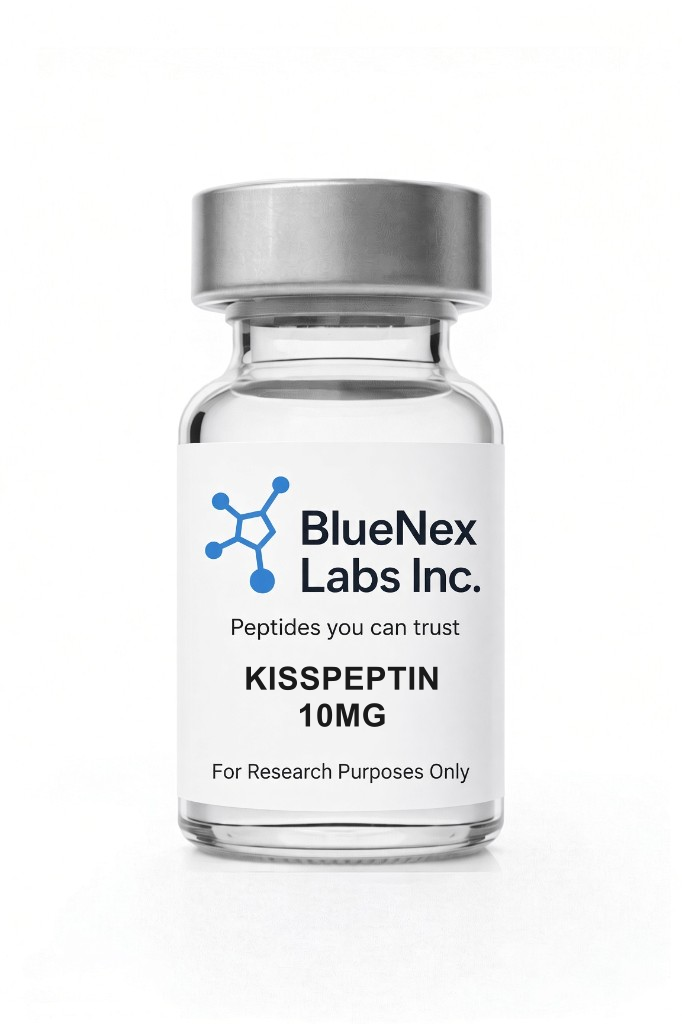
Kisspeptin 10mg Research Peptide Canada
Research use only. Not for human or veterinary use.
Kisspeptin 10mg is listed for neuroendocrine laboratory models. A published Janoshik lot is linked from the certificates library. Research-use only.
Kisspeptin Peptide: Advanced Research Overview, Mechanism, Storage, and Scientific Applications
What Is Kisspeptin?
Kisspeptin is a naturally occurring peptide that serves as one of the most important signaling molecules within the body's neuroendocrine communication network. Encoded by the KISS1 gene, Kisspeptin has become a major focus of modern scientific research due to its role in regulating communication between the brain and reproductive hormone pathways.
Researchers studying endocrine physiology frequently investigate Kisspeptin because it sits near the top of the hormonal signaling hierarchy, acting as a key messenger between the hypothalamus and the downstream pathways associated with reproductive biology, neuroendocrine communication, and hormonal regulation.
Its interaction with the KISS1 receptor (KISS1R/GPR54) has made Kisspeptin one of the most extensively studied peptides in reproductive and endocrine research, with growing scientific interest across multiple disciplines including developmental biology, neuroscience, metabolism, and hormone signaling.
Understanding the Kisspeptin Signaling Pathway
Kisspeptin functions by binding to the KISS1R receptor, a specialized receptor located on neurons involved in hormonal communication. This highly specific interaction initiates a cascade of intracellular signaling events that influence the release of gonadotropin-releasing hormone (GnRH), a critical component of the hypothalamic-pituitary-gonadal (HPG) axis.
Because Kisspeptin operates upstream of several important endocrine signaling pathways, researchers often use it to study:
- Hypothalamic signaling mechanisms
- Neuroendocrine communication networks
- Hormone pulse generation patterns
- Reproductive physiology pathways
- Developmental maturation signaling
- Endocrine feedback regulation
- Cellular receptor activation and signaling
Its targeted mechanism and well-characterized receptor activity make Kisspeptin a valuable tool for controlled laboratory investigations.
Why Researchers Are Interested in Kisspeptin
Scientific interest in Kisspeptin continues to expand due to its unique position within multiple biological systems.
Reproductive Biology Research
Kisspeptin is widely studied for its involvement in reproductive hormone signaling and the regulation of neuroendocrine communication pathways associated with fertility-related research.
Neuroendocrine Research
Researchers frequently utilize Kisspeptin when exploring how the brain coordinates hormonal responses through complex signaling networks.
Hypothalamic-Pituitary-Gonadal (HPG) Axis Studies
As a major upstream regulator of the HPG axis, Kisspeptin remains a central topic in studies involving endocrine communication and hormonal pathway regulation.
Receptor Signaling Investigations
The highly selective interaction between Kisspeptin and KISS1R provides researchers with a useful model for studying receptor-mediated signaling and cellular communication.
Developmental and Physiological Research
Scientists continue investigating the role of Kisspeptin in developmental signaling, neuropeptide interactions, and broader endocrine system dynamics.
Key Characteristics of Kisspeptin
- Naturally occurring neuropeptide
- Encoded by the KISS1 gene
- Specifically targets the KISS1R (GPR54) receptor
- Important component of HPG axis signaling
- Highly researched in endocrine and neuroendocrine science
- Extensively referenced in peer-reviewed literature
- Suitable for advanced laboratory investigations
- Valuable model for studying hormone communication pathways
Common Laboratory Research Applications
Kisspeptin is frequently utilized in studies involving:
Neuroendocrine Communication
Researchers investigate how Kisspeptin facilitates
communication between the nervous system and endocrine axis in vitro. Kisspeptin lots are research-use only.
Storage & Handling
- Store lyophilized material at –20 °C, protected from light and moisture
- Reconstituted solutions: 2–8 °C, short-term laboratory use only
- Avoid repeated freeze–thaw cycles; use sterile technique
Documentation
Batch Certificates of Analysis are listed in the certificates library when published. Match vial size and lot notes before assigning a lot to an assay.
Compliance Notice
Research-use only. Not for human or veterinary use. No medical, cosmetic, or performance claims are made or implied.
Molecular characteristics
- form
- Lyophilized powder
- purity
- ≥99% (COA verified)
- use
- Research use only
Documentation (HPLC / UPLC, MS, COA)
Published lots for this SKU are listed at the exact certificate section. Identity is typically confirmed by mass spectrometry; purity by HPLC / UPLC. A report for another peptide or fill size does not document this vial.
Questions about laboratory procurement? Contact BlueNex Labs.