
Research · 2026-06-16
Scientific lead: Alice Kay, Ph.D.
Tesamorelin gelation in laboratory handling
Direct answer
Why some lyophilized secretagogue sequences self-associate in solution. Physical-chemistry notes for Canadian labs — not a reconstitution protocol.
Scope
Lab practice & storage. Lyophilized handling, temperature and light, degradation, laboratory solvents, and gelation notes.
Reviewer: Alice Kay, Ph.D., scientific lead. This note does not claim that the reviewer authored any cited paper.
Tesamorelin and kisspeptin handling Research Overview
Some GHRH-analog and kisspeptin sequences are discussed in peptide-handling papers because they can self-associate after wetting. This page is that physical-chemistry note, not a reconstitution protocol.
This page provides laboratory-focused information for Tesamorelin and kisspeptin handling. Content is intended for research use only and should be read with the published documentation and analytical data.
Research-use notice: This article is laboratory and educational information only. It is not medical or legal advice, and it does not include how-to-use instructions. BlueNex Labs materials are research use only and are not intended for human or veterinary use. Research-use-only labelling is not a Health Canada authorization.
Publication status: Prepared for the BlueNex Labs Research Knowledge Centre. Literature and library notes checked September 25, 2026. Primary papers and the public COA library can change; verify the lot report in hand before an assay.
Some lyophilized sequences are discussed in peptide-handling papers because they can self-associate after wetting and look viscous, cloudy, or clumped instead of a clear liquid. Tesamorelin and kisspeptin are the two catalogue names this URL inherited for that observation. The observation is physical chemistry. It is not a purity verdict, it is not a failed identity test by itself, and this page is not a preparation method.
Two sequences that are easy to file under one nickname
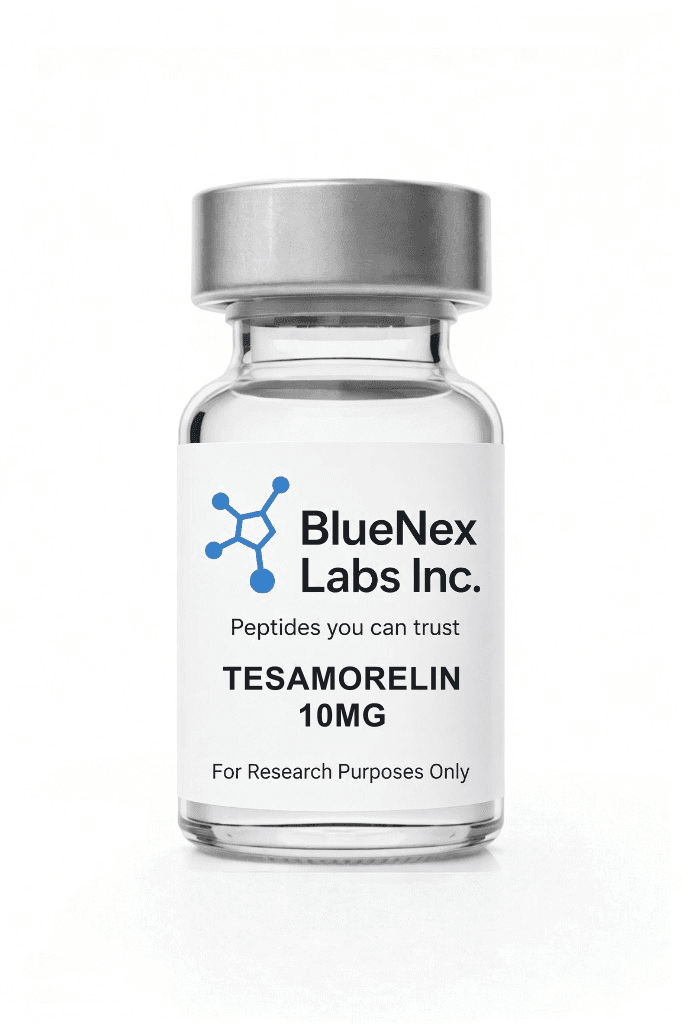
Tesamorelin, as the comparison page records, is GHRH(1-44) amide with a trans-3-hexenoyl group on tyrosine-1. Ferdinandi and colleagues discussed that analogue in 2007 (PMID 17214611). The fatty acyl group changes the mass relative to unmodified GHRH(1-44) and adds a hydrophobic mark at the N terminus. Sermorelin is the 29-residue amide without that acyl group. The masses are not interchangeable. For the comparison, see sermorelin versus tesamorelin. For the sequence notes, see tesamorelin and sermorelin. For the shop URLs, see tesamorelin 10 mg and sermorelin 10 mg.
Kisspeptin-10, on this site, is the amidated human decapeptide YNWNSFGLRF-NH2. Kirby and colleagues, in Pharmacological Reviews in 2010, describe kisspeptins as Arg-Phe amide peptides at the kisspeptin receptor, formerly GPR54 (PMID 21079036). That citation is receptor class. It is not a wetting method. For the laboratory note, see kisspeptin-10. The shop URL is kisspeptin 10 mg. A GHRH analogue and a KISS1R ligand do not share a certificate because both have been discussed next to a gel.
What self-association is, and what it is not
Published peptide-handling literature attributes gelation and aggregation to sequence-dependent properties: hydrophobic stretches, beta-sheet propensity, concentration, pH, temperature, and how a dry cake is wetted. An N-terminal fatty acyl group, as on tesamorelin, is one chemical reason a chain can behave differently from the unmodified amide of the same length. A short amphipathic decapeptide can be discussed in the same physical-chemistry paragraph for a different reason. Shared paragraph is not shared molecule.
A clear liquid is not proof of identity. A viscous liquid is not proof that the mass was wrong. Identity remains the observed mass compared with the mass calculated for the sequence and the species the report names. Chromatographic area percent is a separate question. Read how to read a peptide COA and purity versus identity. If the cake arrived wet, with a broken seal, or with a label that does not match the packing list, quarantine it. Appearance after a deliberate wetting step in your own SOP is a handling note in that SOP. This page does not supply the step.
Lot files stay separate
Tesamorelin 10 mg has library links, including mass and endotoxin, under its own anchor when you open the certificates library and match the sample name. Kisspeptin 10 mg has its own row in the certificates library. A gelation anecdote does not let one PDF cover both vials. Sermorelin is a third file. Sermorelin's documentation does not cover tesamorelin just because the literature calls both peptides "GHRH" analogues. The receiving log is in peptide storage for Canadian laboratories: product name, labelled amount, lot, receipt date, storage location, report URL, and whether the sample name matched.
Leave the vial sealed until the assay. Residual water is the stability risk for a lyophilized peptide. A gel observed after wetting is a solution phenomenon. It does not tell you to heat the dry vial, and it does not tell you a concentration. Solvent choice, if the SOP names one, is the SOP's. Bacteriostatic water is a glossary entry for a reagent, not a volume for these vials.
Canada fulfilment, stated once
Both SKUs ship inside Canada after Interac e-Transfer, on Canada Post Xpresspost. The desk is in Burnaby. Labels use a Port Moody PO Box. For the note, see Canada laboratory procurement. Research-use-only labelling is not a Health Canada authorization. See Are research peptides legal in Canada?. How batch reports are published is on documentation standards. The scientific lead record is Alice Kay, Ph.D.
What the notebook should say
If a solution looked viscous, write the shop slug, the lot, the solvent the SOP named, the approximate concentration the SOP named, the temperature, and the time. Name each peptide in full rather than writing "the blend" or "the GHRH," and keep kisspeptin notes on the kisspeptin line, separate from tesamorelin. Neither note applies to sermorelin. Then point the file at the lot report, not at this article, for identity. This URL explains why the observation exists in the handling literature. It does not rank the vials, and it does not replace the mass.
A receiving line that survives a cloudy vial
Photograph the dry cake before any wetting the SOP calls for, and photograph the label in the same frame as the cap. If the cake arrived already wet, stop. Quarantine is a labelled box that is not the working stock. Write one sentence that says the seal or the cake failed the receipt check. Do not decide from that sentence that the mass was wrong, and do not decide that a clear solution later proves the mass was right. Identity remains the report.
Tesamorelin's hexenoyl group is a hydrophobic mark. Kisspeptin's decapeptide can be discussed for amphipathic self-association. Those are two chemical reasons a liquid can look viscous. They are not a reason to share a certificate, and they are not a reason to apply either sentence to sermorelin's 29-residue amide. The desk is 4309 Canada Way, Burnaby, BC V5G 1J3. Labels use a Port Moody PO Box. Put the order number in the Interac message field. Sold-out status on either 10 mg card is inventory. It does not merge the sequences.
Frequently asked questions
Does a cloudy or viscous appearance after wetting prove the lot failed identity?
No. Self-association is a physical-chemistry observation discussed for some sequences. Identity is still the mass on that lot's report. Quarantine a wet cake that arrived already compromised, and do not decide identity by eye.
Does this page list a solvent volume for tesamorelin or kisspeptin?
No. It records why gelation is discussed for these sequences. Solution preparation belongs in the laboratory SOP. This page is not a preparation method.
Are sermorelin and tesamorelin the same gelation case?
No. Tesamorelin is the 44-residue GHRH amide with an N-terminal hexenoyl group. Sermorelin is the 29-residue amide without that acyl group. The comparison page keeps the masses apart. This note does not merge them.
Which catalogue URLs does the gelation note cover?
Tesamorelin 10 mg and kisspeptin 10 mg. Each keeps its own lot file. A shared observation about wetting does not make one certificate cover the other.
Catalogue cross-reference
Catalogue URLs: tesamorelin 10 mg and kisspeptin 10 mg. Gelation notes are physical chemistry, not a preparation method. Match each lot file separately.
Orders ship inside Canada only after Interac e-Transfer checkout. Sold-out SKUs remain listed and cannot be added to the cart. Match each vial to its own Certificate of Analysis when a lot is published. Research use only. Not for human or veterinary use. This page is not a protocol.
References
- PMID 17214611
- PMID 21079036
Research use only. BlueNex Labs does not provide medical or veterinary advice. Confirm your institution’s policies before purchase. Lot-file rules for this note are on the documentation standards page. Scientific lead: Alice Kay, Ph.D.