
Research · 2026-08-24
Scientific lead: Alice Kay, Ph.D.
Retatrutide trial literature and lot COAs
Direct answer
Educational overview of investigational retatrutide as a GLP-1/GIP/glucagon receptor agonist in public clinical programs. Not a catalogue page and not an approval.
Scope
Metabolic & energy-signaling models. Incretin, mitochondrial, and secretagogue literature. These notes summarize published models — they are not catalog pages.
Reviewer: Alice Kay, Ph.D., scientific lead. This note does not claim that the reviewer authored any cited paper.
Retatrutide trial literature Research Overview
Public trial programmes discuss retatrutide as an investigational incretin-receptor ligand. This page is that literature note. It is not a catalog listing and it is not an approval.
This page provides laboratory-focused information for Retatrutide trial literature. Content is intended for research use only and should be read with the published documentation and analytical data.
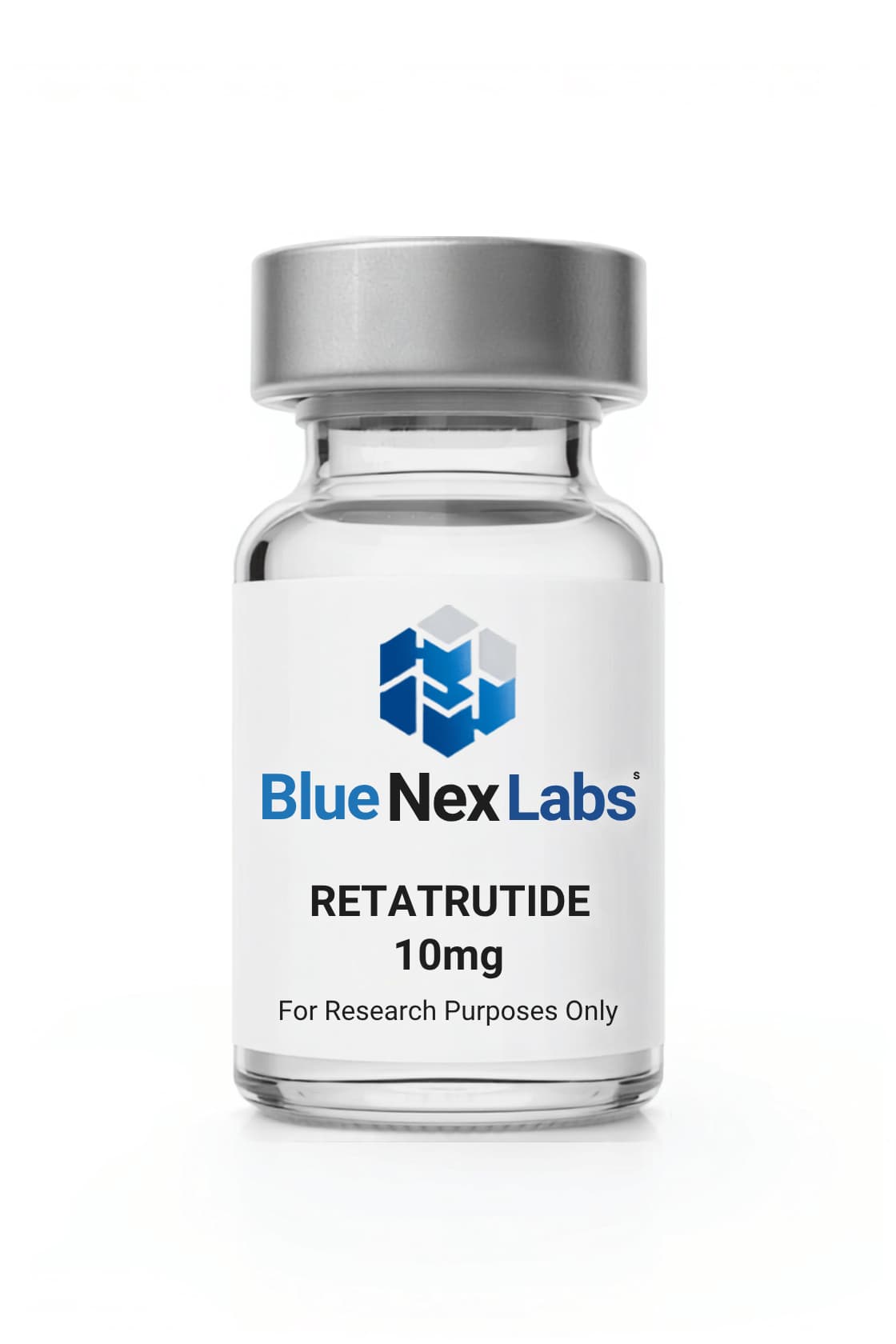
Research-use notice: This article is laboratory and educational information only. It is not medical or legal advice, and it does not include how-to-use instructions. BlueNex Labs materials are research use only and are not intended for human or veterinary use. Research-use-only labelling is not a Health Canada authorization.
Publication status: Prepared for the BlueNex Labs Research Knowledge Centre. Literature and library notes checked September 25, 2026. Primary papers and the public COA library can change; verify the lot report in hand before an assay.
Retatrutide is the investigational peptide code LY3437943. Published descriptions call it a single chain with agonist activity at three receptors: glucose-dependent insulinotropic polypeptide (GIP), glucagon-like peptide-1 (GLP-1), and glucagon. The lyophilized research fills are separate listings: retatrutide 10 mg, retatrutide 20 mg, and retatrutide 30 mg. This page is the literature note. It is not an authorization and it is not a method.
Receptor class, stated narrowly
A triple-agonist label is a pharmacology sentence. It means the molecule is discussed as engaging three named receptors, not that every catalogue vial has been run through a receptor panel by BlueNex Labs. The incretin-receptor ligand glossary line is the class definition. The comparison page semaglutide, tirzepatide, and retatrutide separates the three catalogue families. Semaglutide is filed as a GLP-1 receptor ligand. Tirzepatide is filed as a dual GLP-1 and GIP ligand. Retatrutide is the triple-receptor name. Those sentences are how papers name the molecules. They are not measurements of the cake in a given vial.
For the longer class note, see GLP-1 peptide research in 2026. Pathway landings such as metabolic research peptides group purchasing cards. They do not merge certificates.
Two phase 2 papers, kept as papers
Jastreboff and colleagues reported a phase 2 randomized program of retatrutide in adults without type 2 diabetes in the New England Journal of Medicine in 2023 (PMID 37366315, ClinicalTrials.gov NCT04881760). The publication compared several weekly dose arms over 48 weeks; see the cited paper for its design. The primary endpoint in that paper is percent change in body mass at 24 weeks, with a further readout at 48 weeks. Those figures belong to the sponsor's cohort and the sponsor's drug product. They are not a BlueNex Labs specification, and this catalogue does not copy the weekly amounts into a purchasing form or a laboratory SOP.
Rosenstock and colleagues reported a separate phase 2 program in adults with type 2 diabetes in The Lancet in 2023 (PMID 37385280). That paper compares retatrutide with placebo and with an active control in a defined glucose-marker cohort. A diabetes-program endpoint is not evidence about a lyophilized research solid, and it is not a Health Canada notice of compliance. Read both papers as sponsor science. Read Are research peptides legal in Canada? before a purchasing office treats a research vial as the investigational article.
Uncited sponsor endpoint figures are not restated here. For the status note, see retatrutide FDA status and TRIUMPH. Neither this page nor that status note sells a vial. A committee timeline in the United States does not change Canadian drug authorization.
What a laboratory should copy from a paper, and what it should not
A method file that cites PMID 37366315 should cite the endpoint, the cohort, and the fact that the material was the sponsor's product. It should not paste the weekly milligram arms onto a research-use vial as if the numbers were a protocol. Concentrations in a cell assay, if your institution runs one, belong in the SOP you wrote, with the lot mass you measured. This article does not supply those concentrations.
Fatty-diacid modification and a multi-day half-life are pharmacokinetic statements in the sponsor literature. They explain why a weekly schedule appears in a trial protocol. They do not describe the lyophilized cake, the cap colour, or the HPLC area percent on a Janoshik row.
Analytical data are cap-specific
The certificates library, reviewed with the September 2026 lot list, publishes one retatrutide row per fill: the Retatrutide 10 mg certificate row for the blue cap, the Retatrutide 20 mg certificate row for the purple cap, and the Retatrutide 30 mg certificate row for the pink cap. Mass and purity links are not interchangeable across caps. Some rows also list an endotoxin result. An endotoxin line on one cap does not extend to another cap. What is a peptide COA in Canada? states the rule: one batch, one document. How to read a peptide COA separates an HPLC percentage from a mass.
If the report names a salt, an adduct, or a counter-ion, copy that species into the study file. If the PDF does not print a free-peptide mass, leave that field blank. The receiving log in peptide storage for Canadian laboratories is where the cap colour, the milligrams, and the report URL belong.
Canada fulfilment, once
The fills ship inside Canada only, after Interac e-Transfer. The desk is in Burnaby. Canada Post Xpresspost labels use a Port Moody PO Box. Standard shipping and the free-shipping threshold are the figures on the FAQ and on the provincial fulfilment note. Our parcels are not picked up on weekends or statutory holidays. A Friday payment can wait until the next operating day for the first scan. That is a carrier fact, not a transit guarantee.
Records that keep the trial paper and the vial apart
Use two identifiers. The literature identifier is the PMID and the trial registry number. The catalogue identifier is the shop slug, the milligram size, the cap, and the library URL. Mixing them into one screenshot is how a purchasing packet starts to look like a clinical protocol. BlueNex Labs does not provide that protocol. Sold-out sizes stay visible and cannot be added to the cart.
Neighbour SKUs on the same metabolic shelf, tirzepatide, semaglutide, and cagrilintide, have their own notes and their own reports when a lot is published. A retatrutide chromatogram does not document those vials.
Cap colour is part of the lot identity
The public library names cap colours beside the milligram fills: a blue cap on one retatrutide size, a purple cap on another, a pink cap on the third, under the batch notes printed with those rows. Cap colour is a handling cue. It is not a purity result. If two vials share a cap colour and differ in milligrams, the milligram line on the label still controls. If a later batch changes the cap, the new row controls, and the September 2026 description does not travel forward automatically.
Write the task identifier from the Janoshik page into the study file next to the cap. A group mass file, when the library lists one, is still a separate document from the size-specific file. Do not average them. The lot-verification checklist is the short version of that match. Provincial delivery timing does not change which PDF is valid. It only changes when the sealed vial reaches the bench.
Frequently asked questions
Is the retatrutide research note a catalogue page?
No. Milligram fills, CAD price, and stock are on the 10 mg, 20 mg, and 30 mg product URLs. This note summarizes published trial literature and how a laboratory matches a cap colour to a lot report.
Does a published trial authorize a lyophilized retatrutide vial in Canada?
No. A sponsor program and a research-use-only catalogue lot are different records. Research-use-only labelling is not a Health Canada authorization and it does not create a Drug Identification Number.
Where are retatrutide Certificates of Analysis?
Each fill has its own report: the Retatrutide 10 mg certificate, the Retatrutide 20 mg certificate, and the Retatrutide 30 mg certificate. A 10 mg report does not document a 30 mg vial. Open the file that names the cap and the milligrams in hand.
How does BlueNex Labs fulfil a retatrutide order in Canada?
Checkout uses a Canadian address and Interac e-Transfer. Parcels move on Canada Post Xpresspost. The desk is in Burnaby, and the sender line uses a Port Moody PO Box. The catalogue does not ship outside Canada.
Catalogue cross-reference
Milligrams and CAD price stay on retatrutide 10 mg, retatrutide 20 mg, and retatrutide 30 mg. Match the pink-cap certificate, or the blue-cap and purple-cap rows, before the vial enters a study file.
Orders ship inside Canada only after Interac e-Transfer checkout. Sold-out SKUs remain listed and cannot be added to the cart. Match each vial to its own Certificate of Analysis when a lot is published. Research use only. Not for human or veterinary use.
References
- PMID 37366315
- PMID 37385280
Research use only. BlueNex Labs does not provide medical or veterinary advice. Confirm your institution’s policies before purchase. Lot-file rules for this note are on the documentation standards page. Scientific lead: Alice Kay, Ph.D.