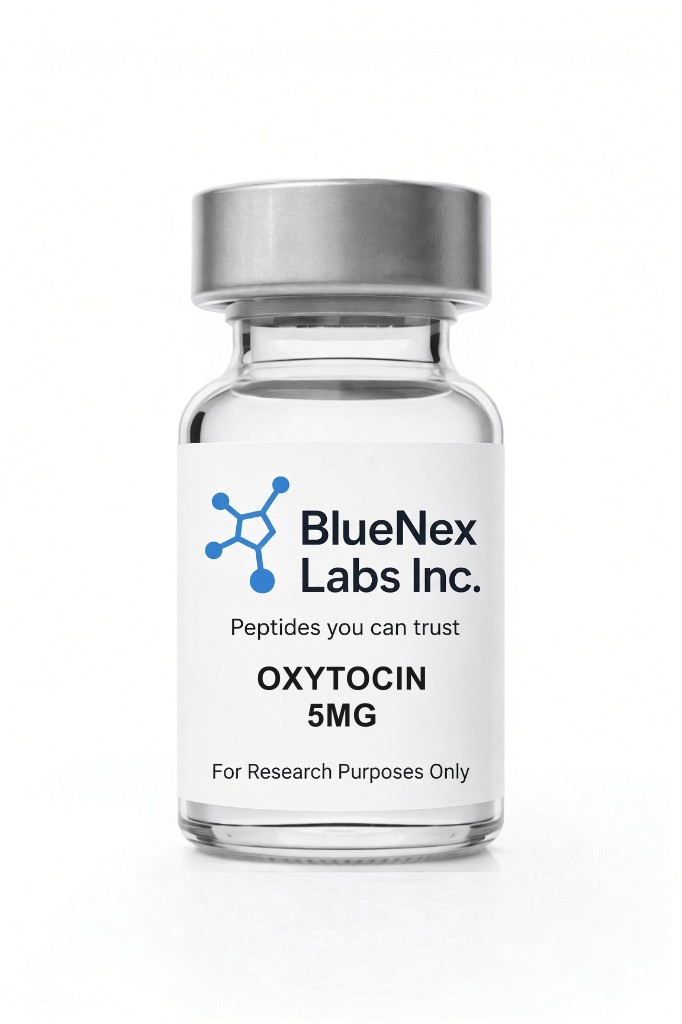
Oxytocin 5mg Research Peptide Canada
Research use only. Not for human or veterinary use.
Oxytocin 5mg is catalogued for OXTR-binding laboratory models. This page is not a behavioural or clinical product listing. Research-use only.
🧬 Oxytocin (5mg) — High‑Purity Neuropeptide for Social‑Behavior, Stress‑Response & Receptor‑Signaling Research
Oxytocin (5mg) is a research-grade synthetic nonapeptide that replicates the naturally occurring oxytocin sequence found in mammals. As one of the most extensively studied peptide hormones in modern scientific literature, Oxytocin is widely utilized in laboratory investigations involving receptor biology, cellular communication, neuroendocrine signaling, and peptide-mediated molecular interactions.
Its well-characterized biochemical profile and highly specific interaction with the oxytocin receptor (OXTR) have made it a valuable model peptide for researchers seeking to better understand cellular signaling mechanisms, receptor activation dynamics, and complex communication networks within biological systems.
BlueNexLabs supplies high-purity Oxytocin (5mg) to research facilities across Canada, including Vancouver, Calgary, Edmonton, Toronto, Ottawa, Montreal, Winnipeg, Halifax, and Quebec City.
🔍 What Is Oxytocin?
What Is Oxytocin?
Oxytocin is a cyclic peptide composed of nine amino acids linked together by a characteristic disulfide bond. This compact molecular structure contributes to its stability and receptor specificity, making it a frequently studied compound within neuropeptide and receptor signaling research.
Because its biological pathways have been thoroughly characterized, Oxytocin is regularly used as a reference molecule in laboratory studies focused on cellular communication systems, peptide-receptor interactions, molecular signaling networks, and neuroendocrine pathway analysis.
- Oxytocin receptor (OXTR) interaction studies
- Neuropeptide signaling investigations
- Cellular communication research
- Receptor activation and regulation analysis
- Signal-transduction pathway mapping
- Molecular pharmacology research
- Comparative peptide science
📡 Mechanistic Overview
🔷 Neuromodulatory & Behavioral Signaling
- Referenced in studies involving social‑behavior pathways
- Supports mapping of OXTR‑mediated signaling cascades
- Used in models examining peptide‑driven neuromodulation
🔶 Stress‑Response & Adaptation Pathways
- Applied in research involving stress‑response markers
- Supports investigations into cellular resilience and adaptive signaling
- Used in multi‑pathway neuroendocrine modeling
🔵 Peptide–Receptor Interaction Dynamics
- Examined in OXTR‑binding affinity studies
- Supports structural‑interaction modeling and receptor‑activation mapping
- Used in comparative studies vs. other neuropeptide analogs
🧱 Molecular Characteristics
Oxytocin remains one of the most recognizable research peptides due to its simple structure, established receptor selectivity, and extensive scientific history. Its molecular properties make it suitable for both biological and analytical laboratory investigations.
- Peptide Class: Cyclic Nonapeptide
- Format: Lyophilized Powder
- Fill Amount: 5mg per vial
- Molecular Formula: C43H66N12O12S2
- Molecular Weight: Approximately 1007 Da
- Identity: Matches endogenous Oxytocin sequence
- Research Designation: Research Use Only (RUO)
Oxytocin Receptor (OXTR) Research
One of the primary areas of Oxytocin research involves its interaction with the oxytocin receptor (OXTR), a G-protein coupled receptor associated with multiple cellular signaling pathways. Researchers frequently utilize Oxytocin when examining receptor activity, binding characteristics, intracellular messenger systems, and downstream signaling events.
- Receptor-binding affinity studies
- Ligand-receptor interaction analysis
- Receptor activation mechanisms
- Signal-transduction pathway evaluation
- Comparative peptide-receptor investigations
- Cellular response profiling
Research Focus Areas
Oxytocin is referenced in OXTR-binding, ligand–receptor, and signal-transduction models. Those assays stay in the laboratory. This vial is not a behavioural or clinical product.
Storage & Handling
- Store lyophilized material at –20 °C, protected from light and moisture
- Reconstituted solutions: 2–8 °C, short-term laboratory use only
- Avoid repeated freeze–thaw cycles; use sterile technique
Documentation
Batch Certificates of Analysis are listed in the certificates library when published. Match vial size and lot notes before assigning a lot to an assay.
Compliance Notice
Research-use only. Not for human or veterinary use. No medical, cosmetic, or performance claims are made or implied.
Vial size
$30.00CAD
46 in stock · SKU OXY510252025-1
Molecular characteristics
- form
- Lyophilized powder
- purity
- ≥99% (COA verified)
- use
- Research use only
Documentation (HPLC / UPLC, MS, COA)
Batch Certificates of Analysis are added to the certificates library when published. This page does not invent lot numbers.
Questions about laboratory procurement? Contact BlueNex Labs.