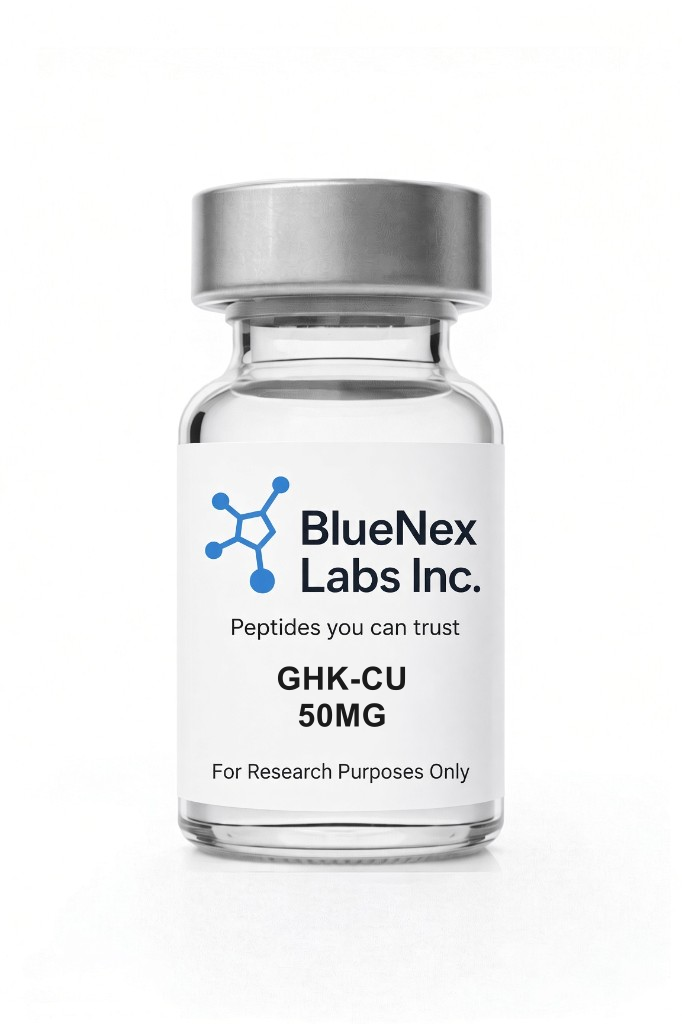
GHK-Cu 50mg Research Peptide Canada
Research use only. Not for human or veterinary use.
GHK-Cu 50mg is the lyophilized copper-binding tripeptide listed for Canadian laboratory purchase. Open the GHK-Cu certificate anchor for published lots, then add the 50mg fill to cart. Research-use only.
🧬 GHK‑Cu Peptide — 50 mg
High‑Purity Copper‑Binding Tripeptide for Regenerative Signaling, Gene Expression & Cellular Repair Research
GHK‑Cu (glycyl‑L‑histidyl‑L‑lysine copper complex) is a high‑purity, research‑grade copper‑binding tripeptide widely referenced in laboratory research involving gene‑expression regulation, extracellular‑matrix (ECM) remodeling, cellular‑repair signaling, and copper‑dependent biochemical pathways.
Supplied by BlueNexLabs, GHK‑Cu is provided as a lyophilized peptide (50 mg) with COA‑verified purity, analytical consistency, and audit‑safe Research‑Use‑Only (RUO) labeling, supporting reproducible experimental workflows across Canadian research environments.
🔬 Overview of GHK‑Cu in Research Settings
GHK‑Cu is a naturally occurring copper‑binding peptide complex originally identified in human plasma and frequently used as a model compound in studies examining how copper availability influences cellular signaling and transcriptional activity. In controlled laboratory settings, GHK‑Cu is commonly referenced in research involving:
- Gene‑expression and transcriptional‑cascade modulation
- Extracellular‑matrix organization and collagen‑associated signaling
- Cellular repair and structural remodeling pathways
- Oxidative‑stress response and cellular‑resilience mechanisms
- Peptide–metal binding and copper‑transport dynamics
Its strong affinity for copper ions and broad mechanistic scope make GHK‑Cu a valuable tool for regenerative‑signaling and peptide‑metal interaction research.
🧪 What Is GHK‑Cu?
GHK‑Cu is a glycyl‑L‑histidyl‑L‑lysine tripeptide complexed with Cu²⁺ ions and used in laboratory research involving:
- Copper‑dependent enzymatic and regulatory pathways
- Gene‑expression and transcriptional‑network studies
- ECM remodeling and collagen‑associated signaling models
- Oxidative‑stress and inflammatory‑marker assays
- Peptide–metal binding kinetics and interaction analysis
- Cellular repair and tissue‑modeling environments
Its well‑characterized binding behavior supports predictable performance in controlled in‑vitro and preclinical systems.
📡 Mechanistic Research Overview (Audit‑Safe)
🧬 Gene Expression & Transcriptional Modulation
- Referenced in studies examining ECM‑related gene networks
- Used in mapping transcriptional‑cascade and regulatory activity
- Supports modeling of copper‑dependent signaling pathways
🧱 Extracellular Matrix & Structural Remodeling
- Applied in research involving collagen‑associated markers
- Supports fibroblast‑activity and ECM‑organization studies
- Used in multi‑pathway tissue‑remodeling research models
⚖️ Oxidative Stress & Cellular Resilience
- Examined in oxidative‑stress and adaptation assays
- Supports investigations into cellular‑repair signaling
- Used in comparative studies versus non‑metal‑binding peptides
🧱 Molecular & Chemical Characteristics
Type: Copper‑binding tripeptide (GHK‑Cu)
Form: Lyophilized powder
Fill Size: 50 mg
Origin: Naturally occurring peptide sequence
Identity Verification: Mass Spectrometry (MS)
Purity Analysis: HPLC / UPLC
Structural & Biochemical Notes
- Demonstrates strong affinity for Cu²⁺ ions
- Predictable behavior in peptide–metal interaction studies
- Sensitive to oxidation and hydrolysis following reconstitution if improperly handled
🔬 Research Focus Areas
GHK‑Cu is commonly referenced in laboratory research involving:
- Gene‑expression and transcriptional‑cascade modeling
- ECM remodeling and fibroblast‑activity studies
- Oxidative‑stress and inflammatory‑marker assays
- Copper‑binding and metal‑transport investigations
- Cellular‑repair and structural‑remodeling environments
- Multi‑pathway regenerative‑signaling research
Its broad mechanistic relevance supports controlled, pathway-specific laboratory workflows. GHK-Cu is supplied as a research ligand, not as a cosmetic finished good or a medicine.
Storage & Handling
- Store lyophilized material at –20 °C, protected from light and moisture
- Reconstituted solutions: 2–8 °C, short-term laboratory use only
- Avoid repeated freeze–thaw cycles; use sterile technique
Documentation
Batch Certificates of Analysis are listed in the certificates library when published. Match vial size and lot notes before assigning a lot to an assay.
Compliance Notice
Research-use only. Not for human or veterinary use. No medical, cosmetic, or performance claims are made or implied.
Molecular characteristics
- form
- Lyophilized powder
- purity
- ≥99% (COA verified)
- use
- Research use only
Documentation (HPLC / UPLC, MS, COA)
Published lots for this SKU are listed at the exact certificate section. Identity is typically confirmed by mass spectrometry; purity by HPLC / UPLC. A report for another peptide or fill size does not document this vial.
Questions about laboratory procurement? Contact BlueNex Labs.