
Research · 2025-09-21
Scientific lead: Alice Kay, Ph.D.
What is AOD-9604? hGH-fragment research
Direct answer
AOD-9604 is a synthetic C-terminal fragment of human growth hormone discussed in mouse lipid-metabolism papers. This site has no AOD-9604 catalogue vial.
Scope
Metabolic & energy-signaling models. Incretin, mitochondrial, and secretagogue literature. These notes summarize published models — they are not catalog pages.
Reviewer: Alice Kay, Ph.D., scientific lead. This note does not claim that the reviewer authored any cited paper.
AOD-9604 Research Overview
AOD-9604 is a modified C-terminal fragment of human growth hormone discussed in adipocyte lipolysis models. This site has no AOD-9604 catalog vial.
This page provides laboratory-focused information for AOD-9604. Content is intended for research use only and should be read with the published documentation and analytical data.
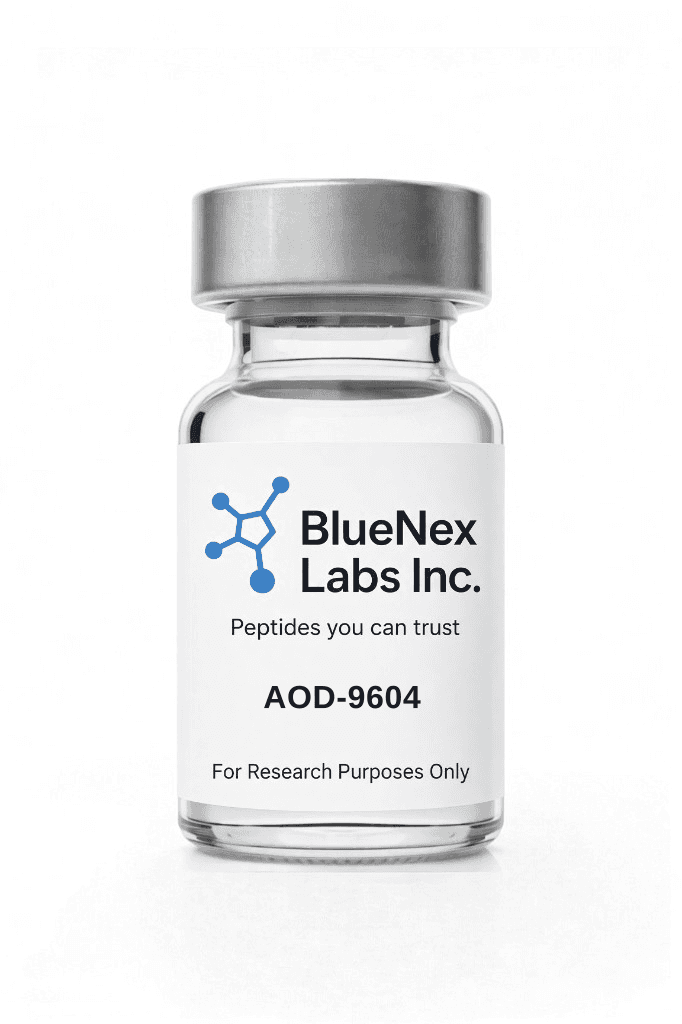
Research-use notice: This article is laboratory and educational information only. It is not medical or legal advice, and it does not include how-to-use instructions. BlueNex Labs materials are research use only and are not intended for human or veterinary use. Research-use-only labelling is not a Health Canada authorization.
Publication status: Prepared for the BlueNex Labs Research Knowledge Centre. Literature and library notes checked September 25, 2026. Primary papers and the public COA library can change; verify the lot report in hand before an assay.
AOD-9604 is a name used in the growth-hormone fragment literature for a synthetic piece of the C-terminus of human growth hormone. Heffernan, Ng, and colleagues describe it as residues 177–191 with an added N-terminal tyrosine, prepared by solid-phase synthesis and checked by mass spectrometry and amino-acid analysis in their own laboratory (PMID 11713213). There is no AOD-9604 shop SKU on this site. This page does not offer a vial, a price, or a certificate.
The fragment is not full-length growth hormone
Mature human growth hormone is a 191-residue protein. A 16-residue C-terminal analogue is a different molecule, with a different mass, a different receptor question, and a different analytical file. Papers from the Monash group asked whether that short sequence could be separated, in mouse adipose assays, from the growth-promoting activity of the intact hormone. The 2001 Endocrinology paper reports lipid-oxidation and adipose-mass readouts in obese mice and in beta-3 adrenergic-receptor knockout mice, and it reports that the fragment raised beta-3 receptor RNA without requiring that receptor for every acute readout. Those are mouse endpoints. This note does not translate them into a catalogue claim, and it does not quote the paper's consumer-facing wording.
An earlier methods note from the same circle, often cited as Ng and colleagues in Hormone Research in 2000, discusses the synthetic lipolytic domain under the same AOD9604 code. Cite the assay: adipose tissue in a mouse, an oxidation measurement, a knockout control. Do not collapse those systems into a single attribute of a powder.
Why this page refuses a shop URL
BlueNex Labs lists research solids it actually sells. AOD-9604 is not among them. Inventing a product URL, a price, or a Janoshik identifier would be a false record. If a purchasing office needs a growth-hormone secretagogue that is on the catalogue, the live vials are CJC-1295 without DAC with ipamorelin, ipamorelin 10 mg, sermorelin, and tesamorelin. Those sequences act at GHRH or ghrelin receptors in the literature. They are not the 177–191 fragment, and their certificates do not identify it.
For the class hub, see secretagogue research peptides. For the educational neighbour that groups published muscle-biology models without a fitness protocol, see peptides in muscle-biology laboratory models. Follistatin-344 and IGF-1 LR3 are also research-note only: follistatin-344 and IGF-1 LR3.
What an external analytical file would still have to show
This section is a reading rule for a report someone else might hand you. It is not a promise that BlueNex Labs will stock the fragment. A usable file names the sequence, including the extra tyrosine if that is the construct, the observed mass, the purity method, and the lot. A screenshot that shows only a percentage is not that file. What is a peptide COA? and how to read a peptide COA apply to any peptide lot, including lots this shop does not sell.
A tesamorelin mass, a sermorelin chromatogram, or a CJC-1295 combination report does not document AOD-9604. The certificates library has no AOD-9604 anchor. Absence is the honest state.
Legal category
When a growth-hormone fragment is advertised for human administration, Canadian drug rules are in play regardless of a research-use label. For the summary, see Are research peptides legal in Canada?. Anti-doping lists can also name growth-hormone fragments. This article does not advise athletes and does not describe administration. It records why the fragment is discussed in adipocyte papers and why this catalogue stops at the discussion.
Handling language without a vial
General lyophilized-peptide receiving, for materials this site does sell, is in peptide storage for Canadian laboratories. Interac checkout, Canada Post Xpresspost, the Burnaby desk, and the Port Moody sender line are fulfilment facts for listed SKUs. They are not an offer to supply AOD-9604. If a third-party parcel uses this name, match it to a report you can open, or do not enter it in a study file. This page cannot identify that parcel.
How to cite the fragment without inflating it
A careful citation has four parts: the residue range 177–191, the extra N-terminal tyrosine, the PMID, and the species or tissue in the assay. Drop any one of those and the sentence starts to sound like a product attribute. The knockout result is especially easy to flatten. The paper's point was that long-term adipose-mass change in that mouse line depended on a receptor the fragment does not have to occupy for every acute oxidation readout. That is a mechanism limit. It is not a reason to call the fragment interchangeable with intact growth hormone, and it is not a reason to call it interchangeable with a GHRH analogue.
Amino-acid analysis and mass spectrometry, which the authors used to check their synthetic batch, are the same two questions a modern COA splits across a mass result and a purity table. If you ever hold a third-party file, look for both. A purity percentage without a mass is not identity. A mass without a sequence that includes or excludes the extra tyrosine is not identity either. BlueNex Labs will not fill those fields for you, because the compound is not in the shop.
Search-engine nicknames that pair this fragment with training or with body-composition programs are outside the paper and outside this catalogue. The muscle-biology note exists so those nicknames have a laboratory URL that does not pretend to be a protocol. Use it for the category map. Use this page for the fragment itself.
Leave the fragment unnamed in a purchase order unless the sequence, including the extra tyrosine, is written beside the PMID.
Frequently asked questions
Does BlueNex Labs sell AOD-9604?
No. There is no AOD-9604 shop SKU, no price, and no Product Offer. This page is a research note only.
What fragment is AOD-9604 in the papers cited here?
Heffernan and colleagues describe AOD9604 as a synthetic fragment of human growth hormone corresponding to residues 177–191 with an added N-terminal tyrosine. Confirm any lot you did not buy here against that description yourself. This catalogue does not publish an AOD-9604 mass.
Can a secretagogue certificate stand in for AOD-9604?
No. CJC-1295, ipamorelin, sermorelin, and tesamorelin are different sequences with their own vials. Their reports do not identify this fragment.
Where should a purchasing office go instead?
Use the public catalogue for materials that are actually listed, and use this URL only as background reading. This page's URL is not a catalogue SKU and cannot be ordered.
Catalogue cross-reference
Read the muscle-biology laboratory note for neighbouring categories that are in the literature, and open the catalogue only for SKUs that exist.
This page does not offer a vial, a price, or a Product Offer. Neighbouring materials that do have catalogue SKUs are listed on the research catalogue under their own names. A shared freezer box is not a shared certificate. Research use only. Not for human or veterinary use.
References
- PMID 11713213
Research use only. BlueNex Labs does not provide medical or veterinary advice. Confirm your institution’s policies before purchase. Lot-file rules for this note are on the documentation standards page. Scientific lead: Alice Kay, Ph.D.