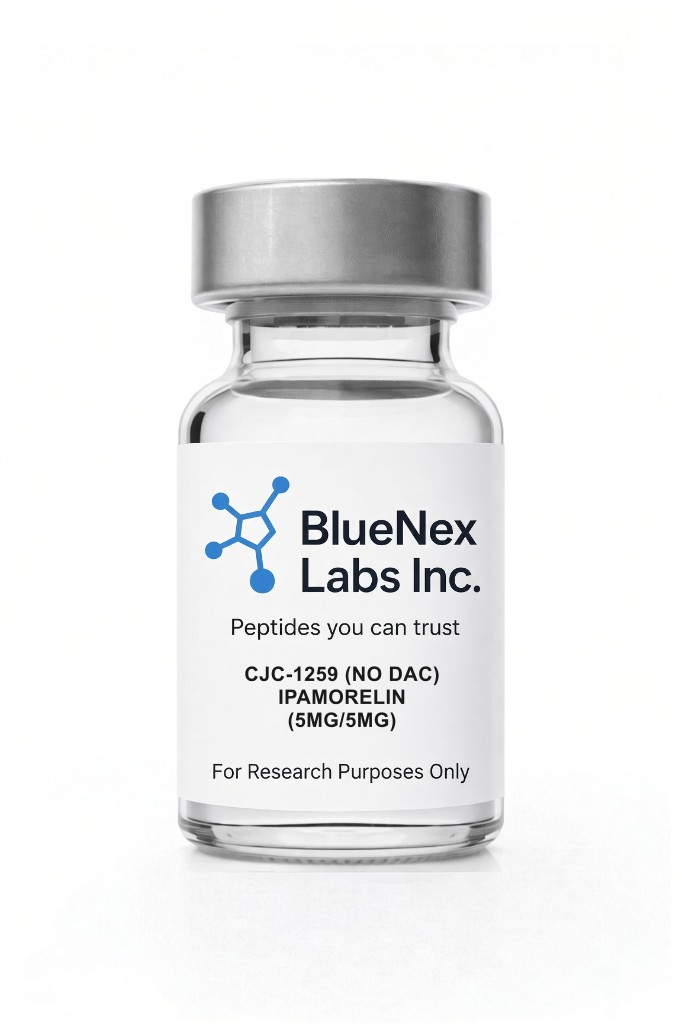
CJC-1295 Ipamorelin Peptide Canada
Research use only. Not for human or veterinary use.
This live combo SKU is CJC-1295 (no DAC) with Ipamorelin at 5mg/5mg. It is a research convenience vial, not a protocol. Open the combo certificate section when a lot is listed. Research-use only.
🧬 CJC‑1295 (No DAC) + Ipamorelin Peptide Blend
Dual‑Pathway GHRH & GHSR‑1a Research Peptides for Endocrine Signaling & Receptor‑Pathway Studies
CJC‑1295 (No DAC) + Ipamorelin is a high‑purity, research‑grade dual‑peptide formulation widely referenced in laboratory research involving endocrine signaling, receptor co‑activation, intracellular messenger integration, and peptide‑receptor kinetics.
Supplied by BlueNexLabs, this formulation combines CJC‑1295 (No DAC)—a short‑acting GHRH analog—with Ipamorelin, a selective GHSR‑1a agonist. Together, they support controlled investigation of parallel receptor systems under Research‑Use‑Only (RUO) conditions in Canadian research environments.
🔬 Overview of the CJC‑1295 (No DAC) + Ipamorelin Research Model
This dual‑peptide system is commonly used as a model platform for studying how GHRH receptor (GHRH‑R) signaling and growth hormone secretagogue receptor (GHSR‑1a) signaling behave independently and in combination.
Unlike DAC‑modified peptides, CJC‑1295 (No DAC) lacks a drug‑affinity complex, resulting in short‑window receptor engagement. This property makes it particularly useful for high‑resolution kinetic studies and time‑course experiments focused on pulsatile receptor activation patterns.
When paired with Ipamorelin, researchers can explore dual‑pathway signaling architecture without long‑acting peptide confounders.
🧪 What Is CJC‑1295 (No DAC) + Ipamorelin?
This formulation contains two distinct research peptides:
CJC‑1295 (No DAC)
- Synthetic GHRH analog without DAC modification
- Used in laboratory models of GHRH‑R binding and cAMP‑linked signaling
- Short in‑vitro half‑life supports temporal resolution studies
Ipamorelin
- Selective GHSR‑1a pentapeptide agonist
- Used in studies of Ca²⁺ mobilization and receptor‑bias behavior
- Demonstrates predictable, receptor‑specific signaling in vitro
Together, this combination enables dual‑axis endocrine signaling research under controlled laboratory conditions.
📡 Mechanistic Research Overview (Audit‑Safe)
🧬 Dual‑Receptor Pathway Activation
- Used to study simultaneous GHRH‑R and GHSR‑1a engagement
- Supports analysis of receptor crosstalk and pathway amplification
- Applied in comparative single‑ vs. dual‑receptor studies
⚙️ Intracellular Messenger Integration
- Referenced in research examining cAMP signaling (GHRH‑R)
- Supports studies of Ca²⁺ mobilization (GHSR‑1a)
- Enables mapping of convergent vs. divergent transcriptional responses
🔁 Receptor Bias & Kinetic Behavior
- Applied in assays measuring β‑arrestin recruitment and receptor internalization
- Used for receptor recycling and ligand‑dependent trafficking studies
- Supports short‑window kinetic modeling due to No‑DAC design
🧱 Molecular & Chemical Characteristics
Type: Dual‑peptide research formulation
Form: Lyophilized powder
Fill Size:
- 5 mg CJC‑1295 (No DAC)
- 5 mg Ipamorelin
Identity Verification:
- Each peptide independently verified via Mass Spectrometry (MS)
- Purity confirmed by HPLC / UPLC
Structural & Biochemical Notes
CJC‑1295 (No DAC):
- Short‑acting GHRH analog without albumin‑binding modification
- High solubility in polar buffers
- Stability influenced by pH, ionic strength, and temperature
Ipamorelin:
- Selective GHSR‑1a agonist with low off‑target activity in vitro
- Predictable solubility and low nonspecific binding
- Stability improves in mildly acidic buffer systems
Combined Behavior:
- Supports dual‑axis signaling analysis (cAMP, Ca²⁺, MAPK, CREB)
- Low aggregation risk when properly buffered
- Suitable for time‑course and receptor‑bias experiments
🔬 Research Focus Areas
This dual-peptide formulation is commonly referenced in GHRH-R and GHSR-1a laboratory models, time-course assays, and receptor-bias experiments. It is a research convenience SKU, not a combined protocol for people.
Storage & Handling
- Store lyophilized material at –20 °C, protected from light and moisture
- Reconstituted solutions: 2–8 °C, short-term laboratory use only
- Avoid repeated freeze–thaw cycles; use sterile technique
Documentation
Batch Certificates of Analysis are listed in the certificates library when published. Match vial size and lot notes before assigning a lot to an assay.
Compliance Notice
Research-use only. Not for human or veterinary use. No medical, cosmetic, or performance claims are made or implied.
Molecular characteristics
- form
- Lyophilized powder
- purity
- ≥99% (COA verified)
- use
- Research use only
Documentation (HPLC / UPLC, MS, COA)
Published lots for this SKU are listed at the exact certificate section. Identity is typically confirmed by mass spectrometry; purity by HPLC / UPLC. A report for another peptide or fill size does not document this vial.
Questions about laboratory procurement? Contact BlueNex Labs.