
Research · 2026-10-28
By Alice Kay · Last reviewed 29 Oct 2026
What Are Peptides?
Research-use notice: This article summarizes published scientific literature for educational purposes. It is not medical advice and does not provide dosing, administration or human-use information. Findings described in the literature do not apply to any BlueNex Labs product, which is supplied only for in-vitro laboratory research and not for human or animal use.
Direct answer
Peptides are short chains of amino acids joined by peptide bonds. Most contain between 2 and about 50 amino acids.
Scope
Peptide science primers. What research peptides are, how naming and freeze-drying work, and introductory laboratory questions.
This note does not claim that Alice Kay authored any cited paper.
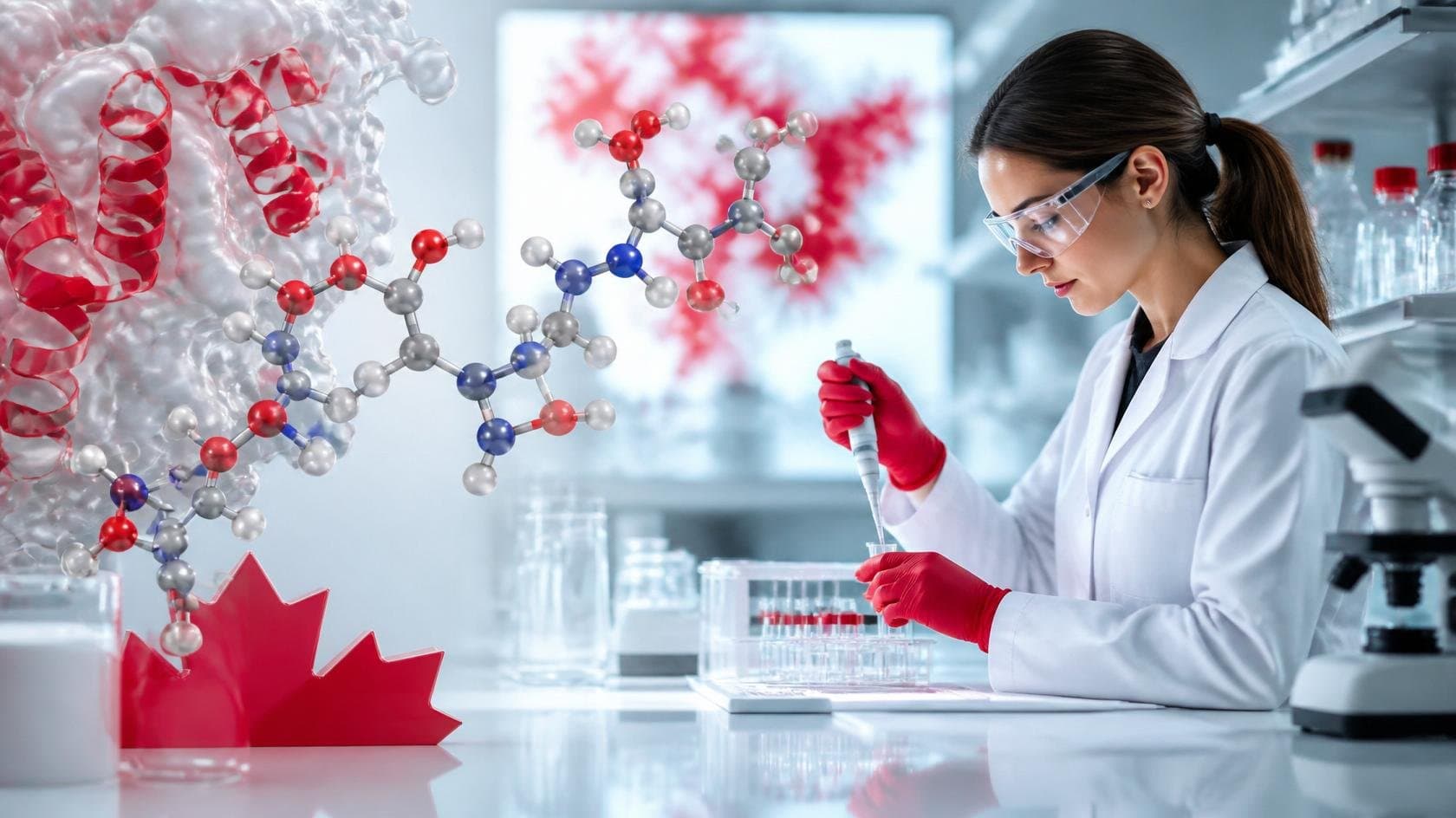
Peptides are short chains of amino acids joined by peptide bonds. Most contain between 2 and about 50 amino acids. Longer chains that fold into stable three-dimensional shapes are usually called proteins. Peptides occur naturally in plants, animals and people, where many act as signalling molecules, and they can also be made in a laboratory.
This guide goes deeper than a definition. It covers the chemistry of amino acids and peptide bonds, how peptides compare with polypeptides and proteins, well-known natural peptides, how synthetic peptides are made, why they are freeze-dried, how purity is checked, and how peptides are regulated in Canada. For the narrower topic of lab-grade compounds, see what are research peptides. Everything BlueNex Labs sells is supplied for laboratory research use only and is not for human or animal use.
Quick answer: what is a peptide?
- Building blocks: amino acids, of which 20 are standard in human proteins.
- The link: a peptide (amide) bond between one amino acid's carboxyl group and the next one's amino group.
- Size: roughly 2 to 50 amino acids. A dipeptide has two, a tripeptide three, and an oligopeptide a few.
- Role in nature: hormones, neurotransmitters, antimicrobial defences, antioxidants and structural fragments.
- Origin: natural, or synthetic (made by chemical synthesis or recombinant methods).
Amino acids: the building blocks
Every amino acid shares the same backbone: a central carbon bonded to an amino group (–NH2), a carboxyl group (–COOH), a hydrogen atom and a side chain, often called the R group. The side chain is what makes each amino acid different. Some are small and neutral (glycine, alanine), some carry a charge (lysine, aspartic acid), some repel water (leucine, phenylalanine), and some contain sulphur (cysteine, methionine).
Because a peptide's behaviour comes from the side chains along its length, the same handful of building blocks can produce molecules with very different charge, solubility, shape and binding properties. Scientists write sequences using one-letter or three-letter codes, read from the N-terminus (the free amino end) to the C-terminus (the free carboxyl end).
How a peptide bond forms
A peptide bond forms when the carboxyl group of one amino acid reacts with the amino group of another. One molecule of water is released, so chemists call this a condensation (or dehydration) reaction. The result is an amide linkage, –CO–NH–, that repeats along the chain and forms the peptide backbone.
The peptide bond has partial double-bond character. It is flat and does not rotate freely, which limits how the chain can bend. This rigidity is one reason peptides and proteins adopt predictable shapes such as alpha-helices and beta-sheets. Breaking a peptide bond requires water and usually an enzyme (a protease) or harsh conditions; this process is called hydrolysis.
Peptides vs polypeptides vs proteins
"Peptides vs proteins" is one of the frequently discussed questions on the topic, and the honest answer is that the boundary is a convention rather than a hard rule.
| Term | Typical length | Structure | Examples |
|---|---|---|---|
| Dipeptide / tripeptide | 2–3 amino acids | Simple, flexible | Carnosine, glutathione, GHK |
| Oligopeptide | ~2–20 amino acids | Usually flexible | Oxytocin (9), vasopressin (9) |
| Polypeptide | ~20–50+ amino acids | May form local structure | Glucagon (29), insulin chains |
| Protein | Usually 50+ amino acids | Folded 3D structure, sometimes multiple chains | Hemoglobin, collagen, enzymes |
Size is only part of it. Proteins typically fold into stable tertiary structures and may combine several chains (quaternary structure). Insulin, with 51 amino acids in two chains linked by disulphide bonds, sits right on the line and is described as both a peptide hormone and a small protein.
Levels of structure
- Primary: the amino-acid sequence.
- Secondary: local patterns such as helices and sheets, held by hydrogen bonds.
- Tertiary: the overall fold of one chain.
- Quaternary: how multiple chains assemble.
Short peptides mostly have primary structure and some flexible secondary structure. That flexibility is one reason peptides can be studied, synthesized and modified more easily than large proteins.
How peptides work in nature
Health Canada describes peptides as molecules that occur naturally and help cells and tissues communicate. In biology, most bioactive peptides work by binding to a specific receptor on a cell surface, much like a key fitting a lock. Binding triggers a signal inside the cell. Because the fit depends on exact sequence and shape, a small change of one amino acid can change or remove that interaction.
Natural peptides are usually short-lived. Enzymes in blood and tissue break them down within minutes in many cases, which is why researchers study modifications that improve stability.
Well-known natural peptides
- Insulin: a 51-amino-acid hormone made in the pancreas. Its discovery in Toronto in 1921–22 by Banting, Best, Collip and Macleod led to the 1923 Nobel Prize, a landmark in Canadian science.
- Oxytocin and vasopressin: nine-amino-acid hormones from the pituitary. Vincent du Vigneaud's synthesis of oxytocin, the first synthetic peptide hormone, earned the 1955 Nobel Prize in Chemistry.
- Glutathione: a tripeptide (glutamate, cysteine, glycine) found in most cells and widely studied as a cellular antioxidant.
- GLP-1 and glucagon: gut and pancreatic peptides involved in metabolic signalling.
- Endorphins and enkephalins: peptides that act in the nervous system.
- Antimicrobial peptides: such as LL-37, part of innate immune defence.
- Collagen fragments: short peptides released when collagen breaks down, including the copper-binding tripeptide GHK, first described in human plasma in the 1970s.
How synthetic peptides are made
Solid-phase peptide synthesis (SPPS)
Most research peptides are made by solid-phase peptide synthesis, developed by Robert Bruce Merrifield, who received the 1984 Nobel Prize in Chemistry for it. In SPPS, the first amino acid is anchored to an insoluble resin bead. Each next amino acid is added in a repeating cycle:
- Remove the protecting group from the growing chain's end (deprotection).
- Add the next protected amino acid with a coupling reagent.
- Wash away excess reagents.
Because the chain stays attached to the resin, washing is fast and the process can be automated. The two main chemistries are Fmoc and Boc, named after their protecting groups; Fmoc is the most common today. When the sequence is complete, the peptide is cleaved from the resin and its side-chain protecting groups are removed.
Each coupling step is not perfectly efficient, so very long sequences build up errors, such as deletion sequences missing one amino acid. That is why purification and testing matter so much.
Liquid-phase and hybrid synthesis
Classical solution-phase synthesis is still used for very short peptides and some large-scale manufacturing. Longer peptides are sometimes made by joining shorter fragments (fragment condensation or native chemical ligation).
Recombinant production
Long peptides and proteins, such as insulin, are often produced by recombinant DNA technology. A gene for the sequence is placed into bacteria or yeast, which then make the peptide. This suits long sequences but is less flexible for unnatural amino acids or chemical modifications.
Common modifications
Researchers modify peptides to change stability or behaviour. Examples include C-terminal amidation, N-terminal acetylation, cyclization, D-amino acids, fatty-acid chains (lipidation), PEGylation and metal complexes such as copper in GHK-Cu. Each modification creates a different molecule with its own properties.
Classes of research peptides
Research peptides are often grouped by the biological system or receptor family they are studied in. On our site you can browse these groupings:
- Incretin and metabolic peptide analogues studied in metabolic signalling research, such as Retatrutide. See the metabolic category.
- Growth hormone secretagogues and releasing-hormone analogues, such as Ipamorelin, Sermorelin and CJC-1295 (no DAC)/Ipamorelin. See the GHS category.
- Tissue and cellular research peptides, such as BPC-157, TB-500 and GHK-Cu 100 mg. See the cellular category.
- Mitochondrial peptides, such as SS-31 and MOTS-c. See the mitochondrial category.
- Neuropeptide analogues, such as Selank and Semax. See the cognitive category.
- Immune and antimicrobial peptides, such as Thymosin α-1, KPV and LL-37.
These groupings describe research areas only. They are not claims about any effect in people. For the colour chemistry of one copper peptide, read why GHK-Cu is blue.
Lyophilization: why peptides come as a powder
Most research peptides are supplied lyophilized, meaning freeze-dried. The peptide solution is frozen, then placed under vacuum so the ice turns straight to vapour (sublimation). What remains is a light, dry cake or powder at the bottom of the vial.
Removing water matters because water drives the main ways peptides degrade:
- Hydrolysis: water breaks peptide bonds, especially next to aspartic acid.
- Deamidation: asparagine and glutamine residues lose an amide group.
- Oxidation: methionine, cysteine and tryptophan react with oxygen.
- Aggregation: chains clump together and may fall out of solution.
A lyophilized peptide is far more stable than one in solution. Small differences in the look of the cake, such as a puck versus loose powder, are normal and come from the freeze-drying cycle rather than the content.
Storage and stability in the lab
General laboratory practice for lyophilized peptides is to keep them cold, dry and away from light, in sealed vials, and to let a cold vial reach room temperature before opening so moisture does not condense inside. Many labs store long-term stock frozen and working stock refrigerated. Check each product page and its documentation for specific storage guidance.
Purity, identity and COAs
Because synthesis creates side products, every batch needs testing. A Certificate of Analysis (COA) reports what a batch is and how pure it is. The key methods are:
HPLC (high-performance liquid chromatography)
HPLC, usually reversed-phase, pushes the sample through a column that separates molecules by how strongly they stick to it. A detector draws a chromatogram: the main peak is the target peptide, and smaller peaks are impurities. Purity is reported as the main peak's share of total peak area, for example 99%.
Mass spectrometry (MS)
HPLC shows purity, but not identity. Mass spectrometry measures the molecular mass and confirms it matches the expected sequence. A peptide missing one amino acid will show a different mass. LC-MS combines both methods.
Other tests
- Peptide content or quantity: how much peptide is actually in the vial, since the powder also contains counter-ions (such as acetate or TFA) and residual water.
- Endotoxin and heavy-metal tests: available from some laboratories.
- Amino-acid analysis: confirms composition.
Third-party testing
Independent labs, such as Janoshik Analytical, test samples separately from the manufacturer and publish verifiable reports. A good COA names the product and batch, shows the method, reports both purity and identity, and can be checked with the lab. You can view ours on the certificates page.
Health Canada notes that third-party testing alone cannot show a product is safe, effective or authorized for sale. A COA documents analytical results for a batch; it is not a regulatory approval.
Peptides in Canada: the regulatory context
In Canada, products are regulated by what they are and how they are represented. According to Health Canada's peptides overview, Health Canada has authorized a number of peptide drugs, including insulin. Authorized drugs carry an eight-digit Drug Identification Number (DIN).
Health Canada states that peptides are generally regulated as prescription drugs in Canada. In a 2026 advisory, it warned consumers against buying unauthorized injectable peptides online, listed many common research peptides by name, and stated that "For Research Use Only – Not for Human Consumption" labelling does not make products exempt from regulatory requirements. Its health risks page describes risks such as contamination and mislabelling in unauthorized products.
BlueNex Labs products are not authorized drugs, carry no DIN, and are supplied for in-vitro laboratory research only. They are not for human or animal use, and nothing on this site is medical advice.
Peptide research today
Peptides sit between small-molecule drugs and large biologics. Peer-reviewed reviews, such as Wang et al., "Therapeutic peptides: current applications and future directions" (Signal Transduction and Targeted Therapy, 2022), describe their strengths as high specificity for targets and generally predictable breakdown, and their challenges as short half-life and poor oral stability. Current research focuses on stabilizing modifications, new delivery approaches, cyclic peptides and computational design of new sequences.
Frequently asked questions
What are peptides in simple terms?
Peptides are short chains of amino acids, the same building blocks that make up proteins. Most have between 2 and about 50 amino acids linked by peptide bonds.
What is the difference between a peptide and a protein?
Mainly size and structure. Peptides are shorter, usually under 50 amino acids, and often flexible. Proteins are longer chains that fold into stable three-dimensional shapes. The boundary is a convention, not a strict rule.
What is a polypeptide?
A polypeptide is a longer, unbranched chain of amino acids, often from about 20 to 50 or more. A protein can be made of one or more polypeptide chains.
Are peptides natural or synthetic?
Both. Thousands of peptides occur naturally in plants, animals and people. Synthetic peptides are made in labs, mostly by solid-phase peptide synthesis or recombinant methods.
How are research peptides made?
Most are built by solid-phase peptide synthesis, which adds protected amino acids one at a time to a chain anchored on a resin. The peptide is then cleaved, purified by HPLC, freeze-dried and tested.
Why are peptides freeze-dried?
Water drives degradation such as hydrolysis, deamidation and aggregation. Lyophilization removes water and makes the peptide much more stable for storage and shipping.
What does peptide purity mean?
Purity is usually the percentage of the HPLC chromatogram's total peak area that belongs to the target peptide. It is reported on a Certificate of Analysis, ideally alongside mass spectrometry confirming identity.
What is a COA for peptides?
A Certificate of Analysis is a lab report for a specific batch. It typically shows the HPLC purity, mass spectrometry identity results, batch number and testing lab.
Are peptides legal in Canada?
Health Canada has authorized several peptide drugs, such as insulin and GLP-1 receptor agonists, which carry a DIN. Health Canada states that peptides are generally regulated as prescription drugs and that research-use-only labelling does not exempt products from regulatory requirements. See Health Canada's peptides pages for its current position.
Is collagen a peptide?
Collagen itself is a large structural protein. "Collagen peptides" are short fragments produced when collagen is broken down by hydrolysis.
Browse research materials
Explore the full catalogue in our shop, view batch testing on the certificates page, find more guides in the Research Hub, or read our FAQ and shipping information.
All BlueNex Labs products are sold for laboratory research use only. Not for human or animal use. Not intended to diagnose, treat, cure or prevent any disease.
Sources
- Health Canada — Peptides: Overview
- Health Canada — Peptides: Health risks
- Health Canada advisory on unauthorized peptides (2026)
- Wang L. et al., Therapeutic peptides: current applications and future directions, Signal Transduct Target Ther, 2022
- Nobel Prize in Chemistry 1984 — R. Bruce Merrifield
- Nobel Prize in Physiology or Medicine 1923 — insulin
- Peptide — Wikipedia
- Peptide bond — Wikipedia
- Freeze-drying — Wikipedia
References
This note does not add a separate citation list. Named papers, when the body links them, stay in the text above.
Research use only. BlueNex Labs does not provide medical or veterinary advice. Confirm your institution’s policies before purchase. Lot-file rules for this note are on the documentation standards page. By Alice Kay.