
Research · 2026-10-28
By Alice Kay · Last reviewed 28 Oct 2026
Why Is GHK-Cu Blue? GHK-Cu Colour, Cloudiness and Deposits Explained
Research-use notice: This article summarizes published scientific literature for educational purposes. It is not medical advice and does not provide dosing, administration or human-use information. Findings described in the literature do not apply to any BlueNex Labs product, which is supplied only for in-vitro laboratory research and not for human or animal use.
Direct answer
Why does GHK-Cu look blue, and what does it mean if a solution turns pale, green, cloudy or leaves a deposit? A plain guide to GHK-Cu colour for laboratory researchers in Canada.
Scope
Peptide science primers. What research peptides are, how naming and freeze-drying work, and introductory laboratory questions.
This note does not claim that Alice Kay authored any cited paper.
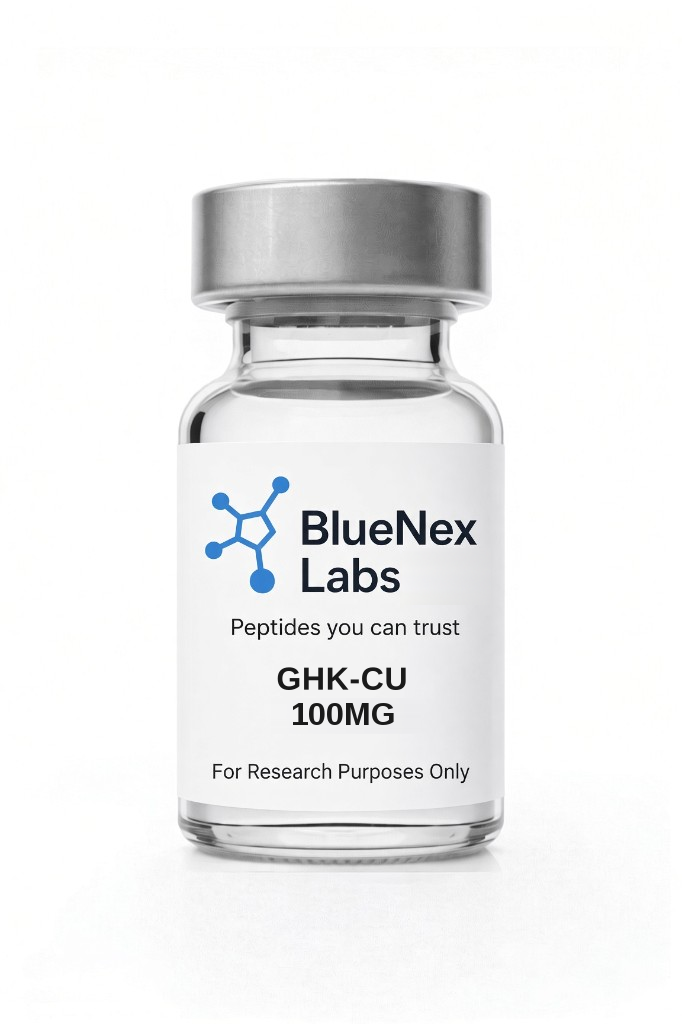
One of the most common questions we get about GHK-Cu is simple: why is it blue? Researchers opening a vial for the first time often expect a white powder and a clear liquid, like most peptides. GHK-Cu is different. This guide from BlueNex Labs explains where the colour comes from, what normal looks like, and what a pale, green, cloudy or speckled solution can tell you. All BlueNex Labs materials are sold for laboratory research only and are not for human or animal use.
What GHK-Cu is
GHK is a tripeptide made of three amino acids: glycine, histidine and lysine. GHK-Cu is that tripeptide bound to a copper(II) ion. The copper sits in a pocket formed by the histidine side chain and nitrogen atoms in the peptide backbone, making a stable copper–peptide complex. If you're new to peptides in general, start with What Are Peptides?, and for the published literature see GHK-Cu in extracellular-matrix and gene-expression literature and our copper peptides mechanism page.
Why GHK-Cu is blue
The colour comes from the copper, not the peptide. Copper(II) ions absorb light in the orange-red part of the visible spectrum. What passes through to your eye is blue to blue-violet. It's the same reason copper sulfate solutions look blue.
So a blue colour is expected. It's a quick visual sign that copper is present and still bound in the complex.
- Freeze-dried powder: a blue to blue-violet cake or powder. Shade varies between batches and with how the cake formed. See lyophilized research peptides.
- In solution: a clear, even blue. Stronger solutions look deeper blue; dilute ones look pale.
Normal vs. warning signs
| What you see | Likely meaning | Lab action |
|---|---|---|
| Clear, even blue | Normal; copper complex intact | Proceed per your protocol |
| Very pale blue | Usually just a lower concentration | Check your volumes |
| Streaky blue right after mixing | Cake still dissolving | Let it stand; swirl gently |
| Blue fading to colourless | Copper may be leaving the peptide (often acidic conditions) | Review diluent and pH; consider discarding |
| Green or brown tint | Possible degradation or contamination | Discard |
| Cloudy, or a blue deposit at the bottom | Copper salts falling out of solution | Discard; review diluent and handling |
Why a GHK-Cu solution goes cloudy or leaves a deposit
A blue haze or a fine blue sediment usually means copper has come out of the complex and formed an insoluble salt. Common causes in the lab:
- pH too high. In alkaline conditions, hydroxide competes with the peptide for copper and can form copper hydroxide, which settles as a blue or blue-green sediment.
- Incompatible buffers. Phosphate buffers can form copper phosphate, which doesn't stay dissolved. Strong chelators such as EDTA pull copper out of the complex.
- Incomplete dissolution. Larger vials (50 mg, 100 mg) have dense cakes that need time. Adding liquid too fast can leave undissolved specks.
- Contamination. Haze or particles that appear days later can point to a lapse in aseptic technique.
Why GHK-Cu can lose its colour
If a solution that started blue becomes pale or colourless, the copper may have separated from the peptide. Acidic diluents (roughly below pH 4–5) can do this, as can chelating agents. Without the copper, you no longer have the same compound, and results won't be comparable to intact GHK-Cu. For broader causes of breakdown, see our peptide degradation guide.
Good lab practice for clear results
- Choose a diluent suited to your assay that keeps conditions near neutral to mildly acidic. Many labs use sterile or bacteriostatic water, such as Hospira bacteriostatic water.
- Run liquid slowly down the vial wall, let the cake wet, then swirl gently. Don't shake.
- Let diluent and vial reach a similar temperature before mixing.
- Protect solutions from light and heat, and follow compound-specific storage data. See our storage and handling guide.
- Record the appearance at mixing so later changes are easy to spot.
Colour isn't a purity test
A nice blue colour shows copper is present. It doesn't confirm identity or purity. That comes from analytical testing such as HPLC and mass spectrometry, reported on a certificate of analysis. Learn how to read a peptide COA. We cover a similar colour question for NAD+ in why NAD+ can look clear or yellow.
GHK-Cu from BlueNex Labs
BlueNex Labs supplies GHK-Cu for laboratory research in 50 mg and 100 mg vials, shipped within Canada. If a vial looks different from what's described here, contact us with a clear photo and the batch details and we'll look into it.
Frequently asked questions
Is GHK-Cu supposed to be blue?
Yes. The copper(II) ion gives both the powder and the solution a blue colour.
Why is my GHK-Cu a different shade from last time?
Shade varies with concentration and the form of the freeze-dried cake. A clear, even blue is what matters.
What does a blue deposit at the bottom of the vial mean?
Usually copper salts have come out of solution, often from high pH or an incompatible buffer. Labs typically discard it.
Why did my GHK-Cu solution turn clear?
The copper may have separated from the peptide, often because of acidic conditions or a chelating agent.
Is a green or brown tint normal?
No. It can point to degradation or contamination.
Does a deeper blue mean higher purity?
No. Colour tracks copper concentration. Purity is confirmed by HPLC and mass spectrometry on the COA.
The bottom line
GHK-Cu is blue because of its copper. A clear, even blue is normal. Paling, green or brown tints, cloudiness and deposits are signs that something in the diluent, pH or handling has changed the complex. Pair a visual check with proper documentation for reliable lab work.
BlueNex Labs products are for laboratory research only. Not for human or animal use.
References
This note does not add a separate citation list. Named papers, when the body links them, stay in the text above.
Research use only. BlueNex Labs does not provide medical or veterinary advice. Confirm your institution’s policies before purchase. Lot-file rules for this note are on the documentation standards page. By Alice Kay.