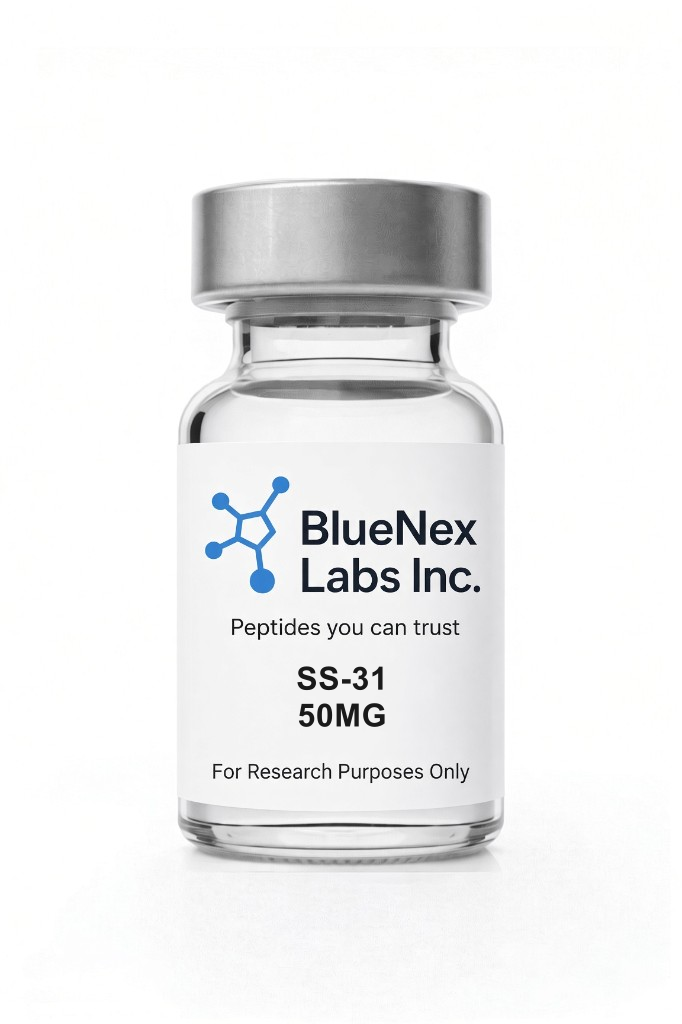
SS-31 10mg / 50mg Peptide Canada
Research use only. Not for human or veterinary use.
SS-31 is sold here as 10mg and 50mg lyophilized fills. Those sizes are separate lots when both exist — do not mix certificate reports. Research-use only.
🧬 SS‑31 (10mg / 50mg) — High‑Purity Mitochondria‑Targeted Tetrapeptide for Cellular‑Bioenergetics Research
SS‑31 is a high‑purity, research‑grade mitochondria‑targeted tetrapeptide widely referenced in Canadian laboratory environments for studies involving cardiolipin interactions, mitochondrial‑membrane stabilization, oxidative‑stress modulation, and cellular‑bioenergetics regulation.
BlueNexLabs supplies high-purity SS-31 peptide in 10mg and 50mg lyophilized formats, supported by analytical testing and Research Use Only (RUO) designation.
Also known as Elamipretide, SS‑31 is engineered to selectively associate with cardiolipin‑rich inner mitochondrial membranes, making it a valuable tool for in‑vitro and preclinical research exploring mitochondrial dysfunction, ROS‑associated pathways, and bioenergetic resilience.
Its compact structure, strong analytical visibility, and predictable behavior in controlled systems make SS‑31 a commonly referenced peptide in Canadian laboratory studies of mitochondrial integrity, electron‑transport chain (ETC) dynamics, and cellular‑stress adaptation.
🔍 What Is SS‑31?
SS‑31 is a synthetic aromatic‑cationic tetrapeptide designed to selectively target the inner mitochondrial membrane (IMM) through high‑affinity binding to cardiolipin, a phospholipid essential for mitochondrial structure and function.
In research settings, SS‑31 is used to study:
- Cardiolipin–peptide interactions
- Mitochondrial‑membrane stabilization
- Electron‑transport chain (ETC) efficiency
- Oxidative‑stress and ROS‑associated pathways
- Cellular‑bioenergetics and ATP‑production models
- Mitochondrial‑dysfunction and stress‑response signaling
🔬 Scientific Context
SS‑31 is frequently referenced in studies involving:
- Mitochondrial permeability and membrane potential
- Cardiolipin oxidation and lipid‑peroxidation models
- ETC complex stability and electron‑leak dynamics
- Cellular‑resilience under metabolic or oxidative stress
- Comparative mitochondrial‑targeted peptide research
Its unique ability to localize to mitochondria without requiring membrane potential makes SS‑31 a powerful tool for bioenergetics and mitochondrial‑mechanism research.
📡 Mechanistic Overview
🔷 Cardiolipin Binding & Membrane Stabilization
- Selectively associates with cardiolipin‑rich IMM regions
- Supports research involving mitochondrial‑membrane integrity
- Used in models examining lipid‑peroxidation and membrane destabilization
🔶 Oxidative‑Stress & ROS‑Linked Pathways
- Applied in studies involving reactive oxygen species (ROS) markers
- Supports investigations into oxidative‑stress adaptation
- Used in multi‑pathway redox‑biology modeling
🔵 Electron‑Transport Chain (ETC) Dynamics
- Examined in ETC‑complex stability and electron‑leak studies
- Supports mapping of ATP‑production efficiency
- Used in comparative mitochondrial‑function assays
🟣 Cellular‑Bioenergetics & Stress‑Response
- Referenced in metabolic‑stress and mitochondrial‑dysfunction models
- Supports peptide‑mediated resilience and adaptation research
- Used in multi‑axis bioenergetic investigations
🧱 Structural Overview
🧪 Molecular Composition
- Type: Synthetic aromatic‑cationic tetrapeptide
- Form: Lyophilized powder (10mg and 50mg fills)
- Identity: Verified via MS and HPLC/UPLC
- Origin: Designed for mitochondrial targeting
🧬 Functional Domains
- Cationic domain: Facilitates mitochondrial localization
- Aromatic domain: Enables cardiolipin binding
- Bioenergetic domain: Supports ETC‑linked research
🎯 Pathway Targets
- Cardiolipin‑associated mitochondrial pathways
- Oxidative‑stress and redox‑state markers
- ETC‑complex stability and ATP‑production networks
- Mitochondrial‑dysfunction and stress‑response cascades
- Peptide–lipid and peptide–protein interaction models
🔬 Research Focus Areas
SS-31 is referenced in research on cardiolipin-associated mitochondrial membranes, electron-transport assays, and oxidative-stress markers. Catalog vials are research-use only; 10 mg and 50 mg fills have separate lots when both exist.
Storage & Handling
- Store lyophilized material at –20 °C, protected from light and moisture
- Reconstituted solutions: 2–8 °C, short-term laboratory use only
- Avoid repeated freeze–thaw cycles; use sterile technique
Documentation
Batch Certificates of Analysis are listed in the certificates library when published. Match vial size and lot notes before assigning a lot to an assay.
Compliance Notice
Research-use only. Not for human or veterinary use. No medical, cosmetic, or performance claims are made or implied.
Vial size
$45.00CAD
Currently unavailable · SKU SS31-10
Molecular characteristics
- form
- Lyophilized powder
- purity
- ≥99% (COA verified)
- use
- Research use only
Documentation (HPLC / UPLC, MS, COA)
Batch Certificates of Analysis are added to the certificates library when published. This page does not invent lot numbers.
Questions about laboratory procurement? Contact BlueNex Labs.