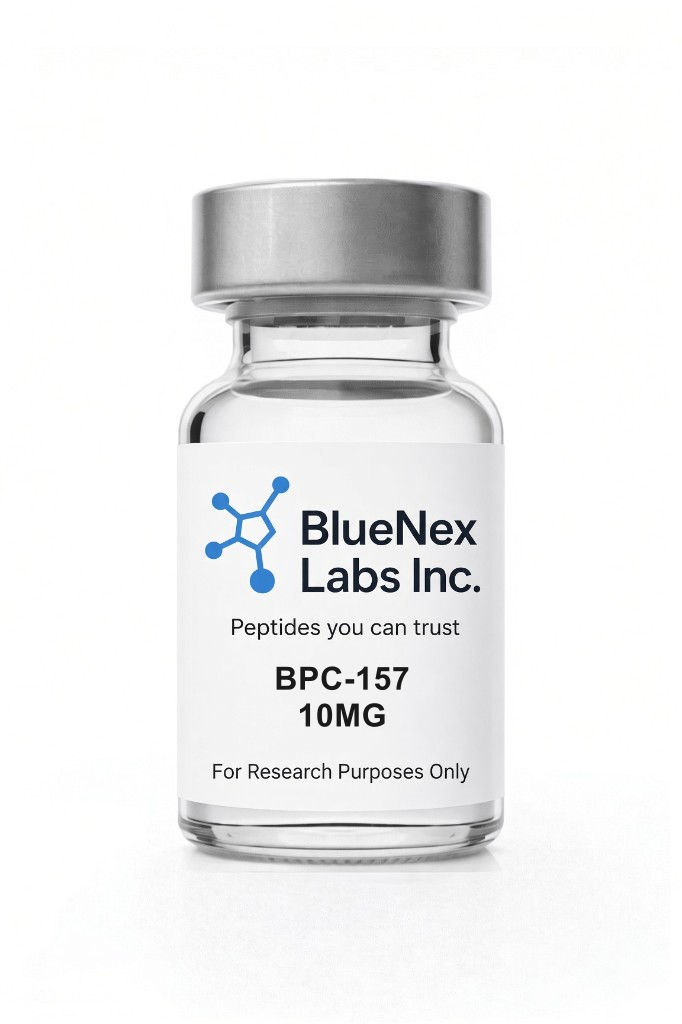
BPC-157 10mg Research Peptide Canada
Research use only. Not for human or veterinary use.
This BPC-157 10mg vial is catalogued for Canadian laboratories that need a documented pentadecapeptide fill. Review the lot in the certificates library when published, then order for domestic fulfilment. Research-use only.
🧬 BPC‑157 Peptide — 10 mg
High‑Purity Pentadecapeptide for Cellular Signaling, Peptide Stability & Stress‑Response Research
BPC‑157 is a high‑purity, research‑grade synthetic pentadecapeptide widely referenced in laboratory research involving cellular signaling pathways, peptide stability, structure–function relationships, and stress‑response modeling. Derived from a partial sequence of the naturally occurring Body Protection Compound (BPC), this peptide is commonly used in controlled in‑vitro and preclinical research environments.
Supplied by BlueNexLabs, BPC‑157 is provided as a lyophilized peptide (10 mg) with COA‑verified purity, analytical consistency, and audit‑safe Research‑Use‑Only (RUO) labeling, supporting reproducible experimental workflows across Canadian research laboratories.
🔬 Overview of BPC‑157 in Research Settings
BPC‑157 is frequently used as a model compound for studying how mid‑length peptides interact with cellular systems and maintain structural integrity under experimental conditions. In laboratory research, it is commonly referenced in studies examining:
- Intracellular and extracellular signaling pathways
- Peptide stability and degradation‑resistance mechanisms
- Structure–function relationships of short peptide fragments
- Cellular stress‑response and adaptation models
- Peptide–protein and matrix‑associated interaction dynamics
Its predictable behavior and analytical visibility make BPC‑157 a practical tool for cellular‑regulation and peptide‑biology research.
🧪 What Is BPC‑157?
BPC‑157 is a synthetic pentadecapeptide used in laboratory research involving:
- Cellular‑signaling and communication studies
- Peptide‑stability and degradation‑resistance profiling
- Structure–function investigations in short peptide systems
- Extracellular‑matrix and peptide–protein interaction modeling
- Oxidative‑stress and cellular‑resilience research
Its compact sequence supports consistent analytical performance in chromatography‑ and spectroscopy‑based research workflows.
📡 Mechanistic Research Overview (Audit‑Safe)
🔗 Cellular Signaling & Pathway Modeling
- Referenced in studies examining intracellular signaling cascades
- Used in models exploring peptide‑mediated communication
- Supports multi‑pathway cellular‑regulation research
🧬 Peptide Stability & Structure–Function Analysis
- Applied in investigations of degradation resistance and peptide integrity
- Used in stability and formulation‑related experimental designs
- Supports analytical method development for mid‑length peptides
⚖️ Stress‑Response & Cellular Adaptation
- Examined in oxidative‑stress and inflammatory‑marker assays
- Supports research into cellular‑resilience mechanisms
- Used in comparative peptide‑biology studies
🧱 Molecular & Chemical Characteristics
Type: Synthetic pentadecapeptide
Form: Lyophilized powder
Fill Size: 10 mg
Identity Verification: Mass Spectrometry (MS)
Purity Analysis: HPLC / UPLC
Structural & Biochemical Notes
- Highly soluble in polar solvents
- Demonstrates predictable behavior in analytical workflows
- Stable in dry form under proper storage conditions
- Sensitive to hydrolysis and oxidation following reconstitution
🔬 Research Focus Areas
BPC‑157 is commonly referenced in laboratory research involving:
- Cellular‑signaling and peptide‑communication studies
- Peptide‑stability and degradation‑resistance modeling
- Structure–function analysis of short and mid‑length peptides
- Extracellular‑matrix and peptide–protein interaction research
- Oxidative‑stress and cellular‑resilience assays
- Multi‑pathway cellular‑biology investigations
Its broad mechanistic relevance supports controlled, pathway‑specific research workflows
in regulated laboratory environments. BPC-157 remains a research solid. Published injury-model papers do not make this vial a medicine.
Storage & Handling
- Store lyophilized material at –20 °C, protected from light and moisture
- Reconstituted solutions: 2–8 °C, short-term laboratory use only
- Avoid repeated freeze–thaw cycles; use sterile technique
Documentation
Batch Certificates of Analysis are listed in the certificates library when published. Match vial size and lot notes before assigning a lot to an assay.
Compliance Notice
Research-use only. Not for human or veterinary use. No medical, cosmetic, or performance claims are made or implied.
Molecular characteristics
- form
- Lyophilized powder
- purity
- ≥99% (COA verified)
- use
- Research use only
Documentation (HPLC / UPLC, MS, COA)
Published lots for this SKU are listed at the exact certificate section. Identity is typically confirmed by mass spectrometry; purity by HPLC / UPLC. A report for another peptide or fill size does not document this vial.
Questions about laboratory procurement? Contact BlueNex Labs.