Research · 2026-07-14
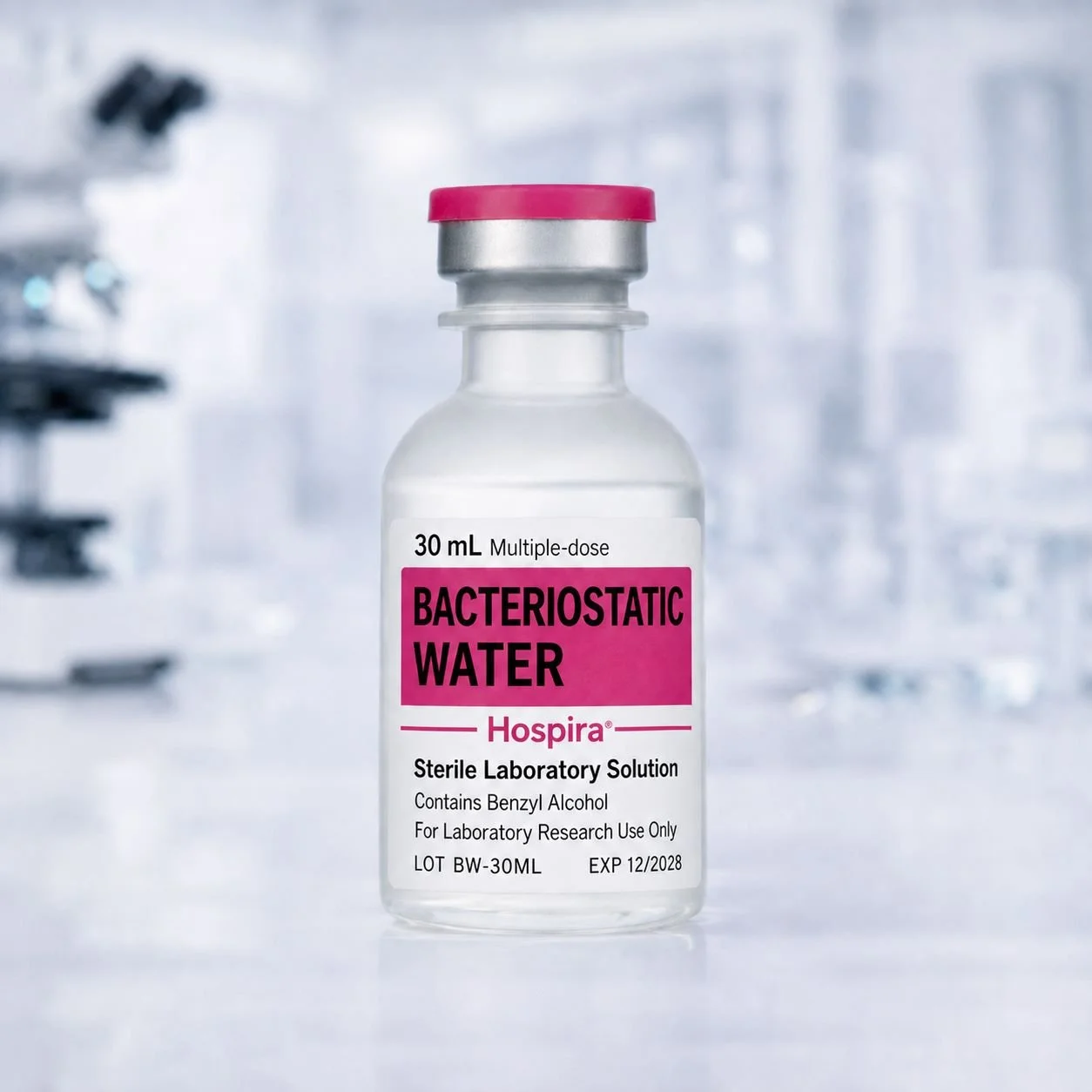
Hospira bacteriostatic water, peptide labs
Disclaimer
This article is intended for educational and laboratory research information purposes only. It does not provide medical advice, dosing guidance, or therapeutic recommendations. Researchers should always consult manufacturer specifications, Certificates of Analysis (COAs), and published stability data when designing experiments.
Why the Choice of Bacteriostatic Water Matters in Peptide Research
In peptide research, the quality of the reconstitution solution can significantly influence experimental consistency, peptide stability, solubility, and storage outcomes. While sterile water is commonly used for immediate-use preparations, many laboratories specify Hospira bacteriostatic water when repeated withdrawals from a reconstituted vial are required. Hospira (Pfizer) BAC Water contains:
Sterile Water for
Injection 0.9% benzyl alcohol as a preservative
Controlled pharmaceutical manufacturing standards
Multi-use vial compatibility
Using a consistent and high-quality reconstitution medium can help reduce variables that may
affect peptide stability studies, solubility assessments, and analytical testing. Related Research Products: Bacteriostatic Water: https://bluenexlabs.com/product/bacteriostatic-water/ Research Peptides Collection: https://bluenexlabs.com/product-category/research-peptides/ Peptide Storage and Handling Guide: /research What Is the pH of Hospira BAC Water?
Hospira Bacteriostatic
Water typically has a pH range that falls approximately between 4.5 and 7.0, although batch-to-batch variation may occur within manufacturer specifications. Many researchers focus on peptide purity while overlooking a critical factor which is the pH and quality of the BAC Water used. Hospira BAC water has been proven to be consistently proper in pH and sterility.
The peptide's stability at specific pH levels. Every peptide possesses unique amino acid sequences and structural characteristics that may become more or less stable depending on solution pH. Potential outcomes include:
Deamidation Oxidation Aggregation Hydrolysis Solubility reduction
Loss of analytical integrity
These effects may influence research reproducibility and long-term storage studies.
How pH Can Affect Peptide Stability 1. Deamidation Deamidation occurs when amino acid residues such as: Asparagine (Asn) Glutamine (Gln) undergo chemical conversion over time.
Potential Consequences
Formation of peptide variants Reduced analytical consistency Altered chromatographic profiles Decreased purity measurements Peptides Potentially Sensitive Examples may include:
Semaglutide Tirzepatide Retatrutide GLP-1 analogs
Multi-chain research peptides
Prevention Strategies ✅ Maintain recommended storage temperatures ✅
Minimize storage time in solution ✅
Use freshly reconstituted preparations when possible ✅
Avoid repeated temperature cycling ✅
Store according to manufacturer guidance 2.
Peptide Aggregation
Some peptides naturally tend to aggregate when exposed to certain pH ranges. Aggregation may produce: Cloudiness Reduced solubility Visible particulate formation Variable concentrations between aliquots Peptides Frequently Discussed for Aggregation Concerns CJC-1295 Ipamorelin GHRP-based peptides Certain growth hormone secretagogues Prevention Strategies ✅ Reconstitute slowly ✅ Avoid vigorous shaking ✅ Gently swirl until dissolved ✅ Use appropriate storage temperatures ✅ Avoid excessive concentration levels 3.
Oxidation Oxidation can occur when susceptible amino acids such as: Methionine Cysteine Tryptophan are exposed to oxygen or unfavorable storage conditions. Potential Consequences Purity degradation Additional impurity peaks Reduced stability Peptides Potentially Sensitive BPC-157 Thymosin variants Certain GLP analogs Oxytocin Tesamorelin Prevention Strategies ✅ Limit light exposure ✅ Keep vials sealed ✅ Store refrigerated when appropriate ✅ Minimize air exposure after reconstitution ✅ Avoid repeated warming cycles 4.
Hydrolysis Hydrolysis is a chemical breakdown process that can occur in aqueous solutions over time. Even highly purified peptides may gradually degrade after prolonged exposure to water.
Possible Effects
Shortened shelf life Reduced purity Fragment formation Stability losses Peptides Often Studied for Hydrolytic Stability Long-chain peptides GLP-1 analogs Multi-amino-acid signaling peptides Prevention Strategies ✅ Reconstitute only when needed ✅ Use smaller aliquots ✅ Avoid extended room-temperature storage ✅ Follow recommended storage conditions How Benzyl Alcohol May Influence Peptide Research One distinguishing feature of Hospira BAC Water is the inclusion of 0.9% benzyl alcohol.
The preservative helps reduce microbial contamination risks in multi-use research situations. However, researchers should recognize that some peptides may respond differently to preserved versus non-preserved diluents. Potential considerations include:
Solubility differences
Stability variation
Changes in long-term storage outcomes
Potential incompatibilities with highly sensitive molecules
For this reason, many laboratories evaluate: Sterile water BAC water Buffered solutions to determine optimal conditions for specific peptides.
Peptide-Specific Reconstitution Considerations Semaglutide Common Challenges Deamidation
Long-term aqueous stability concerns Best Practices Refrigerated storage Avoid prolonged room-temperature exposure Minimize repeated freeze-thaw cycles Tirzepatide Common Challenges Stability reduction during extended storage Environmental degradation Best Practices Use high-quality reconstitution media Store consistently at recommended temperatures Limit unnecessary agitation Retatrutide Common Challenges Potential degradation over extended storage periods Best Practices Maintain cold-chain storage Avoid excessive handling Use freshly prepared solutions when practical BPC-157 Common Challenges Oxidative degradation Temperature sensitivity Best Practices Protect from light Maintain refrigerated conditions Avoid repeated warming CJC-1295 Common Challenges Aggregation at unsuitable concentrations Solubility inconsistencies Best Practices Reconstitute carefully Avoid vigorous shaking Use appropriate solution volumes Why Many laboratories often specify Hospira BAC Water Hospira has become a widely recognized name because of:
Consistent Pharmaceutical Manufacturing Researchers value:
Quality controls
Sterility assurance
Reliable specifications
Multi-Use Compatibility
The addition of benzyl alcohol helps reduce contamination concerns associated with repeated vial access. Reproducibility Using a standardized diluent helps researchers minimize one variable when evaluating peptide performance.
Availability Hospira BAC
Water is widely used in research and laboratory environments throughout: Canada United States Europe Storage Recommendations After Reconstitution General research best practices include: ✅ Refrigerate reconstituted peptides when appropriate ✅ Avoid unnecessary freeze-thaw cycles ✅ Protect from excessive heat ✅ Minimize exposure to direct light ✅ Label preparation and storage dates ✅ Monitor for changes in clarity or appearance ✅ Use sterile handling procedures Frequently Asked Questions (FAQ) What is Hospira (Pfizer) BAC Water?
Hospira Bacteriostatic
Water is sterile water containing 0.9% benzyl alcohol as a preservative. It is commonly used as a laboratory diluent and reconstitution medium for various research applications. Why is pH important when reconstituting peptides? pH can influence peptide solubility, aggregation behavior, oxidation susceptibility, deamidation rates, and overall stability, making it an important variable in research studies.
Can BAC Water affect peptide stability?
Yes. Different peptides may respond differently to preserved solutions, pH conditions, storage temperatures, and handling procedures. Stability should be evaluated individually for each peptide.
Why do some peptides become cloudy after reconstitution?
Cloudiness can result from aggregation, concentration-related solubility limitations, temperature changes, or incompatibilities between the peptide and diluent.
Is Hospira (Pfizer) BAC Water better than sterile water?
Neither is universally superior. Researchers choose between BAC water, sterile water, or buffered solutions based on study design, storage requirements, and peptide-specific characteristics. Hospira BAC water offers a longer shelf-life than Sterile water.
Does benzyl alcohol damage peptides?
Many peptides remain stable in BAC water under appropriate conditions, but certain molecules may exhibit different stability profiles. Researchers should review available stability data for the peptide being studied.
How can researchers reduce peptide degradation?
Researchers commonly: Use proper storage temperatures Minimize repeated vial access Avoid vigorous agitation Limit light exposure Reduce freeze-thaw cycles Follow manufacturer recommendations Conclusion The selection of an appropriate reconstitution medium is an often-overlooked aspect of peptide research.
Hospira BAC
Water is frequently chosen because of its sterility, preservative system, and consistency. However, researchers should recognize that peptide stability is influenced by multiple factors, including pH, oxidation potential, aggregation tendencies, hydrolysis rates, and storage conditions. Understanding these factors can improve research reproducibility, reduce variability, and help maintain peptide integrity throughout the study period.
Research-use only. BlueNex Labs does not provide medical or veterinary advice. Confirm your institution’s policies before purchase.