Research · 2025-09-21
What is TB-500? Actin-fragment research
TB-500 Research Overview
TB-500 is covered here on its own as a thymosin beta-4 fragment in actin-binding and cell-migration models. The note that pairs it with BPC-157 is a different page.
This page provides laboratory-focused information for TB-500. Content is intended for research use only and should be read with the published documentation and analytical data.
> Research-use notice: This article is educational laboratory context only. It is not medical advice. No dosing, administration, or human-use guidance is provided. BlueNex Labs research-use-only products are not intended for human or veterinary use.
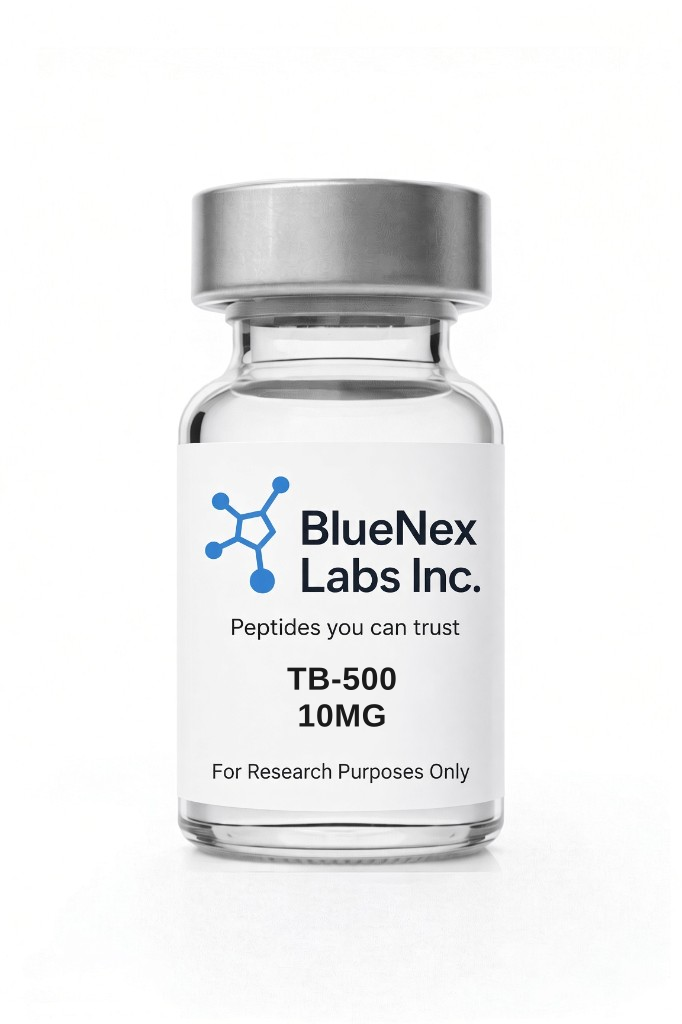
TB-500 is a synthetic peptide fragment modeled on an actin-binding region of thymosin beta-4. Research groups use it to probe cytoskeletal dynamics, cell migration, and angiogenesis signaling. This page is a TB-500-only research guide. It is not the paired BPC-157 note. The single-peptide SKU is the TB-500 10mg product page.
Structure
Published descriptions usually emphasize:
A short fragment built around the actin-binding motif of thymosin beta-4, rather than the full-length protein
A different sequence from thymosin alpha-1, which is a 28-residue thymic peptide covered in What is Thymosin Alpha-1? Immune-model note
Lyophilized fills whose mass and purity are lot-specific when a Certificate of Analysis is published
Separation from dual-peptide vials that also contain BPC-157
The 5mg/5mg blend and the 10mg/10mg blend are different SKUs. A blend certificate does not document the TB-500-only vial.
Mechanisms discussed in research settings
Papers place the thymosin beta-4 fragment in:
Actin-binding and cytoskeletal-polymerization assays
Cell-migration and motility models
Angiogenesis and vascular-signaling readouts in controlled systems
Comparisons with BPC-157, which are summarized separately in BPC-157 and TB-500 as paired lab topics
That pairing article is a literature note about two sequences. This page stays with TB-500 alone. Neither page is a protocol.
What this guide is not
It is not a “buy the stack” landing. The BPC-157 pentadecapeptide has its own guide: What is BPC-157? Structure & research. Cellular SKUs as a group are listed under Cellular & Biological Peptides Canada.
Documentation and RUO
Identity and purity are analytical questions. How to read a peptide Certificate of Analysis explains HPLC versus mass spectrometry. Batch reports for this SKU appear in the certificates library when a lot is published.
Research-use only. Not for human or veterinary use.
Research-use only. BlueNex Labs does not provide medical or veterinary advice. Confirm your institution’s policies before purchase.