
Research · 2026-11-22
By Alice Kay · Last reviewed 22 Nov 2026
SNAP-8 peptide in Canada: structure, literature and lot checks
Research-use notice: This article summarizes published scientific literature for educational purposes. It is not medical advice and does not provide dosing, administration or human-use information. Findings described in the literature do not apply to any BlueNex Labs product, which is supplied only for in-vitro laboratory research and not for human or animal use.
Direct answer
SNAP-8 peptide is the trade name for acetyl octapeptide-3, a linear eight-residue synthetic peptide: Ac-Glu-Glu-Met-Gln-Arg-Arg-Ala-Asp-NH2 (Ac-EEMQRRAD-NH2).
Scope
Tissue, matrix & repair models. BPC-157, GHK-Cu, TB-500, and related matrix or cell-migration papers. Educational overviews, not product listings.
This note does not claim that Alice Kay authored any cited paper.
Direct answer
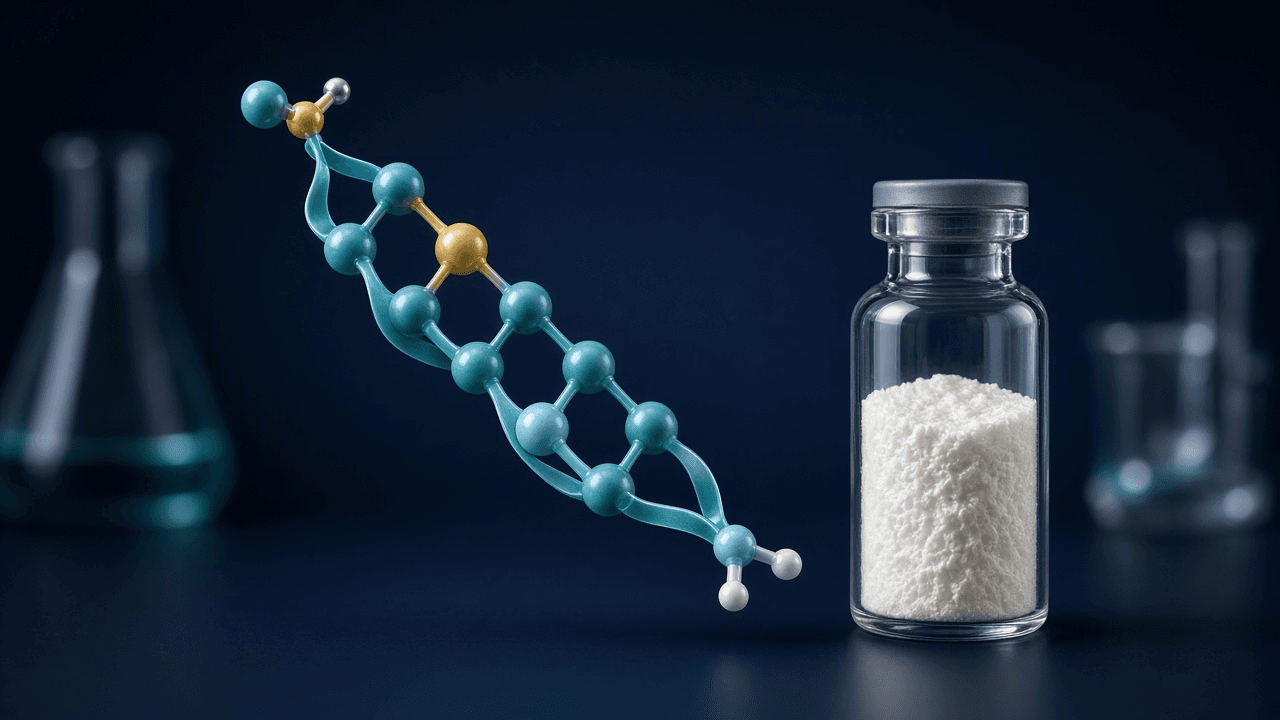
SNAP-8 peptide is the trade name for acetyl octapeptide-3, a linear eight-residue synthetic peptide: Ac-Glu-Glu-Met-Gln-Arg-Arg-Ala-Asp-NH2 (Ac-EEMQRRAD-NH2). PubChem lists the formula C41H70N16O16S, an average molecular weight of 1075.2 g/mol and CAS 868844-74-0. Its core matches residues 12 to 19 of human SNAP-25. In Canada, BlueNex Labs supplies it for in-vitro laboratory research only.
Scope
Laboratory notes on SNAP-25 fragment peptides and analytical literature. Educational overviews, not product listings.
This note does not claim that Alice Kay authored any cited paper.
SNAP-8 is a trade name for acetyl octapeptide-3. It is not the SNAP-25 protein itself, and it is not the same molecule as the shorter hexapeptide Ac-EEMQRR-NH2 described by Blanes-Mira and colleagues in 2002. Shin, Han, Yoon, Jeong and Park (2024) write the octapeptide as Ac-Glu-Glu-Met-Gln-Arg-Arg-Ala-Asp-NH2. PubChem lists acetyl octapeptide-3 under CID 76283482, with the formula C41H70N16O16S, an average molecular weight of 1075.2 g/mol, an exact mass of 1074.488 Da and the CAS number 868844-74-0. UniProt record P60880, the canonical 206-residue human SNAP-25 sequence, reads EEMQRRAD at residues 12 to 19.
BlueNex Labs lists SNAP-8 10 mg as a research-use-only material and ships it within Canada. This guide covers the structure of the SNAP-8 peptide, how it differs from the related hexapeptide, what the opened papers actually test, and what to check on a lot. It does not cover dosing, administration or any use in people or animals. The product page states that the listing is not a drug, food, cosmetic or natural health product, and is not for ingestion, injection or topical application.
SNAP-8 at a glance
| Property | Value | Source |
|---|---|---|
| Names | SNAP-8; acetyl octapeptide-3; also listed as acetyl glutamyl heptapeptide-3 | Shin et al., 2024; Ji et al., 2020; PubChem synonyms |
| Sequence (three-letter) | Ac-Glu-Glu-Met-Gln-Arg-Arg-Ala-Asp-NH2 | Shin et al., 2024; PubChem |
| Sequence (one-letter) | Ac-EEMQRRAD-NH2 | Shin et al., 2024; UniProt P60880 (core residues) |
| Length | 8 residues (octapeptide), N-acetylated, C-amidated | Shin et al., 2024; PubChem |
| SNAP-25 alignment | Residues 12–19 of human SNAP-25 (EEMQRRAD) | UniProt P60880 |
| Molecular formula | C41H70N16O16S | PubChem CID 76283482 |
| Molecular weight | 1075.2 g/mol (average); exact mass 1074.488 Da | PubChem CID 76283482 |
| CAS number | 868844-74-0 | PubChem CID 76283482 |
Structure: eight residues, an acetyl cap and an amide
SNAP-8 is short enough to read residue by residue. Shin and colleagues give Ac-Glu-Glu-Met-Gln-Arg-Arg-Ala-Asp-NH2. In one-letter code that is Ac-EEMQRRAD-NH2. The chain is linear, and there is no disulfide.
Two end groups matter for mass:
The N-terminus is acetylated (Ac-), not a free amino group.
The C-terminus is an amide (–NH2), not a free carboxylic acid.
The eight letters in the middle match a documented stretch of SNAP-25. The UniProt canonical sequence for human SNAP-25 (P60880; 206 residues) begins MAEDADMRNELEEMQRRADQLADES… Counting from the initiator methionine, residues 12 to 19 are EEMQRRAD. Residues 12 to 17 are EEMQRR, the window Blanes-Mira and colleagues used for the hexapeptide. Residues 18 and 19 are alanine and aspartic acid, the two residues that distinguish the octapeptide core from that hexapeptide.
A receiving log should not treat “SNAP-8,” “SNAP-25” and “acetyl hexapeptide” as interchangeable names. SNAP-25 is a 206-residue protein. The catalogue peptide is an eight-residue, end-capped fragment of one short stretch of that protein. A primer on what peptides are is useful background; it does not make this analogue the parent protein.
How SNAP-8 differs from the SNAP-25 hexapeptide
Blanes-Mira, Clemente, Jodas, Gil, Fernández-Ballester, Ponsati, Gutierrez, Pérez-Payá and Ferrer-Montiel (2002), in the International Journal of Cosmetic Science, described a hexapeptide, Ac-EEMQRR-NH2, patterned after amino acids 12 to 17 of the N-terminal domain of SNAP-25. In that paper the authors reported that the hexapeptide interfered with the formation or stability of the SNARE complex and inhibited calcium-dependent catecholamine release in chromaffin-cell experiments. They also reported a topical emulsion study in healthy volunteers. Those results belong to the hexapeptide they tested. They are not a data set for acetyl octapeptide-3.
Built from its sequence, the hexapeptide Ac-EEMQRR-NH2 (acetyl hexapeptide-3, CAS 616204-22-9) has the formula C34H60N14O12S and an average molecular weight of about 889.0 g/mol; the MedChemExpress record for that CAS number gives the same formula and 888.99. One caution for anyone checking against databases: the PubChem record for acetyl hexapeptide-3 (CID 71587772) currently shows C35H62N14O11S and 887.0 g/mol, because its deposited structure carries a carbon–carbon double bond where the first peptide carbonyl should be. On the sequence-based figure, the octapeptide is heavier by about 186 g/mol, the combined residue mass of the added alanine and aspartic acid. A mass spectrum should separate the two sequences. A certificate that names only “SNAP” or only “acetyl peptide” is not enough to tell them apart.
Ji, Lee, Kim, Seo, Choi, Oh, Min, Park, Kim, Jeong and Paik (2020), in the Journal of Analytical Science and Technology, used acetyl hexapeptide-3 as the internal standard in an LC-MS/MS method for acetyl octapeptide-3. They selected the [M+2H]2+ ions as precursors, at m/z 538 for the octapeptide and m/z 445 for the hexapeptide internal standard; the [M+H]+ ions, at m/z 1076 and m/z 890, were detected at low intensity. That instrumental split is consistent with two different masses, not with one interchangeable peptide, and the hexapeptide ions fit the sequence-based mass near 889 Da.
What the opened papers actually test
The peer-reviewed record for the octapeptide itself is thin, and it is easy to over-read.
Ji and colleagues (2020) developed a liquid chromatography–tandem mass spectrometry method for quantifying acetyl octapeptide-3, including in extracts of a biodegradable microneedle patch. They reported linearity with r ≥ 0.9971 and a limit of quantification of 0.0125 ng/mg in the results section; the abstract gives the same figure as 0.0125 ng/mL. They also found the peptide stable for at least 96 hours in distilled water at 4 °C under the conditions of that test. The paper is an analytical method. Its abstract and introduction repeat commercial claims about wrinkle improvement and about being “more effective” than the hexapeptide; those statements are not measurements from the method, and this note does not adopt them. What the work does establish is that the named octapeptide can be detected and quantified by LC-MS/MS. It also shows that a patch matrix can change the calculated amount if the calibration does not include that matrix; the authors report that the matrix-matched curve gave a result 16.3% smaller than the water-based curve.
Shin, Han, Yoon, Jeong and Park (2024), in Annals of Dermatology, studied a dissolving microneedle patch that combined SNAP-8 with L-ascorbic acid 2-glucoside (AA2G), sodium cyclic lysophosphatidic acid (NcPA) and hyaluronic acid. It was compared with a hyaluronic-acid-only placebo patch, with the active patch applied to the area around one eye and the placebo to the other. Twenty-four subjects aged 30 to 65 were enrolled; three dropped out, and 21 completed the study. The authors reported instrumental differences between the active and placebo sides over 28 days and no adverse effects in that study. Those results are for the multi-ingredient patch versus hyaluronic acid. They cannot be assigned to acetyl octapeptide-3 alone.
Avcil, Akman, Klokkers, Jeong and Çelik (2020), in the Journal of Cosmetic Dermatology, studied hyaluronic-acid microneedle patches loaded with arginine/lysine polypeptide, acetyl octapeptide-3, palmitoyl tripeptide-5, adenosine and seaweed extracts, in a monocentric 12-week trial on healthy subjects with aged skin. The abstract reports instrumental skin measurements for the whole patch and states that the product was well tolerated. The same abstract says the composition “works in a multi-targeted manner and all ingredients might possibly be acted synergistically.” There is no basis in that report for isolating acetyl octapeptide-3 as the cause of any measured change, and the abstract does not describe a control arm.
No paper opened for this note reports a SNARE-complex or neurotransmitter-release assay that used acetyl octapeptide-3 as the sole test article. Mechanism language that is sometimes attached to SNAP-8 in catalogue copy is often borrowed from the 2002 hexapeptide paper or from later secondary descriptions. Those borrowings should be labelled as such.
What has not been shown, and what the Canadian listing is
No opened source identifies a Health Canada–authorized SNAP-8 medicine. A Drug Product Database search on 22 November 2026 for the ingredient names “acetyl octapeptide” and “SNAP-8” returned no records. That result is a database record, not a regulatory determination: it only shows that those ingredient searches did not return an authorized human drug under those names.
BlueNex Labs materials are not medicines, foods, cosmetics or natural health products, are not authorized by Health Canada, and are not for human or animal use. The product page states that the material is not for ingestion, injection or topical application. Papers that test cosmetic patches or emulsions describe those finished articles. They do not describe this catalogue vial, and they are not a use instruction. A separate note, Are research peptides legal in Canada?, covers the broader research-use context.
Neighbouring catalogue peptides are not substitutes
SNAP-8 sometimes sits in the same conversation as other matrix or skin-biology research materials. They are not the same sequence.
GHK-Cu 50 mg is a copper tripeptide with its own literature note, GHK-Cu copper peptide in Canada.
KLOW 80 mg and GLOW 70 mg are multi-peptide blends; see the KLOW blend documentation note and the GLOW blend documentation note. A blend certificate does not document SNAP-8 10 mg.
KPV 10 mg is an alpha-MSH fragment, covered in What is KPV?.
A wider literature survey is in peptides in skin-aging biology models. That page does not make the vials interchangeable.
What to check on a SNAP-8 lot
As of the product page opened for this note, SNAP-8 10 mg did not have a published Certificate of Analysis in the certificates library. The absence of a public file is not a substitute result. If a report is later posted, or supplied with a lot, the useful checks are:
The name on the report matches the vial: SNAP-8, acetyl octapeptide-3, or Ac-EEMQRRAD-NH2, not “SNAP-25” and not the hexapeptide Ac-EEMQRR-NH2.
Identity is supported by mass spectrometry or LC-MS, against an expected average mass near 1075.2 Da, not against the hexapeptide mass near 889 Da. Ji and colleagues show that LC-MS/MS can resolve the octapeptide from an acetyl-hexapeptide internal standard. How peptide purity is measured explains the usual HPLC and LC-MS distinction.
Purity is a peak-area result for that lot. How to read a peptide Certificate of Analysis walks through the usual fields.
The fill size and lot identifier on the vial match the report. Publishing rules are on the COA documentation standards page.
Storage follows the lot file and ordinary lyophilized-peptide practice; see the peptide storage guide for Canadian labs and the note on why labs use lyophilized research peptides.
None of these steps is a protocol for use.
SNAP-8 peptide in Canada: catalogue and fulfilment notes
BlueNex Labs is a Burnaby, B.C., catalogue for lyophilized research materials, with Interac e-Transfer payment and Canada Post Xpresspost shipping inside Canada only. Size, stock and current terms stay on the SNAP-8 10 mg product page; this article is not a storefront and does not list prices. Other guides live on the peptide research hub.
The listing is research use only. It is not a medicine, food, cosmetic or natural health product, is not authorized by Health Canada, and is not for human or animal use.
FAQ
What is SNAP-8 peptide?
SNAP-8 is a trade name for acetyl octapeptide-3, a linear eight-residue peptide written as Ac-Glu-Glu-Met-Gln-Arg-Arg-Ala-Asp-NH2 (Ac-EEMQRRAD-NH2). The eight-residue core matches residues 12 to 19 of human SNAP-25 in UniProt P60880. BlueNex Labs supplies it only as a research-use-only material, not as a medicine or a cosmetic.
What are the formula, molecular weight and CAS number of acetyl octapeptide-3?
PubChem CID 76283482 lists acetyl octapeptide-3 with the formula C41H70N16O16S, an average molecular weight of 1075.2 g/mol, an exact mass of 1074.488 Da and CAS number 868844-74-0.
Is SNAP-8 the same as SNAP-25 or as Argireline?
No. SNAP-25 is a 206-residue protein. The shorter peptide Ac-EEMQRR-NH2, called Argireline in Blanes-Mira et al. (2002) and also known as acetyl hexapeptide-3, matches SNAP-25 residues 12 to 17. SNAP-8 keeps that window and adds alanine and aspartic acid (residues 18 and 19), with the same acetyl and amide end caps. The two peptides have different masses, about 1075 versus 889 g/mol, and should not share a certificate.
Do published cosmetic-patch studies isolate SNAP-8?
No. The two human studies opened for this note used multi-ingredient microneedle patches. Shin et al. (2024) tested SNAP-8 together with AA2G and NcPA against a hyaluronic-acid placebo. Avcil et al. (2020) tested a patch that also contained other peptides, adenosine and seaweed extracts. Neither report lets a reader assign the measured changes to acetyl octapeptide-3 alone. Those papers describe finished topical articles, not this research-use vial.
Has SNAP-8 been shown, on its own, to block the SNARE complex?
No paper opened for this note reports a SNARE-complex or neurotransmitter-release assay that used acetyl octapeptide-3 as the sole test article. The 2002 Blanes-Mira experiments that discuss SNARE interference were done with the hexapeptide Ac-EEMQRR-NH2.
Is there an authorized SNAP-8 medicine in Canada?
A Health Canada Drug Product Database search on 22 November 2026 for “acetyl octapeptide” and “SNAP-8” returned no drug records. BlueNex Labs lists SNAP-8 10 mg only for in-vitro laboratory research. It is not authorized by Health Canada and is not for human or animal use, including topical application.
What should a laboratory check before assigning a SNAP-8 lot to an assay?
Match the vial name and lot to the Certificate of Analysis, when one exists. Confirm identity by mass spectrometry against the expected octapeptide mass near 1075.2 Da, not the hexapeptide mass near 889 Da, and read the lot's own purity result. As of the product page opened for this note, a public COA had not yet been posted for this SKU.
Sources
1. UniProt Consortium. Synaptosomal-associated protein 25, Homo sapiens (SNAP25), P60880, canonical sequence (206 residues). Residues 12–19 read EEMQRRAD; residues 12–17 read EEMQRR. uniprot.org/uniprotkb/P60880. Accessed 22 November 2026. 2. PubChem. Acetyl octapeptide-3, CID 76283482. National Center for Biotechnology Information. Formula C41H70N16O16S; average molecular weight 1075.2 g/mol; exact mass 1074.48764138 Da; CAS 868844-74-0; synonyms include SNAP-8 and acetyl glutamyl heptapeptide-3. pubchem.ncbi.nlm.nih.gov/compound/76283482. Accessed 22 November 2026. 3. PubChem. Acetyl hexapeptide-3, CID 71587772. National Center for Biotechnology Information. Record lists C35H62N14O11S and 887.0 g/mol; its deposited structure shows a C=C in place of the first peptide carbonyl, so these figures do not match the sequence Ac-EEMQRR-NH2. pubchem.ncbi.nlm.nih.gov/compound/71587772. Accessed 22 November 2026. 4. MedChemExpress. Argireline (acetyl hexapeptide-3), CAS 616204-22-9. Formula C34H60N14O12S; molecular weight 888.99. medchemexpress.com/cas/616204-22-9.html. Accessed 22 November 2026. 5. Blanes-Mira C, Clemente J, Jodas G, Gil A, Fernández-Ballester G, Ponsati B, Gutierrez L, Pérez-Payá E, Ferrer-Montiel A. A synthetic hexapeptide (Argireline) with antiwrinkle activity. Int J Cosmet Sci. 2002;24(5):303-310. PMID 18498523. doi:10.1046/j.1467-2494.2002.00153.x. PubMed 6. Ji M, Lee H-S, Kim Y, Seo C, Choi S, Oh S, Min J, Park H-J, Kim JD, Jeong DH, Paik M-J. Method development for acetyl octapeptide-3 analysis by liquid chromatography-tandem mass spectrometry. J Anal Sci Technol. 2020;11:34. doi:10.1186/s40543-020-00232-8. SpringerOpen 7. Shin JY, Han D, Yoon KY, Jeong DH, Park YI. Clinical safety and efficacy evaluation of a dissolving microneedle patch having dual anti-wrinkle effects with safe and long-term activities. Ann Dermatol. 2024;36(4):215-224. PMID 39082657. PMC11291098. doi:10.5021/ad.23.136. PubMed · PMC 8. Avcil M, Akman G, Klokkers J, Jeong D, Çelik A. Efficacy of bioactive peptides loaded on hyaluronic acid microneedle patches: a monocentric clinical study. J Cosmet Dermatol. 2020;19(2):328-337. PMID 31134751. doi:10.1111/jocd.13009. PubMed
Health Canada. Drug Product Database. Ingredient-name searches for “acetyl octapeptide” and “SNAP-8” returned no records. Accessed 22 November 2026 via the Drug Product Database API.
References
- PMID 18498523
- PMID 39082657
- PMID 31134751
Research use only. BlueNex Labs does not provide medical or veterinary advice. Confirm your institution’s policies before purchase. Lot-file rules for this note are on the documentation standards page. By Alice Kay.