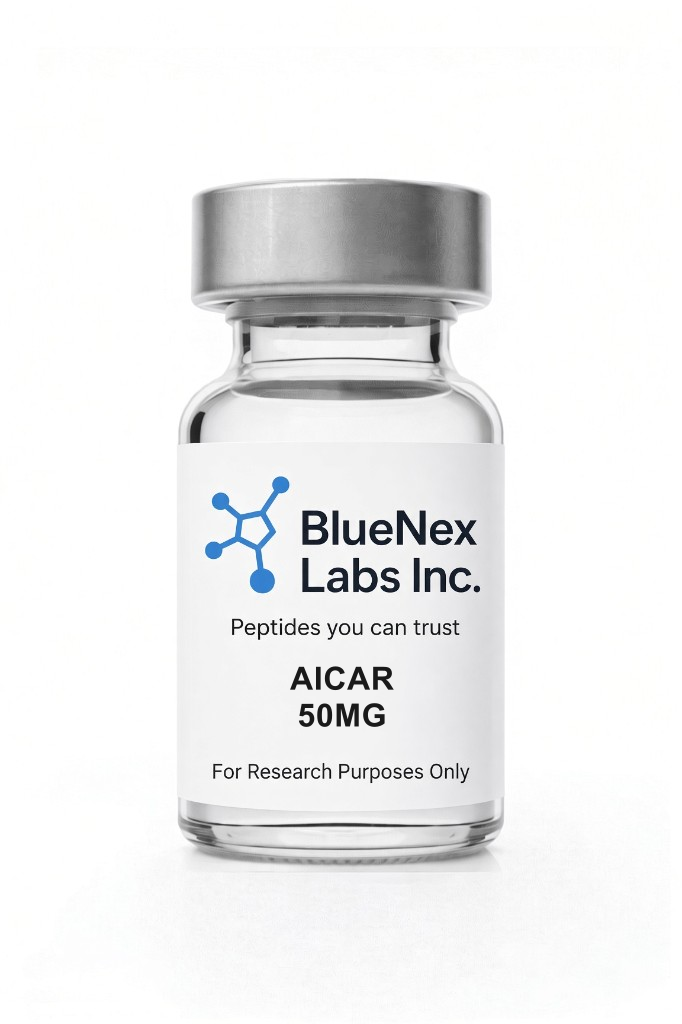
AICAR 50mg Research Material Canada
Research use only. Not for human or veterinary use.
AICAR 50mg is an AMPK-pathway research reagent, not a performance product. Confirm the published lot before an assay. Research-use only.
🧬 AICAR Research Compound | High-Purity AMPK Research Material Canada
High-Purity AICAR for AMPK Signaling, Cellular Energy Research & Metabolic Pathway Studies
AICAR (5-Aminoimidazole-4-carboxamide ribonucleotide), also known as Acadesine in scientific literature, is a well-established biochemical research compound used extensively in laboratory investigations focused on AMP-activated protein kinase (AMPK) signaling, cellular energy sensing, and metabolic pathway regulation.
As a synthetic adenosine nucleotide analog, AICAR is frequently utilized in controlled research models designed to examine how cells detect fluctuations in energy availability and respond through intracellular signaling networks.
BlueNexLabs supplies high-purity AICAR research compound with analytical documentation and Research-Use-Only (RUO) labeling for qualified laboratory and scientific research applications throughout Canada.
🧪 What Is AICAR?
AICAR (5-Aminoimidazole-4-carboxamide ribonucleotide) is a synthetic purine nucleotide analog that has become an important tool compound in molecular biology and biochemical research.
Within laboratory environments, AICAR is primarily studied because of its relationship with cellular energy regulation pathways, particularly those involving AMPK, a conserved protein kinase involved in cellular responses to changes in energy status.
Researchers use AICAR-containing experimental systems to investigate:
- Intracellular energy-sensing mechanisms
- AMP-related signaling pathways
- Cellular adaptation responses
- Metabolic pathway communication
- Bioenergetic regulation
- Mitochondrial signaling networks
AICAR serves as a valuable research model for studying how molecular signals influence cellular behavior under different experimental conditions.
📡Overview AICAR Research Applications
AICAR is widely referenced in scientific research involving cellular signaling, metabolism, and molecular regulation.
Common research areas include:
AMPK Signaling Pathway Research
AMP-activated protein kinase (AMPK) functions as an important cellular energy sensor studied across many areas of molecular biology.
AICAR is commonly used in experimental models investigating:
- AMPK-associated signaling cascades
- Energy availability sensing mechanisms
- Intracellular phosphorylation events
- Regulation of downstream signaling pathways
- Cellular responses to altered energy states
Researchers use AICAR as a biochemical tool to better understand relationships between energy signals and cellular regulation.
Cellular Energy & Bioenergetic Research
Cellular energy balance involves complex interactions between nutrient availability, molecular signaling, and metabolic pathways.
AICAR is studied in laboratory models examining:
- Cellular energy homeostasis
- ATP-related signaling mechanisms
- Bioenergetic adaptation processes
- Energy stress response pathways
- Metabolic communication between cellular systems
These studies help researchers characterize how cells coordinate energy-related processes at the molecular level.
Mitochondrial Function & Metabolic Signaling Studies
Mitochondria play a central role in cellular energy production and metabolic signaling.
Research involving AICAR may include investigations into:
- Mitochondrial signaling pathways
- Cellular respiration models
- Energy utilization mechanisms
- Metabolic adaptation responses
- Molecular pathways associated with mitochondrial activity
AICAR provides researchers with a controlled compound for studying interactions between energy sensing and cellular function.
Metabolic Pathway Research Models
AICAR is frequently included in laboratory investigations exploring complex metabolic networks.
Research applications may include:
- Glucose metabolism pathway studies
- Lipid metabolism signaling research
- Nutrient-response modeling in energy-sensing assays
AICAR is an AMPK-pathway research reagent. It is not a performance or metabolic-health product.
Storage & Handling
- Store lyophilized material at –20 °C, protected from light and moisture
- Reconstituted solutions: 2–8 °C, short-term laboratory use only
- Avoid repeated freeze–thaw cycles; use sterile technique
Documentation
Batch Certificates of Analysis are listed in the certificates library when published. Match vial size and lot notes before assigning a lot to an assay.
Compliance Notice
Research-use only. Not for human or veterinary use. No medical, cosmetic, or performance claims are made or implied.
Molecular characteristics
- form
- Lyophilized powder
- purity
- ≥99% (COA verified)
- use
- Research use only
Documentation (HPLC / UPLC, MS, COA)
Published lots for this SKU are listed at the exact certificate section. Identity is typically confirmed by mass spectrometry; purity by HPLC / UPLC. A report for another peptide or fill size does not document this vial.
Questions about laboratory procurement? Contact BlueNex Labs.