
Research · 2026-11-20
By Alice Kay · Last reviewed 20 Nov 2026
Oxytocin peptide in Canada: structure, receptor and lot checks
Research-use notice: This article summarizes published scientific literature for educational purposes. It is not medical advice and does not provide dosing, administration or human-use information. Findings described in the literature do not apply to any BlueNex Labs product, which is supplied only for in-vitro laboratory research and not for human or animal use.
Direct answer
Oxytocin is a nine-residue cyclic peptide. Its sequence is Cys-Tyr-Ile-Gln-Asn-Cys-Pro-Leu-Gly-NH2, written in one-letter code as CYIQNCPLG-NH2.
Scope
Cognitive & neuroscience models. Sleep-architecture and neuroendocrine peptides discussed in laboratory literature.
This note does not claim that Alice Kay authored any cited paper.
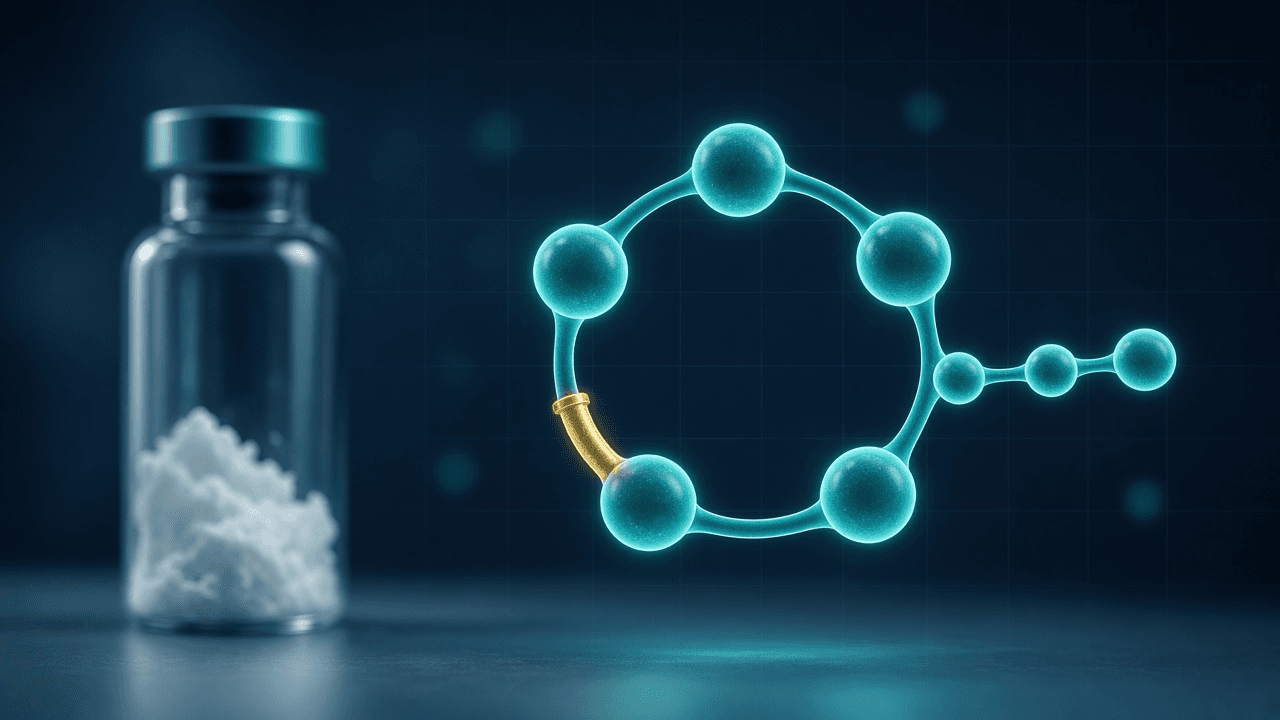
Oxytocin is a nine-residue cyclic peptide. Its sequence is Cys-Tyr-Ile-Gln-Asn-Cys-Pro-Leu-Gly-NH2, written in one-letter code as CYIQNCPLG-NH2. A disulfide bond between the two cysteines (positions 1 and 6) closes a six-residue ring, and the C-terminal glycine ends as an amide. PubChem lists the formula as C43H66N12O12S2, the average molecular weight as 1007.2 g/mol and the CAS number as 50-56-6. In the published literature, oxytocin is the ligand of the oxytocin receptor (OXTR), a G protein-coupled receptor.
BlueNex Labs lists Oxytocin 5 mg as a lyophilized research-use-only material and ships it within Canada. This guide covers what the published papers establish about the molecule and its receptor, how oxytocin differs from vasopressin, and what to check on a lot before it goes into an assay. It doesn't cover dosing, administration or any use in people or animals.
Oxytocin at a glance
| Property | Value | Source |
|---|---|---|
| Sequence (three-letter) | Cys-Tyr-Ile-Gln-Asn-Cys-Pro-Leu-Gly-NH2 | Viero et al., 2010; PubChem |
| Sequence (one-letter) | CYIQNCPLG-NH2 | Viero et al., 2010 |
| Length | 9 residues (nonapeptide) | Viero et al., 2010; Yedvabny et al., 2015 |
| Disulfide | Cys1–Cys6, forming the "tocin ring" | Yedvabny et al., 2015; PubChem |
| C-terminus | Glycinamide (–NH2) | Viero et al., 2010; PubChem |
| Molecular formula | C43H66N12O12S2 | PubChem CID 439302 |
| Molecular weight | 1007.2 g/mol (average); monoisotopic mass 1006.44 Da | PubChem CID 439302 |
| CAS number | 50-56-6 | PubChem CID 439302 |
| Receptor | Oxytocin receptor (OXTR), a class I GPCR coupled mainly through Gq | Kimura et al., 1992; Gimpl and Fahrenholz, 2001 |
These are reference values for the named compound. They aren't lot results. A lot's identity and purity are whatever its own Certificate of Analysis reports.
Sequence, ring and tail
Oxytocin is short enough to read residue by residue. Viero and colleagues, in a 2010 review in CNS Neuroscience & Therapeutics, describe it as "a peptide of only nine amino acids": cysteine, tyrosine, isoleucine, glutamine, asparagine, cysteine, proline, leucine and glycinamide. They note that the cysteines form a sulfur bridge.
The structure has two parts:
The ring. Positions 1 to 6 (Cys-Tyr-Ile-Gln-Asn-Cys) are closed by the disulfide between the two cysteines. Yedvabny and colleagues (Journal of Physical Chemistry B, 2015) call this the tocin ring, the feature that oxytocin shares with vasopressin.
The tail. Positions 7 to 9 (Pro-Leu-Gly) hang off the ring as a short open chain. The final glycine carries an amide (–NH2) instead of a free carboxylic acid.
Both features affect identity testing. The amide changes the mass compared with a free-acid version of the same nine residues. The disulfide means the intact molecule has two fewer hydrogens than the open, reduced chain. Either difference shows up in a mass spectrum, which is why a report that only names "oxytocin" without an observed mass says little.
The site glossary covers the underlying terms: amino-acid residue, disulfide bridge, cyclic peptide, amidation and C-terminus. For how chain chemistry relates to stability, see peptide structure and stability.
Why the 1953 papers called it an octapeptide
Oxytocin has a central place in the history of peptide chemistry. In 1953, Vincent du Vigneaud, Charlotte Ressler and Stuart Trippett published the amino-acid sequence and a proposed structure in The Journal of Biological Chemistry. In the same year, du Vigneaud's group reported a chemical synthesis in the Journal of the American Chemical Society, under the title "The synthesis of an octapeptide amide with the hormonal activity of oxytocin."
"Octapeptide" can look like a contradiction, since modern papers count nine residues. The difference is in how the residues are counted. The 1953 work treated the two disulfide-linked cysteines as a single cystine unit, which gives eight amino acids. Viero et al. make the same point, calling oxytocin "the nonapeptide (or more precisely the octapeptide amide as first described by Vincent du Vigneaud in 1953)." Current literature counts each cysteine separately, which gives nine.
Viero et al. also note that oxytocin was the first peptide hormone to be sequenced and synthesized, and that du Vigneaud received the 1955 Nobel Prize for the work. That prize was in Chemistry. For a wider history, see when were peptides discovered?.
The oxytocin receptor (OXTR)
Most laboratory work on oxytocin centres on its receptor. In 1992, Kimura and colleagues reported in Nature that they had isolated the human oxytocin receptor's complementary DNA by expression cloning. The receptor it encodes is a 388-amino-acid protein with seven transmembrane domains, typical of G protein-coupled receptors (GPCRs). When they expressed it in Xenopus oocytes, the receptor responded specifically to oxytocin and produced an inward membrane current.
In a 2001 review in Physiological Reviews, Gimpl and Fahrenholz describe the oxytocin receptor as "a typical class I G protein-coupled receptor that is primarily coupled via G(q) proteins to phospholipase C-beta." The same abstract notes that the receptor's high-affinity state requires both magnesium ions and cholesterol, and that its agonist-binding region differs from its antagonist-binding site.
These are receptor-classification facts from the papers. They describe the receptor system the literature studies, not a measured property of any catalogue lot. For general background on how peptide ligands act at receptors, see how do peptides work?.
Oxytocin vs vasopressin
Oxytocin and vasopressin are closely related. Yedvabny et al. describe both as cyclic nonapeptides that "differ only by two residues," and note that both have a tocin ring formed by a disulfide between the first and sixth cysteines. PubChem's records show exactly which two residues differ:
| Oxytocin | Vasopressin (arginine vasopressin) | |
|---|---|---|
| Sequence | CYIQNCPLG-NH2 | CYFQNCPRG-NH2 |
| Position 3 | Isoleucine (I) | Phenylalanine (F) |
| Position 8 | Leucine (L) | Arginine (R) |
| Disulfide | Cys1–Cys6 | Cys1–Cys6 |
| Formula | C43H66N12O12S2 | C46H65N15O12S2 |
| Molecular weight | 1007.2 g/mol | 1084.2 g/mol |
| CAS | 50-56-6 | 113-79-1 |
Yedvabny et al. note that this similarity is linked experimentally to cross-activity between the two hormones' receptors. For lab records, the point is simpler: the two names aren't interchangeable. A report for one doesn't document the other, and the roughly 77 g/mol mass difference makes them easy to tell apart by mass spectrometry.
What to check on an oxytocin lot
A label tells you what a supplier says is in the vial. A lot report tells you what was measured. When an oxytocin lot report is available, check four things:
The name and lot match the vial. The sample name, lot number and fill size on the report should match the container you have.
The observed mass matches the amidated, disulfide-closed peptide. It should agree with about 1006.4 Da (monoisotopic) or 1007.2 g/mol (average). A free-acid version would come in about 1 Da higher, and the open, reduced chain about 2 Da higher.
Purity is reported by a named method, usually HPLC, with the chromatogram or its summary attached.
The report belongs to this lot, not a different batch or a different peptide.
As of 20 November 2026, the Oxytocin 5 mg product page shows that no Certificate of Analysis is published for this SKU yet, and it doesn't list a lot number. When a report is added, it will appear on the product page and in the certificates library. For a step-by-step walkthrough, see how to read a peptide certificate of analysis, how peptide purity is measured and the endotoxin testing note.
Buying oxytocin for research in Canada
The Oxytocin 5 mg product page has the current price, stock and any active offer. This article doesn't quote them, so it won't go out of date when they change. A few things stay the same:
Format: 5 mg of lyophilized powder per vial, listed under Cellular & Tissue Research.
Shipping: orders ship from Burnaby, BC by Canada Post Xpresspost within Canada.
Payment: Interac e-Transfer. The Canada laboratory procurement note explains how ordering and receiving work.
Status: research use only. The product page carries the full research-use statement, which governs this material.
If you're comparing suppliers, how to verify a Canadian peptide supplier sets out what to ask for before ordering. The Canadian regulatory background is covered in are research peptides legal in Canada?.
What this guide does not cover
This guide doesn't give a diluent, volume, concentration, storage temperature or route, and it doesn't describe any effect in people or animals. Reconstitution and handling belong to the laboratory's own procedure and the product note supplied with the vial. For general background, see lyophilized research peptides and the peptide storage and handling guide for Canadian laboratories. Social media claims about oxytocin are no substitute for a sequence, a receptor class or a lot report. The viral peptide claims versus evidence note explains why.
Frequently asked questions
What is the amino acid sequence of oxytocin?
Oxytocin is Cys-Tyr-Ile-Gln-Asn-Cys-Pro-Leu-Gly-NH2 (CYIQNCPLG-NH2). It has nine residues, a disulfide bond between Cys1 and Cys6, and an amidated C-terminal glycine. This is the sequence given by Viero et al. (2010) and the PubChem compound record.
What are oxytocin's molecular formula, molecular weight and CAS number?
PubChem (CID 439302) lists the formula C43H66N12O12S2, an average molecular weight of 1007.2 g/mol (monoisotopic mass 1006.44 Da) and CAS number 50-56-6. These are reference values for the compound, not results for any particular lot.
How is oxytocin different from vasopressin?
The two peptides differ at two positions: isoleucine versus phenylalanine at position 3, and leucine versus arginine at position 8 (CYIQNCPLG-NH2 versus CYFQNCPRG-NH2). Both have a Cys1–Cys6 disulfide and an amidated C-terminus. Vasopressin's molecular weight is 1084.2 g/mol, so a mass spectrum can tell the two apart.
What receptor does oxytocin act on in published research?
The oxytocin receptor (OXTR). Kimura et al. (1992) cloned the human receptor and described it as a 388-amino-acid G protein-coupled receptor with seven transmembrane domains. Gimpl and Fahrenholz (2001) describe it as a class I GPCR coupled mainly through Gq proteins to phospholipase C-beta.
Is research-use oxytocin a Health Canada-authorized medicine?
No. BlueNex Labs supplies research materials to qualified buyers for in-vitro laboratory research only. Products are not drugs, foods, cosmetics or natural health products, are not authorized by Health Canada, and are not for human or animal use. They don't carry a Drug Identification Number (DIN). See are research peptides legal in Canada?.
Does the BlueNex Labs Oxytocin 5 mg have a Certificate of Analysis?
Not yet. As of 20 November 2026, the product page shows that no Certificate of Analysis is published for this SKU. When a lot report is added, it will be linked from the product page and the certificates library. That report, not the reference values on this page, is the identity record for the lot.
References
1. du Vigneaud V, Ressler C, Trippett S. The sequence of amino acids in oxytocin, with a proposal for the structure of oxytocin. J Biol Chem. 1953;205(2):949-957. PMID 13129273. doi:10.1016/S0021-9258(18)49238-149238-1). 2. du Vigneaud V, Ressler C, Swan JM, Roberts CW, Katsoyannis PG, Gordon S. The synthesis of an octapeptide amide with the hormonal activity of oxytocin. J Am Chem Soc. 1953;75(19):4879-4880. doi:10.1021/ja01115a553. 3. Viero C, Shibuya I, Kitamura N, Verkhratsky A, Fujihara H, Katoh A, Ueta Y, Zingg HH, Chvatal A, Sykova E, Dayanithi G. Review: Oxytocin: crossing the bridge between basic science and pharmacotherapy. CNS Neurosci Ther. 2010;16(5):e138-e156. PMID 20626426. PMC2972642. doi:10.1111/j.1755-5949.2010.00185.x. 4. Yedvabny E, Nerenberg PS, So C, Head-Gordon T. Disordered structural ensembles of vasopressin and oxytocin and their mutants. J Phys Chem B. 2015;119(3):896-905. PMID 25231121. doi:10.1021/jp505902m. 5. Kimura T, Tanizawa O, Mori K, Brownstein MJ, Okayama H. Structure and expression of a human oxytocin receptor. Nature. 1992;356(6369):526-529. PMID 1313946. doi:10.1038/356526a0. 6. Gimpl G, Fahrenholz F. The oxytocin receptor system: structure, function, and regulation. Physiol Rev. 2001;81(2):629-683. PMID 11274341. doi:10.1152/physrev.2001.81.2.629. 7. PubChem. Oxytocin, CID 439302. National Center for Biotechnology Information. pubchem.ncbi.nlm.nih.gov/compound/439302. Accessed 20 November 2026. 8. PubChem. Argipressin (arginine vasopressin), CID 644077. National Center for Biotechnology Information. pubchem.ncbi.nlm.nih.gov/compound/644077. Accessed 20 November 2026.
The Nobel Prize in Chemistry 1955: Vincent du Vigneaud. NobelPrize.org. nobelprize.org/prizes/chemistry/1955/summary.
References
- PMID 13129273
- PMID 20626426
- PMID 25231121
- PMID 1313946
- PMID 11274341
- DOI 10.1016/S0021-9258(18
- DOI 10.1021/ja01115a553
- DOI 10.1111/j.1755-5949.2010.00185.x
- DOI 10.1021/jp505902m
- DOI 10.1038/356526a0
- DOI 10.1152/physrev.2001.81.2.629
Research use only. BlueNex Labs does not provide medical or veterinary advice. Confirm your institution’s policies before purchase. Lot-file rules for this note are on the documentation standards page. By Alice Kay.