
Research · 2026-06-01
Scientific lead: Alice Kay, Ph.D.
What is CJC-1295 with Ipamorelin?
Direct answer
CJC-1295 without DAC at 5 mg and ipamorelin at 5 mg share one catalogue vial. Two receptors, two masses, and a blend Certificate of Analysis that does not cover ipamorelin 10 mg.
Scope
Metabolic & energy-signaling models. Incretin, mitochondrial, and secretagogue literature. These notes summarize published models — they are not catalog pages.
Reviewer: Alice Kay, Ph.D., scientific lead. This note does not claim that the reviewer authored any cited paper.
CJC-1295 and Ipamorelin Research Overview
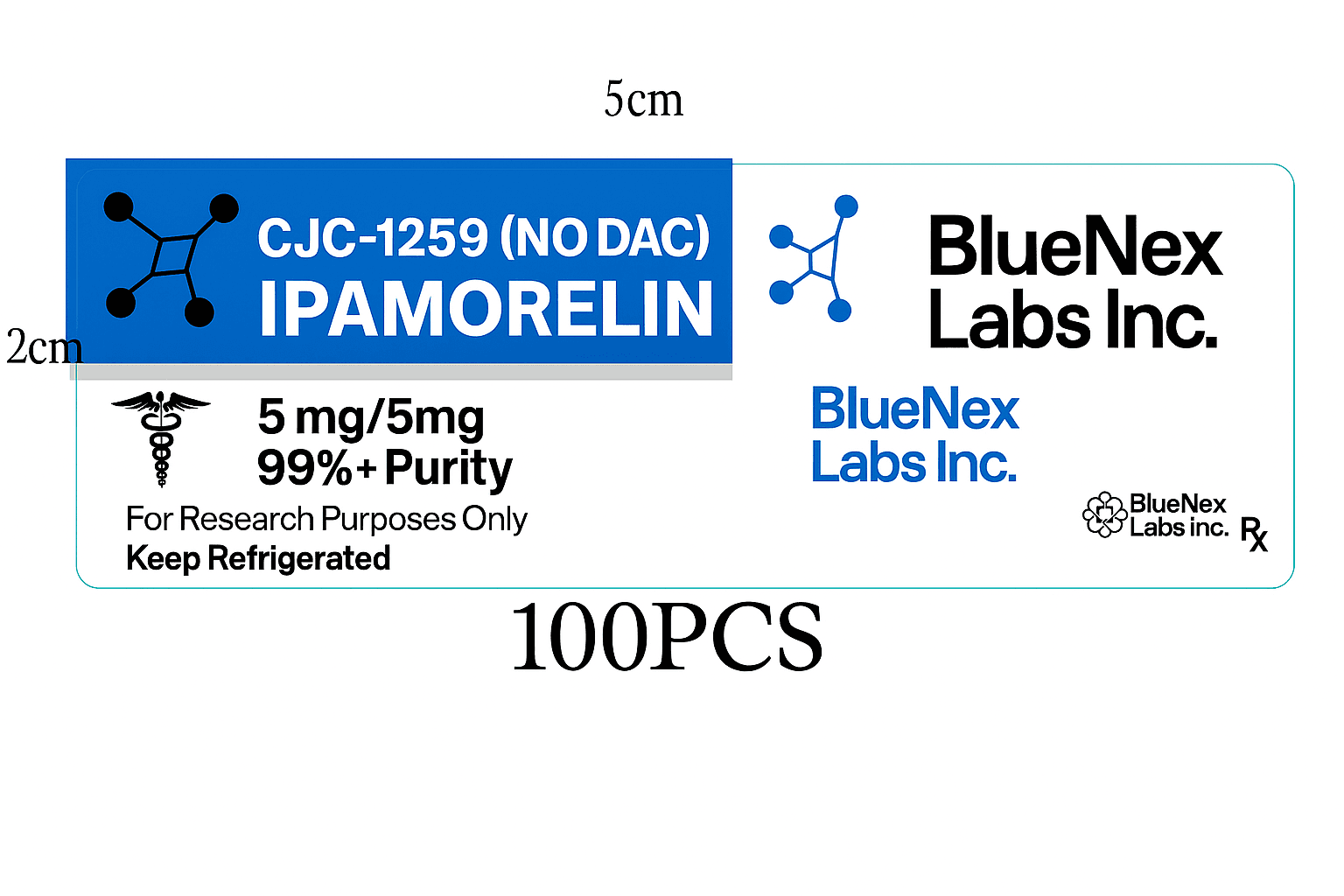
CJC-1295 without DAC and Ipamorelin bind different receptors in growth-hormone signaling models. The live catalog item is the 5mg/5mg blend, documented here as a catalog fill with its own lot file.
This page provides laboratory-focused information for CJC-1295 and Ipamorelin. Content is intended for research use only and should be read with the published documentation and analytical data.
Research-use notice: This article is laboratory and educational information only. It is not medical or legal advice, and it does not include how-to-use instructions. BlueNex Labs materials are research use only and are not intended for human or veterinary use. Research-use-only labelling is not a Health Canada authorization.
Publication status: Prepared for the BlueNex Labs Research Knowledge Centre. Literature and library notes checked September 24, 2026. Primary papers and the public COA library can change; verify the lot report in hand before an assay.
CJC-1295 without DAC and ipamorelin, on this catalogue, share one lyophilized container. The shop URL is CJC-1295 (no DAC) / Ipamorelin 5 mg/5mg. This page is the documentation note for that fill. For the comparison with ipamorelin alone, see CJC-1295 / ipamorelin versus ipamorelin. Neither page is a method. Price and stock stay on the listing. There is no CJC-only shop URL. A bare /shop/cjc-1295 path redirects to the paired fill.
What the vial contains
The product record states two labelled amounts: 5 mg CJC-1295 (no DAC) and 5 mg ipamorelin. Those are catalogue fills for this SKU. They are not a statement that the two sequences are one molecule, and they are not interchangeable with ipamorelin 10 mg. The 10 mg vial is ipamorelin alone. A 5 mg portion inside the blend is not that lot.
Ipamorelin is the synthetic pentapeptide Aib-His-D-2-Nal-D-Phe-Lys-NH2. Raun and colleagues described it in 1998 as a growth hormone secretagogue that, in their pharmacological profiling, acted through a GHRP-like receptor rather than the GHRH receptor (PMID 9849822). In current naming that receptor is GHSR-1a. The aminoisobutyric acid and the D-residues change the calculated mass relative to an all-proteinogenic pentapeptide of the same length. The paper's measurements stay in that paper. They are not a specification on this cake.
CJC-1295, in the Jetté 2005 paper, is a tetrasubstituted analogue of hGRF(1-29) carrying a C-terminal maleimidopropionyl lysine (Endocrinology, DOI 10.1210/en.2004-1286). That group is the drug affinity complex, discussed there as binding albumin. "No DAC" means that albumin-binding group is absent. The remaining backbone is still discussed as a GHRH-receptor analogue. It is not ipamorelin, and it is not sermorelin. A paper on the DAC conjugate does not establish the identity of the no-DAC lot. The mass on the Certificate of Analysis is the identity record.
Class notes are GHRH analogues and GHSR ligands. Glossary lines are CJC-1295 (no DAC) and ipamorelin. Sermorelin and tesamorelin have their own laboratory notes. They are not nicknames for this backbone.
Why a blend Certificate of Analysis is a different document
A single-compound Certificate of Analysis names one sequence, one observed mass, and a purity figure for the peak the laboratory assigned. A blend file has to be read as a multi-component record. Component identification means each mass the PDF prints is copied next to the sequence the PDF assigns. If the file prints one purity figure and does not assign that figure to one component, copy the figure once and write that it was not split by sequence. Do not divide it by the number of names on the label. A single-peptide area percent does not apply to the blend, and the blend figure does not apply to a single-peptide vial.
Chromatographic area percent and mass identity answer different questions. Read chromatogram, mass spectrum, purity versus identity, and how peptide purity is measured. A blend chromatogram can show more than one peptide-related peak. Not every peak belongs to the most familiar name on the label. If the PDF names a salt, keep that line on the component the PDF names. Net peptide content is recorded only when the PDF states it.
Open how to read a peptide Certificate of Analysis and the COA verification FAQ. Copy the task identifier from the Janoshik URL on verify.janoshik.com or janoshik.com, the sample name, the date, and any endotoxin number with its unit. A photograph of a report is not the report. Cap colour and the labelled milligram split are lot-specific.
For the library row for the paired fill, see CJC-1295 (no DAC) / ipamorelin in the certificates library. The row reviewed on September 20, 2026 includes a mass link and an endotoxin link. Open the Ipamorelin 10 mg certificate row for the single-peptide vial. Match the sample name and the 5 mg/5 mg split to the vial in hand. A single mass on the blend PDF has to be read against the sequence the laboratory assigned. If the report is silent about which chain a mass belongs to, record the silence. Do not guess.
One cake, more than one sequence
The blend arrives as one lyophilized solid. The sequences are not visible as layers, and they should not be separated by eye or by trying to scrape a portion of the cake. Residual water can cleave peptide bonds in every chain in that cake and can collapse the solid. For the format primer, see lyophilized research peptides. Open the parcel the day it arrives. Do not leave it in a vehicle, an outdoor box, or on a loading dock. Move the closed vial into controlled storage and follow the temperature on the product note. A cake that looks different after a cold Canada Post parcel is not an identity test for any component. Do not heat a very cold vial. For the receiving note, see peptide storage for Canadian laboratories. This page does not list a diluent volume.
The receiving log lists the product name, each labelled constituent and the fill the product record states, the cap colour if one is printed, the lot number, the receipt date, the storage location, the report URL, and whether the sample name matched the container. Quarantine the vial when the seal is broken, the solid looks wet, the label does not match the packing list, or the report link will not open.
Catalogue format and Canada fulfilment
The CJC-1295 (no DAC) / ipamorelin fill is a catalogue format. The vial groups the constituents named on the product record in one container so a laboratory that already decided to hold those sequences can purchase one glass. It is not a combined method, and it is not a use instruction for people or animals. Ordering the single-peptide vials is a different purchase. Their certificates do not document this blend, and this blend's certificate does not document them.
Paid orders ship on Canada Post Xpresspost inside Canada after Interac e-Transfer. The desk is 4309 Canada Way, Burnaby, BC V5G 1J3. The label sender is a Port Moody, BC PO Box for the carrier account. Put the order number in the Interac message field so the payment can be matched to the emailed invoice. Those facts are restated on the shipping FAQ and the payment FAQ. For the procurement note, see Canada laboratory procurement. The shop URL is CJC-1295 (no DAC) / Ipamorelin 5 mg/5mg.
A research-use-only container is not a clinical-trial drug product and it does not carry a Drug Identification Number. What the research-use-only phrase does and does not do is on the research-use-only FAQ. This page is not legal advice. Domestic Xpresspost keeps the parcel on a Canadian carrier. It does not remove research-use-only limits.
Sermorelin does not currently have a certificates-library row. Tesamorelin, when published, is a different mass. Neither file documents this pair. A request that names only CJC-1295 still arrives as this two-sequence vial unless the purchase was ipamorelin 10 mg.
For the category index that currently lists this material, see the GHS category. The menu is a purchasing route. It does not merge certificates across the shelf.
Frequently asked questions
What fill does the CJC-1295 no-DAC and ipamorelin vial state?
5 mg of CJC-1295 without DAC and 5 mg of ipamorelin, in one lyophilized container. There is no CJC-only shop URL. Ipamorelin 10 mg is a different listing.
Does the ipamorelin 10 mg Certificate of Analysis cover the blend?
No. The paired fill and the 10 mg pentapeptide have separate library anchors. A certificate for one does not document the other.
How is purity recorded when the blend report prints one figure?
Copy the figure next to the sample name. If the PDF does not assign it to one sequence, leave a note that the figure was not split. The 10 mg ipamorelin area percent does not complete the blend record.
Is the paired vial a combined method?
No. It is a catalogue format that places a GHRH-analogue backbone and a GHSR ligand in one glass. It is not a use instruction, and research-use-only wording is not a Health Canada authorization.
References
- PMID 9849822
- DOI 10.1210/en.2004-1286
Research use only. BlueNex Labs does not provide medical or veterinary advice. Confirm your institution’s policies before purchase. Lot-file rules for this note are on the documentation standards page. Scientific lead: Alice Kay, Ph.D.