
Research · 2026-11-10
By Alice Kay · Last reviewed 10 Nov 2026
What is Adipotide?
Research-use notice: This article summarizes published scientific literature for educational purposes. It is not medical advice and does not provide dosing, administration or human-use information. Findings described in the literature do not apply to any BlueNex Labs product, which is supplied only for in-vitro laboratory research and not for human or animal use.
Direct answer
Adipotide is the chimeric peptidomimetic CKGGRAKDC-GG-D(KLAKLAK)2, also called FTPP. This note records the sequence, the two source papers, and the 10 mg Canada vial. It does not restate experimental endpoints.
Scope
Metabolic & energy-signaling models. Incretin, mitochondrial, and secretagogue literature. These notes summarize published models — they are not catalog pages.
This note does not claim that Alice Kay authored any cited paper.
Publication status: Prepared for the BlueNex Labs Research Knowledge Centre. Literature and library notes checked 10 November 2026. Primary papers and the public certificate library can change; verify the lot report in hand before an assay.
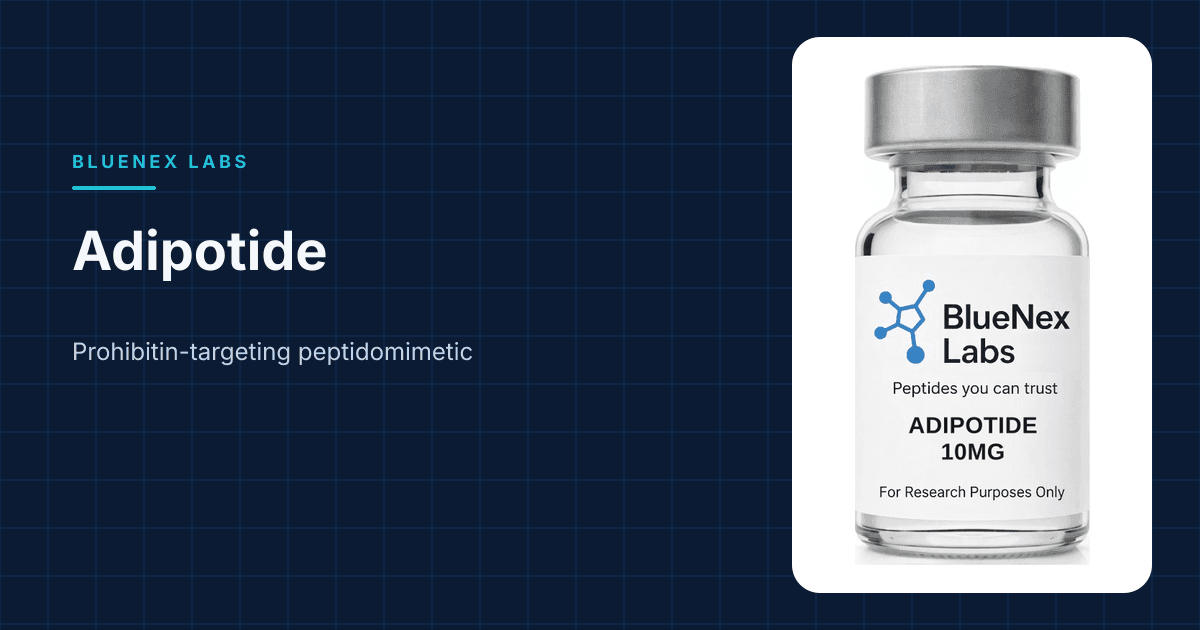
Adipotide, on this catalogue, is one lyophilized research solid. The shop URL is Adipotide 10 mg. Laboratories also see the name FTPP and the longer name prohibitin-targeting peptide. This page is the sequence note. Price and stock stay on the shop URL. The analytical question is whether a future lot file matches the chimeric sequence the label claims. No certificate row is published for this SKU today.
The sequence the papers name
The product record on this site states the published sequence as a prohibitin-targeting motif, CKGGRAKDC, joined to D-(KLAKLAK)2 by a glycine linker. Barnhart and colleagues, writing in Science Translational Medicine in 2011, use the same construct and the name adipotide for CKGGRAKDC-GG-D(KLAKLAK)2 (PMID 22072637). The first block is nine residues with a cysteine at each end. Those two cysteines are the cyclization marks the phage-display papers use for that motif. The second block is an amphipathic sequence built from D-amino acids, written as two repeats of KLAKLAK. A calculated mass for a different linker, a missing cyclization, or the all-L form of the second block will not match this string. For the glossary lines for those checks, see sequence, disulfide bridge, and molecular weight.
The PubChem record this catalogue already cites for the name adipotide is CID 163360068. That record lists the molecular formula C111H206N36O28S2, a molecular weight of 2557.2, and CAS 859216-15-2 (PubChem CID 163360068). Those figures identify a public compound record. They are not a purity percentage, and they are not a Certificate of Analysis for the vial in hand. Identity for a received vial, when a report exists, is the observed mass on that lot file.
What the two source papers are for
Kolonin and colleagues, in Nature Medicine in 2004, describe CKGGRAKDC as a motif selected by phage display and discuss it as a ligand for prohibitin in adipose-vasculature models (PMID 15133506). That paper is the source for the nine-residue motif. It is not a lot report, and it is not a method for the 10 mg fill.
The 2011 Barnhart paper is the source for the fused name adipotide and for the glycine linker written between the motif and D-(KLAKLAK)2. The paper studied the construct in Old World monkeys and recorded kidney observations in that experiment. This note does not restate the paper's endpoints, and it does not turn those kidney sentences into a handling step. A sentence in a primate paper is not a specification printed on a BlueNex Labs vial. Readers who want the experimental account should open the paper. Readers who want the catalogue object should stay with the sequence, the shop URL, and the lot file when one is published.
Both papers are about a research construct. Neither authorizes a reader to copy an exposure schedule out of a figure. Cell and animal measurements stay in those papers. The catalogue question is narrower: does the observed mass match the chimeric sequence, and does the sample name match the vial in hand?
What this peptidomimetic is not
Adipotide is not an incretin-receptor ligand. GLP-1 peptide research in 2026 covers semaglutide, tirzepatide, and retatrutide as a different class. For the comparison page, see semaglutide versus tirzepatide versus retatrutide. Cagrilintide is an amylin-class analogue with its own note and its own shop URL. A certificate for any of those fills does not document adipotide, and an adipotide label does not document them.
It is also not a mitochondrial-derived peptide. MOTS-c and SS-31 have their own sequences and their own listings. Prohibitin is a protein the 2004 paper names as the binding partner for CKGGRAKDC. Naming that protein does not make the 10 mg vial a MOTS-c fill or an SS-31 fill. The class note mitochondrial peptides as a research class is a neighbour on the reading list. It is not this sequence.
The format is still a dry solid. Lyophilized research peptides explains why the catalogue ships a freeze-dried cake. That page does not give solvent volumes, and neither does this one.
The 10 mg catalogue vial
The live listing is a single 10 mg lyophilized vial at Adipotide 10 mg. It sits with other metabolic research materials under metabolic research peptides. There is no second fill size on this catalogue. A photograph of a different peptide, including any incretin vial, does not identify this glass.
No Certificate of Analysis is published for this SKU. The certificates library is where a lot file would appear, under its own anchor, if one is added later. Until that row exists, the honest laboratory record is a blank cell. How to read a peptide Certificate of Analysis explains HPLC area percent, observed mass, and an endotoxin line as three different results. A high area percent on a neighbouring peptide does not repair a missing file for this one.
Storage and Canada fulfilment
Store the sealed vial at −20 °C or colder, protected from light and moisture. Let the unopened vial warm to room temperature before the cap comes off, so laboratory air does not condense on the cake. Receiving notes for a Canadian parcel are in peptide storage for Canadian laboratories. This page does not give solvent volumes, swirl steps, or any other preparation instruction.
BlueNex Labs ships inside Canada only. Checkout uses Interac e-Transfer, and parcels move on Canada Post Xpresspost from the Burnaby desk. For the map of the catalogue, see research peptides in Canada. Research-use-only labelling is not a Health Canada authorization and it does not create a Drug Identification Number. The distinction is on Are research peptides legal in Canada?
Match the vial to its own lot when a report is published. A report for another peptide does not document this solid. Research use only. Not for human or veterinary use.
Frequently asked questions
What is adipotide in laboratory terms?
Adipotide is a chimeric peptidomimetic, also called FTPP. The sequence joins the motif CKGGRAKDC to D-(KLAKLAK)2 with a glycine linker. The catalogue question is whether a lot file matches that sequence. The 10 mg vial is a lyophilized research solid.
Is adipotide the same molecule as semaglutide or retatrutide?
No. Semaglutide, tirzepatide, and retatrutide are incretin-receptor ligands. Cagrilintide is an amylin-class analogue. Adipotide is a prohibitin-targeting peptidomimetic. The shop URLs and the certificates are not interchangeable.
Is a Certificate of Analysis published for the adipotide 10 mg vial?
No Certificate of Analysis is published for this SKU. A report for another peptide does not document this vial. When a lot file is added, it belongs in the certificates library under its own row.
Does a research-use-only label authorize adipotide in Canada?
No. Research-use-only labelling is not a Health Canada authorization and it does not create a Drug Identification Number. The legality note is the page for that distinction.
How does BlueNex Labs ship an adipotide order inside Canada?
Checkout uses a Canadian address and Interac e-Transfer. Parcels move on Canada Post Xpresspost from the Burnaby desk and stay inside Canada. This page does not give solvent volumes.
References
- PMID 22072637
- PMID 15133506
Research use only. BlueNex Labs does not provide medical or veterinary advice. Confirm your institution’s policies before purchase. Lot-file rules for this note are on the documentation standards page. By Alice Kay.