
Research · 2026-11-11
By Alice Kay · Last reviewed 11 Nov 2026
Tirzepatide Research Peptide in Canada
Research-use notice: This article summarizes published scientific literature for educational purposes. It is not medical advice and does not provide dosing, administration or human-use information. Findings described in the literature do not apply to any BlueNex Labs product, which is supplied only for in-vitro laboratory research and not for human or animal use.
Direct answer
Tirzepatide on this catalogue is a lyophilized research solid in two fills, 10 mg and 30 mg. This note records the 2018 sequence description, the lot files, and Canada fulfilment. It does not restate clinical endpoints.
Scope
Metabolic & energy-signaling models. Incretin, mitochondrial, and secretagogue literature. These notes summarize published models — they are not catalog pages.
This note does not claim that Alice Kay authored any cited paper.
Publication status: Prepared for the BlueNex Labs Research Knowledge Centre. Literature and library notes checked 11 November 2026. Primary papers and the public certificate library can change; verify the lot report in hand before an assay.
Tirzepatide research peptide in Canada, on this catalogue, means two lyophilized research solids and the documents that belong to each one. For the shop URLs, see tirzepatide 10 mg and tirzepatide 30 mg. Price and stock stay on those URLs. This page answers a different question: what chain the name refers to in the published chemistry, how that chain differs from neighbouring incretin ligands, and how a Canadian laboratory matches a vial to a lot file. It does not restate clinical endpoints, and it does not turn a paper into a use instruction.
What this page answers
Searches for tirzepatide research peptide Canada usually mix three objects: the chain in a chemistry paper, a finished pen with a Drug Identification Number, and a lyophilized vial on a research catalogue. Those objects can share a name and still fail to share a lot file. This note keeps them in separate sentences.
The class map for 2026, which also covers semaglutide and retatrutide, stays at GLP-1 peptide research in 2026. The three-way comparison of ligand class, fill size, and certificate coverage stays at semaglutide, tirzepatide, and retatrutide. Use those pages when the question is the group. Stay here when the question is this chain and these two catalogue fills. For the receptor-class page, see incretin receptor ligands. For the short glossary line, see incretin receptor ligand.
BlueNex Labs is a sole proprietorship. The desk is 4309 Canada Way, Burnaby, BC V5G 1J3. A sentence in a paper is not a specification printed on a vial, and a DIN for a finished pen is not a DIN for the glass in this shop.
The 39-residue chain
Coskun and colleagues, writing in Molecular Metabolism in 2018, describe LY3298176 as a 39-amino-acid linear peptide. A C20 fatty diacid is attached through a linker to the lysine at position 20. Positions 2 and 13 are the non-coded residue Aib, α-aminoisobutyric acid. The C terminus is amidated. The paper prints the formula C225H348N48O68 and a molecular weight of 4810.52 daltons (PMID 30473097). That paper is the source this catalogue uses for the structure description. It is not a Certificate of Analysis, and it is not a method for either milligram fill.
The same paper reports receptor-signalling assays in cells that express the GIP receptor or the GLP-1 receptor, and it describes minimal activity at the glucagon receptor in those assays. Those figures belong to the authors' cell systems. A calculated mass for a different linker, a missing Aib, or an acid C terminus instead of the amide will not match the string the paper names. For the glossary lines for those checks, see sequence, molecular weight, and GLP-1 receptor.
The format on this catalogue is still a dry solid. Lyophilized research peptides explains why a freeze-dried cake is the shipping form. That page does not give solvent volumes.
Catalogue identity and the lot mass
The product record on this site lists tirzepatide with formula C225H348N48O68, molecular weight 4813, CAS 2023788-19-2, and PubChem CID 166567236. That line is catalogue identity. It matches the formula in the 2018 paper. The paper's molecular weight is 4810.52 daltons, and the catalogue line prints 4813. The two figures are reference numbers for the named compound. Neither one is the mass a laboratory should file for a received vial. Identity for a received vial, when a report exists, is the observed mass on that lot file, next to the sample name and the milligram fill.
For the public compound record, see PubChem CID 166567236. A PubChem page identifies a public compound record. It does not prove what is in a glass, and it does not replace chromatography or mass spectrometry on the lot. How to read a peptide Certificate of Analysis separates an HPLC area percent from an observed mass. A high area percent on the wrong mass is a different compound. A plausible mass with a crowded chromatogram is an impure sample. Copy both results when both exist, and write "not reported" when a line is absent.
How the ligand classes differ
Purchasing offices often file semaglutide, tirzepatide, and retatrutide on one metabolic shelf. The shelf is a catalogue group. The receptor sets in the description papers are not the same, the sequences are not the same, and the milligram listings are not the same. This table is a filing aid. It is not a ranking, and it does not restate sponsor endpoints.
| Catalogue name | Receptor class in the cited description | Live shop URL | Library row |
|---|---|---|---|
| Tirzepatide | GIP and GLP-1. The 2018 paper also describes minimal glucagon-receptor activity in its cell assays. | 10 mg and 30 mg, separate URLs | Separate rows for each fill |
| Semaglutide | GLP-1. Lau and colleagues, Journal of Medicinal Chemistry, 2015, describe a GLP-1 analogue (PMID 26308095). | Semaglutide, 10 mg and 20 mg on one URL | No semaglutide row is published in the library |
| Retatrutide | GIP, GLP-1, and glucagon. The LY3437943 description is a different paper from the 2018 tirzepatide note (PMID 35985340). | 10 mg, 20 mg, and 30 mg | Separate rows for each fill |
| Cagrilintide | Amylin-class analogue, not an incretin substitution. For the note, see the cagrilintide laboratory note. | Cagrilintide 5 mg | Its own row, not a tirzepatide file |
Overlap at the GLP-1 receptor is not a shared sequence. A certificate for retatrutide does not document tirzepatide, and a tirzepatide label does not document semaglutide. Adipotide is a prohibitin-targeting peptidomimetic on the same metabolic shelf. It is not this chain. The trial literature for retatrutide stays on retatrutide trial literature and the research status note. This page does not repeat those programs.
The 10 mg and 30 mg fills
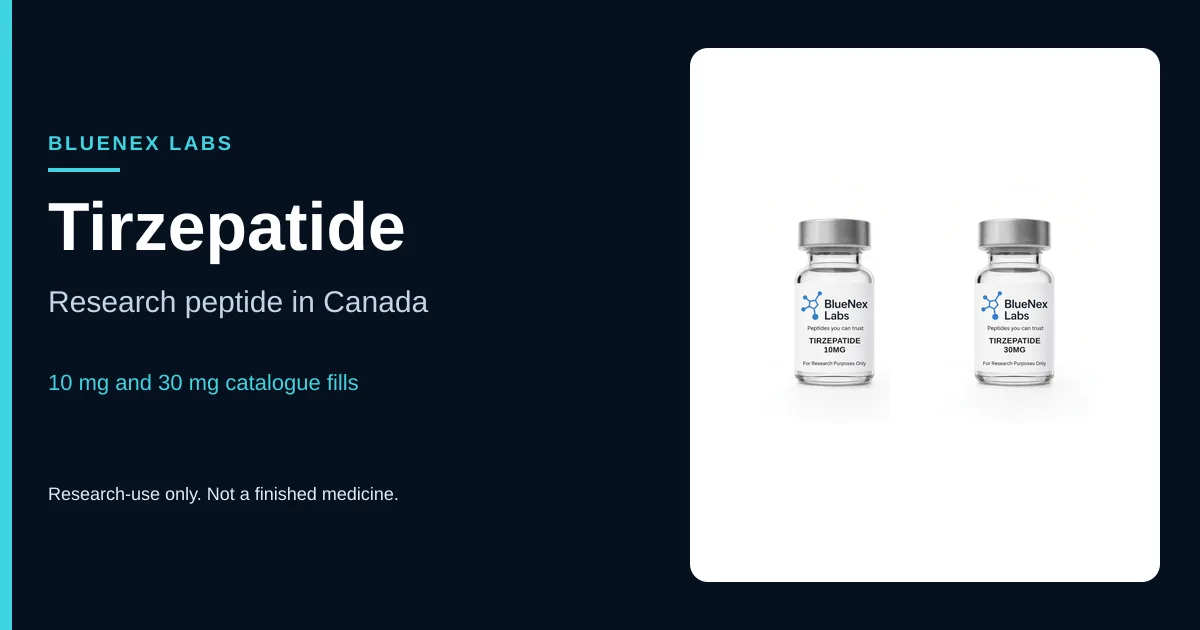
The live listings are a 10 mg lyophilized vial and a 30 mg lyophilized vial. They sit with other metabolic research materials under metabolic research peptides. Cap colour on this catalogue is part of the receiving check: yellow for the 10 mg listing, black for the 30 mg listing. A photograph of a different peptide, including any retatrutide or semaglutide vial, does not identify this glass. There is no second shop URL that merges the two fills into one cart line.
| Check | 10 mg listing | 30 mg listing |
|---|---|---|
| Shop URL | /shop/tirzepatide-10mg | /shop/tirzepatide-30mg |
| Cap colour on the listing | Yellow | Black |
| Library anchor | the Tirzepatide 10 mg certificate row | the Tirzepatide 30 mg certificate row |
| What the row is for | Mass and purity task 153771. Endotoxin is a separate test, task 153772. | Freedom Diagnostics search code JEEP2609170390 for lot JP20260041, product T30. The library row states net content 37.58 mg and purity 99.82%, reported 19 September 2026. Endotoxin is a separate link. |
Those library figures describe the published row for that lot. They are not a promise about a future lot, and the 30 mg numbers do not document the 10 mg vial. Write the fill, the cap colour, and the task or search code on the receiving line before a report is attached. Sold-out status is inventory. It does not merge the two fills, and it does not create a backorder.
Lot files on this catalogue
Open the linked report, not a photograph of it. Check the sample name, the task or search code, the mass result, and the area percent before you file the PDF. No endotoxin line means no endotoxin result. The 10 mg endotoxin task is a different link from the mass task. The 30 mg endotoxin link is a different test from search code JEEP2609170390.
The certificates library is the index. A missing row stays missing. Semaglutide does not have a library row. That absence is a blank cell. It is not permission to attach a tirzepatide PDF because both names appear in incretin papers. Cagrilintide has its own row. That row does not document either tirzepatide fill. What a peptide COA records is the document primer. A receiving line should name the SKU, the cap colour, the report URL, and whether the sample name matched.
Finished pens and this vial
Health Canada's Drug Product Database lists finished tirzepatide pens as marketed prescription products. On the database page retrieved 11 November 2026, DIN 02551985 and DIN 02557533 are both listed as marketed, both at 10 mg per 0.6 mL, and both under Eli Lilly Canada (Drug Product Database search). Those records are finished pens. They are not lyophilized research vials, and they are not BlueNex Labs catalogue numbers. A DIN authorizes the finished product named on that DIN. It does not travel with the ingredient name onto a different container.
Research-use-only labelling is not a Health Canada authorization and it does not create a Drug Identification Number. The distinction is on Are research peptides legal in Canada?. A marketed pen is not evidence that a research cake is the same finished product. If the study file needs the research solid, match the vial to its own lot and leave the DIN cell blank.
Ordering inside Canada
BlueNex Labs ships inside Canada only. Checkout uses Interac e-Transfer after a Canadian address is entered. Parcels move on Canada Post Xpresspost from the Burnaby desk. The sender line on the label uses a Port Moody PO Box. That box is the carrier account. It is not a walk-in counter, and it is not a second warehouse with different lots. The public address is 4309 Canada Way, Burnaby, BC V5G 1J3. Desk hours are Open daily, 9 AM–10 PM PT, for catalogue, Certificate of Analysis, and invoice questions. The desk does not answer medical questions.
Shipping is $25.00 flat rate; free on product subtotals of $299.00 or more. Payment steps are on how to pay by Interac e-Transfer. Put the order number in the message field. For the carrier page, see Canada Post Xpresspost shipping. Orders ship within 1–2 business days after payment. Payments after 12 pm PT, or on a weekend or statutory holiday, are processed the next business day. Transit estimates are not guarantees.
For the operational note, see Canada laboratory procurement. For the catalogue map, see research peptides in Canada. Move the sealed vial into controlled storage the day it arrives. Photograph crushed boxes or cracked caps within 7 days. Receiving practice is in peptide storage for Canadian laboratories.
A practical pass before checkout has six checks:
- The shop URL matches the milligram fill the study file names, 10 mg or 30 mg, not both on one line.
- The cap colour on the listing matches the colour the receiver will look for.
- The library anchor for that fill opens, or the study file says the row is absent.
- The ship-to address is in Canada, and payment is Interac e-Transfer.
- The institution's purchasing rules allow a research-use-only solid.
- Storage location is written down before the parcel is opened on a bench.
Those checks are purchasing and receiving steps. They are not solution steps. This page does not list a diluent, a volume, or a schedule. Solution preparation belongs in the laboratory SOP for the assay being run.
What this page does not do
It does not rank suppliers. It does not set a price. It does not claim that a research vial is the same object as a finished pen, and it does not claim Health Canada authorization for either catalogue fill. It does not restate glucose, body-composition, or safety endpoints from any clinical program. Those endpoints, where a paper reports them, stay in the paper. Copying them onto a shop URL would turn a literature note into a product claim this catalogue does not make.
Semaglutide still uses the shared class note and the three-way comparison. Retatrutide keeps its own literature URLs. Cagrilintide keeps its laboratory note. If a parcel contains more than one of those vials, the materials table needs one line per lot.
Match the vial to its own lot when a report is published. A report for another peptide does not document this solid. Research use only. Not for human or veterinary use. BlueNex Labs is a sole proprietorship.
Frequently asked questions
What is tirzepatide in laboratory terms?
Tirzepatide, also called LY3298176 in the 2018 description paper, is a 39-residue linear peptide with a C20 fatty diacid on lysine 20, Aib at positions 2 and 13, and an amidated C terminus. The catalogue question is whether a lot file matches that chain. The 10 mg and 30 mg vials are lyophilized research solids.
Is tirzepatide the same molecule as semaglutide or retatrutide?
No. Published descriptions discuss semaglutide at the GLP-1 receptor, tirzepatide at the GIP and GLP-1 receptors, and retatrutide at the GIP, GLP-1, and glucagon receptors. The shop URLs and the certificates are not interchangeable.
Do the 10 mg and 30 mg tirzepatide vials share one Certificate of Analysis?
No. The 10 mg yellow-cap listing and the 30 mg black-cap listing are separate shop URLs and separate library rows. A file for one milligram size does not document the other vial.
Does a marketed tirzepatide pen authorize this research vial in Canada?
No. Health Canada's Drug Product Database lists finished tirzepatide pens under their own DINs. A DIN for a finished pen does not authorize a lyophilized research solid, and research-use-only labelling does not create a Drug Identification Number.
How does BlueNex Labs ship a tirzepatide order inside Canada?
Checkout uses a Canadian address and Interac e-Transfer. Parcels move on Canada Post Xpresspost from the Burnaby desk and stay inside Canada. Desk hours are daily, 9 AM–10 PM PT. This page does not give solvent volumes.
References
- Coskun T, Sloop KW, Loghin C, et al. Molecular Metabolism. 2018;18:3–14. The structure section states a 39-residue chain, Aib at positions 2 and 13, a C20 fatty diacid on lysine 20, an amidated C terminus, formula C225H348N48O68, and molecular weight 4810.52 Da. PMID 30473097.
- Lau and colleagues. Journal of Medicinal Chemistry. 2015. Semaglutide is described there as a GLP-1 analogue. PMID 26308095.
- Coskun T, Urva S, Roell WC, et al. Cell Metabolism. 2022. LY3437943 is the retatrutide description paper, a different chain from the 2018 tirzepatide note. PMID 35985340.
- Health Canada Drug Product Database, active-ingredient search retrieved 11 November 2026, listing DIN 02551985 and DIN 02557533 as marketed 10 mg per 0.6 mL finished pens. health-products.canada.ca.
- PubChem compound record used on this catalogue for the name tirzepatide, CID 166567236. PubChem CID 166567236.
References
- PMID 30473097
- PMID 26308095
- PMID 35985340
Research use only. BlueNex Labs does not provide medical or veterinary advice. Confirm your institution’s policies before purchase. Lot-file rules for this note are on the documentation standards page. By Alice Kay.